Showing posts with label Train Town. Show all posts

Wednesday, July 24, 2013

Train Town and Monsoon Market - Playtest Findings


Playtested a bit more of Train Town and Monsoon Market this week. Many thanks to folks who helped playtest! If you're in town and interested, swing by to Atomic Empire in Durham, NC most monday nights and you can see whatever weird idea I've cooked up that week.


Train Town was more of a polish to check if the condition cards made sense as written. The rules themselves and the scoring mechanics were solid.

There was some procedural clarification necessary, making sure that condition cards were used at the end of a turn, thus after the scoring phase.

Also it seemed the 2x2 formation was better as a starter board since it was easier to track the paths from point A to point B. A 3x3 formation led to bigger point swings as each player could cover exponentially more territory with one clever placement.

I may also make the endgame condition when either the condition deck or the path deck runs out. Keeping it only the path deck made the game run a bit too long for a light filler.

I've also submitted this game to a family game design contest out of Korea. That might have been premature, but the deadline was the deadline so I figured I'd take a shot at it even though the game is still in its infancy.


Monsoon Market is also feeling a bit more polished. As an experiment, I made the changes noted in my previous post and it really helped the too-balanced problem.

Where previous playtests resulted in tie, or scores within two or three points of each other, the most recent test resulted in scores of 33, 35, 40. Close enough to keep the game tight but also clearly set apart enough that we could reverse-engineer the results and see how each decision made in play resulted in those scores.

I revised the cards so that the rarest Goods, earliest Days, and most Ships aggregated into the same cards. I cut the rounds down to five trading turns instead of seven. I also simply dealt five random cards to each player's port and ship instead of letting players decide how to organize them. All these revisions led to some tense decision-making, fast trades, and begrudging sacrifices. Good stuff.

It was also interesting seeing some emergent gameplay. When players set aside cards for their ships face-down, it was a little hard making sure they were not mixed up with discards. We settled on putting ship cards underneath our port card. Yay! Now the port card does something besides just identify each player.

Now that the basic core gameplay seems pretty solid, I'm eager to polish this up for another round of public prototyping.

Tuesday, July 16, 2013

Train Town - Prototype B

TrainTownWebHeader

DOWNLOAD: TRAIN TOWN PROTOTYPE B

Well, the response to yesterday's post was really positive, so I've put together a printable prototype for Train Town with a slight retheme. Now, tourists are taking a trip through Train Town to see their favorite attractions. You're trying to build a route that will take as many tourists to as many of their desired attractions as possible.

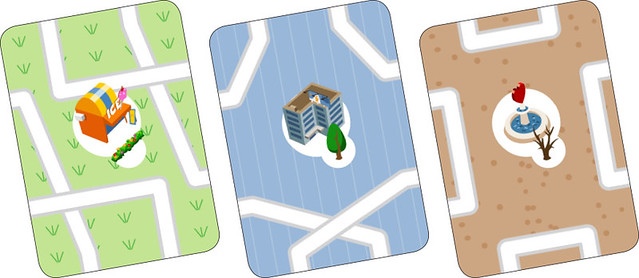
The attractions are one of three types of terrain, one of four types of foliage, and one of nine buildings. Each card has three attractions, as shown in the example above. This was a much more organic way to show what features are on each card without resorting to abstract icons. The theme lends itself well to making landscapes and map-like areas too.

Here's an example of what the prototype looks like in play.


And here's an example of how you can score on your turn. Let's say you placed the tile highlighted in pink below, thus creating the paths highlighted in blue and yellow.


Tourists on the blue path want to see the giant Santa. There is one Santa on this path, so you score 1 pt for that. The tourists also want to see the business building, and there is one on this path, so you score 1 pt again.

Tourists on the yellow path want to see a tall tree and a red tree. There is one tall tree and three red trees, so you score 4 more points. You score 6 pts this turn!

DOWNLOAD: TRAIN TOWN PROTOTYPE B 

UPDATE: Hey all! Just wanted to clear up a couple questions that have come up from another playtester:

How many times can a card be swapped or rotated?
I assume you're using a Condition card to do this, so you may swap/rotate any tile if the Condition card is being used. After using those Condition cards, they're discarded, thus limiting the number of times the tile can be manipulated. For example, if you used the Condition card that says "On a player's turn, she may first discard this card to swap two path tiles." You would discard that Condition card, swap two path tiles of your choice, then continue with your turn as normal. You couldn't keep manipulating those two tiles because the Condition card has already been used. Make sense?

Can you clarify adjacency? Also, does a path card have to be placed adjacent to the previously placed card?
Cards must be placed within the play area, *orthogonally* adjacent to any other card. It cannot be placed diagonally, so you couldn't place a Path tile into the center of the board until at least the second turn minimum. It does not have to be adjacent to the most recently placed Path card. It may be placed anywhere.

What happens to the empty spot after discarding a Condition card?
After a Condition card is discarded, it is *not* replaced. It just leaves an empty corner after it is used.

When is a Condition card used discarded during a turn? Before drawing a path card?
Yes, this is before you draw a new Path card. I'll try to make that and other orders of operations clearer in the rules.

What about Condition cards that do not say they're discarded? Does it stay in play?
If a Condition card doesn't say it must be discarded to be used, then it stays in play.

How many times can a single attraction be scored on the same path? Just once, or multiple times if the path loops around and returns to the same attraction?
Each attraction is only worth 1 pt per corresponding dock. For example, if your tourists want to see a Soda shop and they were on a path that goes past a Soda shop, you'd score 1 pt. If the path loops around and returns to the same Soda shop, it would not score another point. Think of it as the tourists already being bored with the soda shop after having seen it once already. The only exception to this would be if *both* ends of the path had soda shops. In that case, each first visit would be worth 2 pts, because there are two separate tour groups interested in seeing that soda shop.


Sunday, July 14, 2013

Train Town: Sketching Out a Tile-Based Train Game

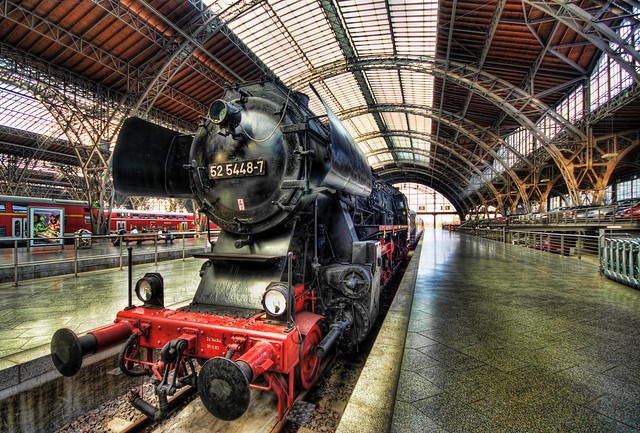
Steam Train 52 5448-7

Last night I quickly sketched out a tile-based train-themed path-building game. I've been on a path-building kick the past few weeks so it kind of makes sense that it would eventually lead to a train game of some kind. Hopefully this adds some twists to the genre to make it worthy of further development.


SUPPLIERS AND PORTS

First, you start with the basic path tile, representing a supplier along a train route. Each path tile has eight exits, with for path segments linking them in some way. Each card also features four goods icons, noted here by the plus sign, the dollar sign and the Q. Any path connecting to this card is supplied the goods indicated by this card.

And these are destination cards, with eight endpoints for the train routes. Each of these is a port, each awaiting a specific good to come from the train. Along the top here you see a port that wants + and a dock that wants $. To the right, a port wants E, another wants +.


SETUP

To set up the game, you randomly shuffle twelve destination cards around the perimeter of the play area like so. The play area is thus an implied 3x3 grid. Because of this arrangement, only two ports on a destination card are in play at any time. Hopefully this adds some replay value, as the demands for goods can change from game to game. (Note: I didn't have time to fill in all the ports with icons, but you get the idea.

To complete setup, you place the Condition cards in the corners of the play area. These are optional play variants that add subtle changes to scoring or grant one-time-use abilities. I'll list some of these at the end of this post.


PLAY

On your turn, you draw one random path tile...

And place it adjacent to another card.

Continue taking turns in this manner, building up the network within the implied 3x3 grid. (Note, I didn't have time to fill in icons on all the path tiles, but hopefully you get the idea.)

You may place tiles on top of other tiles. If this game were to use real thick tiles, they'd be easier to just pick up and replace, but for now I'm assuming cards which are easier to just stack.

Any time you make a route that supplies a port with its requested good, you score one point for each of that good along that route. In this simple example, you score 1 point because you made a path that supplies the "+" port with "+".


ENDGAME

When the last path tile is played, the game is over and whoever has the most points wins!


ALTERNATE LAYOUTS

As with any modular game, you can make alternate layouts like this rectangle. With enough destination cards, you may also have donut-shaped boards or angled boards.


CONDITION CARDS
Right, so condition cards are one of the fun things that might bring this otherwise dry spatial puzzle into some family fun take-that territory. Here are some cards I've got in mind for basic bonus scores.
  • When any player builds a complete path, she scores 1pt per short straight segment on that path. (Alternates include long straight segments, corner segments, particular backgrounds)
  • When any player builds the longest path in play, she scores 3pts.
  • When any player builds a one-segment route, she scores 1 pt.
And here are some more action-oriented cards that act as one-time-use powers. The prerequisite for these cards is always "On a player's turn, instead of playing a path tile, she may discard this card to...
  • ...Swap two adjacent destination cards. (Alternates include two destination cards on the same row, or on the same column.)
  • ...Rotate one destination card 180ยบ.
  • ...Draw and place two path tiles.
  • ...Swap two adjacent path tiles. (Alternates include two path tiles on the same row, or on the same column.)
  • ...Remove all path tiles from one location. Until this player's next turn, no path tiles may be placed in this location.
  • ...Remove one destination card from the play area for the rest of the game.
If you take one of these actions and it creates a scoring path, you can score it as usual.


NEXT STEPS on this idea would be to make a proper print-and-play prototype, but first I wanted to see if this idea actually sounded interesting to anyone but me. So, does it? You tell me! :)