Showing posts with label racing. Show all posts

Friday, August 2, 2013

Early Thoughts on A La Kart


Remember last month when I kicked out this quick idea for a racing auction game, but couldn't figure out a theme that really captured my interest? Well, like all breakthroughs, my wife came up with the best name EVAR. We've been playing a lot of Mario Kart Wii, and she suggested "A La Kart."

The ideas started flooding in after that. It's basically a food-themed racing game, in the spirit of Sugar Rush from Wreck-It Ralph. This would be less focused on candy specifically though. Instead, each suit of the game represents a flavor: Sour, Spicy, Sour, Savory. (I may use Bitter as another thing, but for now I'm sticking with four S's.)

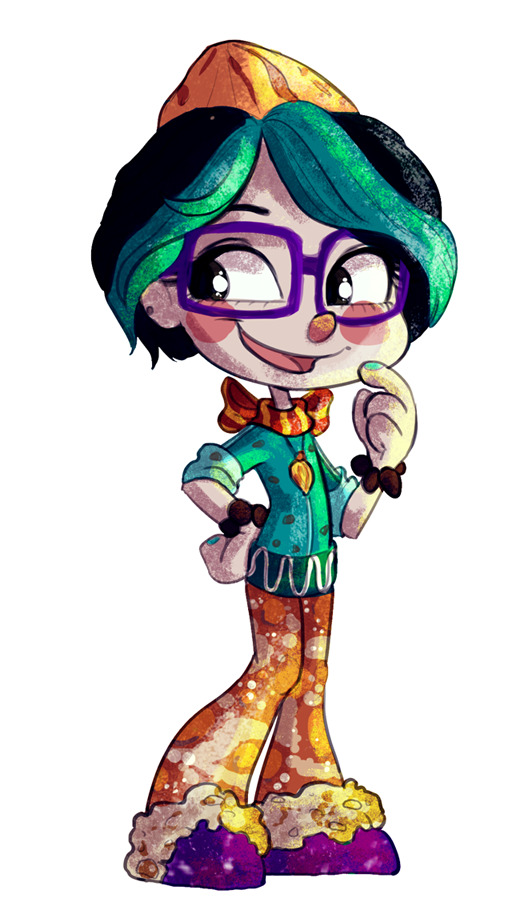
I'd love to hire Miranda Dawn Yeo for the art. She drew the Sugar Rush avatar for my wife you see above. I think that art style would be a blast.


The Basics

A La Kart is a racing-themed auction game. There is no track board, though. Each racer is represented by a unique pawn (or maybe a card?) set in a row, from first to last place. They're always in a tight group throughout the race, jockeying for best position in a randomized series of obstacles. Each round players may BID or COAST:
  • Bid: The first-place player sets the suit for this round. If the first-place racer is an AI (explained below), then use the suit noted on the track card. 
    • Starting with the last-place player, each player bids one card at a time, trying to get the highest total ranks. Players cannot bid more cards than their current Brakes rating.
    • When a player has no more cards of the suit to bid, or simply doesn't want to bid any more, she passes and is out of the auction.
    • The racer (either player or AI) with the highest bid gets first-place position. Second-highest bid gets second-place position, and so on.
  • Coast: Each coasting player can draw and spend cards. These cards depict unique combinations of ranks and suits and some power-ups.
    • Coasting players can draw a number of cards equal to their current Tires rating. Players cannot hold more cards than their Chassis rating. Any remainders must be discarded immediately.
    • Coasting players can then spend cards to use their special effects, which will restore Chassis, Brakes, or Engines, or have some other effect. Players cannot spend more cards than their current Brakes rating.
The base reward for 1st place in a round is worth 2pts, 2nd place is 1pt, and 3rd place is 0pts. For each point reward, add the number of the round and add a reward for the next place. So, the true  round rewards are...
  • First Round:   3, 2, 1
  • Second Round:  4, 3, 2, 1
  • Third Round:   5, 4, 3, 2, 1
  • Fourth Round:  6, 5, 4, 3, 2, 1
  • Fifth Round:   7, 6, 5, 4, 3, 2, 1
  • Sixth Round:   8, 7, 6, 5, 4, 3, 2, 1
  • Seventh Round: 9, 8, 7, 6, 5, 4, 3, 2
  • Eighth Round: 10, 9, 8, 7, 6, 5, 4, 3
The player at the end of the eighth round with the most points wins! But of course, there are some complications.


Stats
There are limits to how many cards each racer can hold in-hand, how many she can bid, and how many she can draw while coasting. These are represented by the racer's three stats.
  • Brakes: The number of cards you can play while bidding or spend while coasting.
  • Chassis: The number of cards you can hold at the end of the round. Discard any extras immediately.
  • Tires: The number of cards you can draw while coasting.
Each racer has a unique ability that can be used once per race.


Analog AI Racers
The game always has eight racers, but can be played with 1-8 players. Any non-player racers' bids shown on the track card, thus creating a sort of dumb AI. You could even make this a solo game, as you try to win the best position amongst the AI racers.

The ranks on player cards are always even numbers, while AI racers always have odd bids. And because the ranks are unique to each suit, even with the occasional boost, ties should be very unlikely, if possible at all.

Also note an asterisk next to an AI racer's bid. That indicates their use of their unique ability at this time, so be sure to resolve that, too.


Random Track
Here's what a typical track setup would be:


Start from the top and work your way down each track. I haven't decided yet whether the whole track would be visible from the start, or if it might get gradually revealed over the course of the race. Maybe I could make that a fourth stat, letting some players know further in advance what's coming two, three, or more rounds ahead.

Each track card has an effect on one or more players. These effects are resolved at the start of the round. In most cases, it adds a negative stat modifier to players who meet certain conditions, like a certain position or a certain bid from the previous round.

And that's pretty much all that's on my mind for now. I'll need to make a proper prototype of this soon or it's gonna go sour in my brain for way before too long.

Tuesday, July 2, 2013

A Racing Auction Game in Search of a Theme

Racing Auction Trick-Taking Mechanic

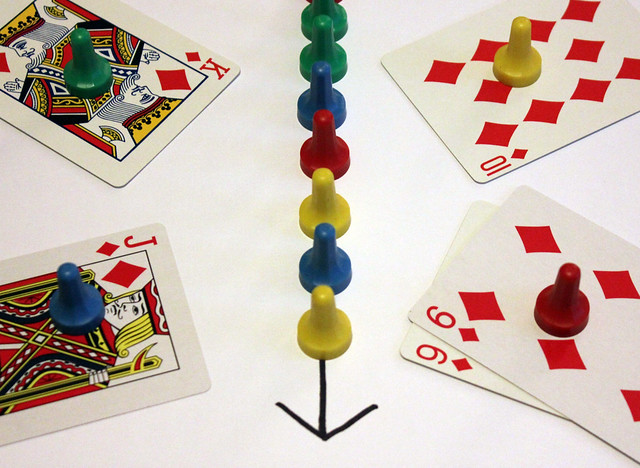
Here's a sort of auction, trick-taking, racing mechanic I've been mulling over the past couple days, in an attempt to make a racing game  Each player has two pawns representing their racers. They are placed in a line in a random starting order. Each player begins with a hand of five standard playing cards. The goal of play is to win the auction for leadership position. Whoever is in the leader position wins most points for the turn, but may be subject to unexpected hazards.


HOW TO PLAY
The leader begins by bidding an amount in the suit of her choice. She may play one or more cards as long as they're the same suit.

In the example above, the yellow player bid 10 diamonds.

Each player then takes turns counter-clockwise (like a racetrack) for an opportunity to bid a higher amount of the leader's chosen suit. If someone does establish a new high bid, then each player gets another opportunity to out-bid that high bid. This continues until no one wants to out-bid the highest bidder.

In the example above, the green player player declines the opportunity to out-bid the yellow player. The blue player bids a Jack of Diamonds (worth 11 diamonds), thus establishing a new high bid. The red player declines, the yellow player declines, the green player decides to bid this time, bidding a King of Diamonds, setting a new high bid. The blue player declines, the red player decides to drop a whammy of 15 Diamonds. The other players decline to outbid the red player.

The pawns are re-arranged according to bid. Whoever won the bid may move one of her pawns to the front of the line. The second-place bidder moves one of his pawns to second place. The third-place bidder moves a pawn to third place, and so on.

After each turn, each player draws one card from the deck. Thus, you could just suit out a couple turns in order to regain your energy before dropping a big bid. The dilemma is that the leader sets the suit for the auction, so the leader may not give you the opportunity to bid in the category in which you're strongest.

The player in first place earns 3pts, second place earns 2pts, and third place earns 1pt. 

GOALS AND OBSTACLES
During the course of the race, there are randomized terrain and event cards that are revealed before each turn.

These cards award special bonuses or penalties to players in specific positions. For example, a RICKETY BRIDGE would harm whoever is in last place because all the other runners in front weakened it.

The SHARP TURN would harm the leader because it was an unexpected obstacle, but the straggling runners have plenty of time to dodge it.

The SWINGING PENDULUM would harm every evenly placed racer, so the second-place, fourth-place, sixth-place, etc.

The cards themselves are awarded to players who are further in back of the line, in fourth, fifth or even last place. These are worth points at the end of the game.


ENDGAME
The game ends after the fifth turn. Each player tallies points earned from obstacle cards and from being in the top 3 positions during the game. Whoever ends the game with the most points wins!


AI / SOLO PLAY
Playtesters have suggested that the event/terrain cards could list the bids of each pawn (with an optional suit notation) so you could technically play solo. You'd just ignore whatever the card says is the bid for your pawn. You just have to beat the bids of the other AI racers. Thus, you could make this always a four-player game, it's just that some of them are AIs.


POSSIBLE THEMES
I need a theme in which the racers always stay in a tight formation, jockeying for incremental positions, facing random obstacles. Those obstacles would clearly be the main channel for whatever theme I choose, because the terrain of a bike race is much different than triathalon. There is also the question of suits and how they could be incorporated into the theme. Here are some of the themes people have chosen that strike my fancy.

  • Ostrich Racing: Each player is racing an ostrich across the savvanah, dodging obstacles along the way like mud pits, predators, and bad weather. The suits represent different terrains of the race course: Desert, Grass, Mud, Jungle?
  • Turtle Race: The racers stay in a tight formation because they're so slow! The obstacles are humorously minimal, like street curbs, small potholes, and discarded strawberries. Suits are Street, Lawn, Sidewalk, Water?
  • Grand Prix Monkey: A pack of monkeys are whizzing through the Amazon rain forest. Obstacles are mainly in the form of predators and tempting distractions. Suits are Ground (for running on the ground), Trees (for swinging through trees), Shortcuts (for cheeky monkeys) Poop (for throwing poop at opponents).
  • All-Terrain Pulp Race: Flying aces race around the world in amphibious flying machinese, dodging outlandish pulp-themed obstacles like mad scientists, exploding volcanoes, and giant apes. Suits represent different areas of the race: Sea, Air, Land, Space.
  • Kaiju Rally: This is a weird one. While I was thinking about the giant apes, I thought, "Why not make the giant monster the racer?" Obstacles would include defending mecha, armies, other monsters, etc. Like the pulp race, this could traverse sea, air, land and space too.

Right. So that's the general idea anyhow. As with many of my potentially self-published games these days, I'm mainly limited by my own ability to make or commission artwork. Aside from that limitation, I'm most amused by the Monkey and Turtle themes.