Extraordinary winds struck eastern Washington on Sunday, with 30-40 mph winds being commonplace, with gusts reaching nearly 60 mph around Wenatchee and vicinity. The result a major duststorm that closed down I90 for a while and resulted in numerous multicar accidents, sending 11 people to the hospital. Visibilities had dropped to less than five feet at times and the powerful winds knocked down many of the apples still on the trees near Wenatchee. It was reported that the ground at some orchards had turned red with apples.
An amazing picture is shown above from one of the the NASA MODIS satellites, clearly showing the dust (the brown stuff oriented NW-SW). The strong winds came at a bad time.... farmers had plowed up their wheat fields in preparation for the next season and rainfall has been very low this year. Although this is one of the worst dust storms in a while, it happens relatively frequently--my book has a section on it.
So why the strong winds? We had a combination of cold high pressure in Alberta and southern BC and a strong low over eastern Oregon and vicinity. The result was the creation of very strong northeasterly winds aloft and an intense low-level pressure gradient (see graphic). You see how packed the lines (isobars) are...that is a HUGE pressure gradient. The computer model forecasts were quite good with this event and the National Weather Service had timely forecasts out well before. Want to see a vivid video of how bad it was...check out http://www.youtube.com/watch?v=yr819WqZMak
But the fun doesn't stop there. Western Washington got part of the action too (but no dust storm alas). As the high pressure built into southern BC a large pressure difference was established down the Fraser River Gap, allowing air to accelerate to the SE in that near sea level gap. Bellingham got hit hard, with winds gusting over 40 mph--accompanied by downed trees and power outages. Again, the computer models had it...see the graphic of wind speed predicted for 8 am on Sunday. You can see the strong NE winds exiting the gap. One of the great things about this blog are the reports I get from many of you--and this event was no exception.
Abram R. ("Abe") Jacobson, Earth and Space Sciences/ University of Washington, was sailing east of Bellingham yesterday and reported seeing waterpouts to the lee (west) of Lummi Island produced by the intense shear produced by the interaction of the strong winds with the island. To quote a warning in his informative email:
"If there are waterspouts on the lee side of Lummi, be afraid. Be very afraid! Water spouts are severe weather."
We launched code.google.com/speed in June, to give web developers access to tools and resources that help them improve the performance of their applications. Since then, the developer community provided us with plenty of suggestions on how to improve our site. Based on your feedback, we made the following improvements:
We added new content:
Four new best practice articles on topics such as optimizing JavaScript
Two new tech talks on new developer tools
A blog gadget that aggregates performance related posts from Google blogs.
We improved the layout to make navigation between different tutorials, tech talks and tools smoother.
Just as making the web faster is an ongoing process, we plan to continue updating and enhancing code.google.com/speed with more resources. Currently, we are focusing on increasing community involvement, such as adding more tutorials and tech talks from non-Google authors. So, as a first step, if you have recently written an interesting article on web performance, please let us know by filling in this form. Our team will evaluate all entries and may contact you for potential next steps.
Back in early 2007, I wrote an article about game reviewing standards (especially in terms of the raw numbers critics assign to titles), and I had almost forgotten about it, but then I saw this video, part of the Sessler's Soapbox series of vlog posts from G4 Tech TV, and it brought the whole matter back for me.
I just hope that more reviewers and critics start approaching new titles with this kind of appraisal... that individual games are part of a continuum of subtle innovations and at times out and out homages to earlier work in the medium. I want to see a higher level of criticism in game reviewing.
It is rumored that Microsoft is poaching staff from various Apple retail outlets to work for them as they start their own retail outlets. Being associated with Apple, naturally they are much more expensive than people that were hired independently. No word on if Justin Long is going to be hired for Microsoft commercials.
This week's winning entry comes from the perennial contender Popped Culture, which always has something transmundane to say about pop culture.
In this case, it was a vision of where the Terminator franchise should have went: Back to the Future... err the past.
Of course, this image isn't relevant merely because it is Homer in the act of traveling through time. You see, his companions in this picture are Sherman and Peabody, and when Marty McFly lands in 1955, he is at Peabody farm, and the kid on that farm is named Sherman Peabody.
Congrats Jeremy. You know the drill. Here is your badge.
The rules of this little contest: Every week I will be selecting one blog post that I have seen from the vast reaches of the blogosphere to bestow with the Homer Simpson Transmundanity Award for being one of the freakiest(in a funny way) things I've seen or read during a 7 day period. It doesn't necessarily have to have been written during the week, I just had to have encountered it. That means that if you find something interesting and repost it like a movie or whatever, if I saw it at your blog first, you get the prize. Of course, creating your own content is also a very good way to win.
Now, if you see a post that you think is worthy of this illustrious prize, just drop me a line at campybeaver@gmail.com and we'll see if we can't get your suggestion up and award-ready while giving you some credit and a link to your own blog.
Temperatures over the region have been generally a bit cooler than normal during the past week (see graphic) as a cold, occasionally showery, upper trough has influenced our weather. But things are going to change in a big way--towards extraordinarily fine autumn weather. The upper level weather map for later today shows the upper trough starting to move south of us, and as a result most of the showers are found over Oregon and southeastern Washington. The visible satellite image this morning shows those shower areas and some low clouds and fog over parts of western and eastern Washington (image). But don't worry about that. The computer forecast models are in agreement that the trough will progressively move south and a HUGE ridge (high pressure) will develop over the eastern Pacific. I have included below the upper level charts for late Sunday and Monday--not only is there a ridge...but northeasterly and easterly flow develops over...and such offshore flow produces rapid drying and west side warming.
But now the F word for all gardeners...especially those of us with the hopes of gathering the last of the season vine-ripened tomatoes. Frost. Nights are getting much longer now and when the skies clear there can be strong and extended radiational cooling to space. Yes, you and everything else emits infrared radiation and thus the ground can cool overnight this time of the year. Clear skies and low humidity promotes this. Take a look at this morning's temps at 7 AM. Temperatures at some locations both east and west of the Cascades dropped into the 30s. Remember these are air temperatures at 2 meters...around 6 ft. It can be cooler at the surface! And as skies clear the next few days and the atmosphere dries, the radiational cooling will increase...so there is certainly a substantial risk of frost in the coolest places (away from water, low spot where cold air drains, etc). So if you have some cold sensitive plants on both sides of the Cascades...protect them.
At Google we're excited about new web technologies like HTML 5, CSS 3, Web Fonts, SVG, faster JavaScript, and more. It's an exciting time to be a web developer, especially with the major advancements made in modern browsers like Firefox, Safari, Opera, and Chrome the last two years. In this blog post I want to share some of the work we've been doing with SVG in particular.
Today kicks off the start of the SVG Open 2009 conference, hosted at Google this year. The SVG Open conference is an annual conference where the SVG community comes together for three-days. Other sponsors of the conference this year include Microsoft and IBM.
What is SVG?
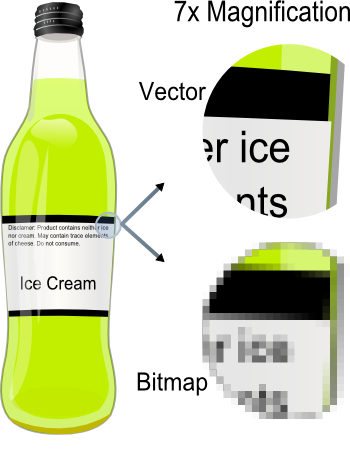
SVG, or Scalable Vector Graphics, is an open web standard that makes it easy to add interactive vector graphics to your web pages. Vector graphics, as opposed to bitmap graphics like JPG, GIF, or PNG files, describe the shapes on your screen with mathematical equations rendered by your computer rather than pixels. This allows vector graphics to stay beautiful and crisp whether displayed on a 40" monitor or a small mobile device.
Just as HTML gives you simple tags such as <form> or <table> to add to your web pages, SVG gives you such graphical tags as <circle> or <rect> for a rectangle that you can drop into your web page. Working with SVG is very similar to working with HTML - you use JavaScript to animate and make things interactive, CSS (Cascading Style Sheets) to add style, etc.
Why Google is Excited About SVG
We're excited about SVG for a host of reasons:
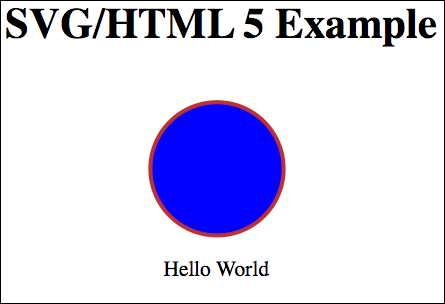
First, SVG is part of the HTML 5 family of technologies. One of the major new features of HTML 5 is the fact that you can now drop SVG tags into normal HTML, directly embedded into your page. We're excited about how this will empower developers. Here, for example, is a small code sample that embeds an SVG circle and rectangle right into an HTML 5 page:
Second, we like that SVG is composed of text and markup, just like HTML. Because it's markup, search engines have a much easier time working with SVG; server-side languages like PHP or Google App Engine can simply emit SVG just like they generate HTML; and users and developers can easily view the source just like a normal web page to learn and move things forward. It's also easy to import and export SVG into tools like the open source Inkscape drawing package or Adobe Illustrator.
Third, the compact size of SVG when combined with HTTP GZip compression can easily make the images on a page roughly an order of magnitude smaller, and when directly embedded into an HTML 5 page can decrease the latency of a page by reducing the number of fetches. Small and fast are definitely two things we like at Google, and we like that SVG helps enable both.
Fourth, SVG integrates with the rest of the web stack, including JavaScript, CSS, and the DOM (Document Object Model). Even better, developers can easily adapt the skills they already know when working with SVG.
Finally, SVG is an open standard that is vendor-neutral. It also has accessibility built in, so when screen readers start to work with SVG your content will be future-proofed with accessibility baked in. We also like that SVG is now natively supported on all modern browsers, including the iPhone.
What Are Some Places We Use SVG?
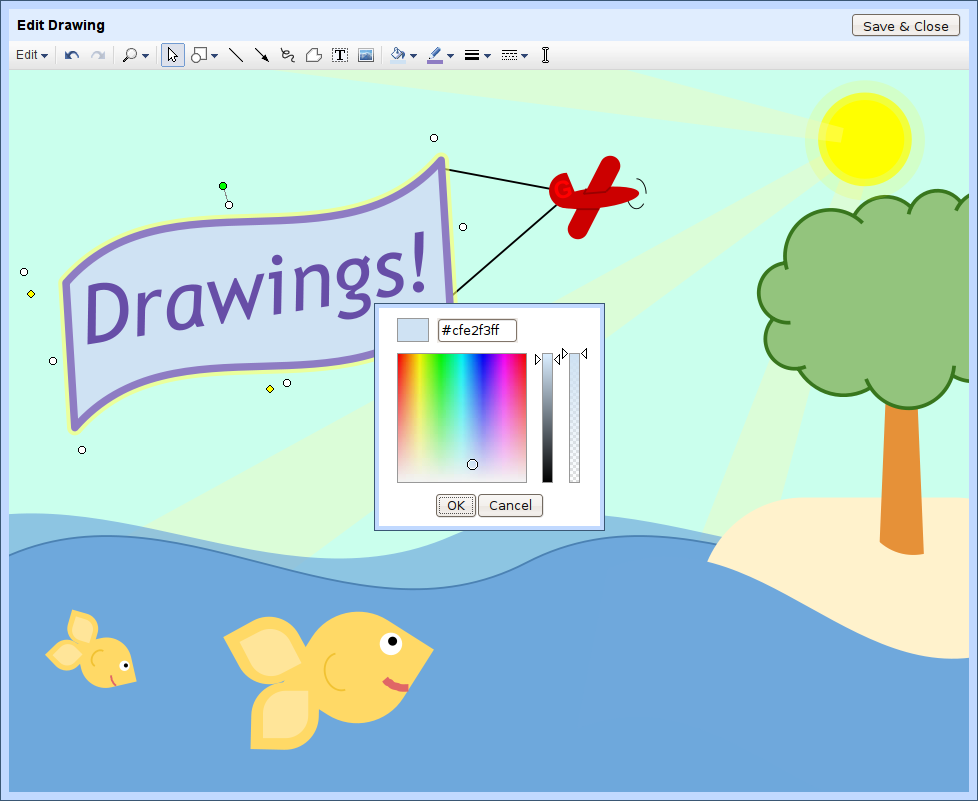
We use SVG ourselves in a range of products. In Google Docs, for example, you can insert drawings, illustrations, and diagrams using a built in drawing tool:
On all browsers we use SVG to build this user interface; on Internet Explorer we have to revert to an older technology named Vector Markup Language (VML) unfortunately.
Another example is the Google Visualization API, which lets you access multiple sources of structured data that you can display, choosing from a large selection of visualizations. Some of these visualizations (such as this one and this one) use SVG to do their drawing on all browsers except Internet Explorer.
Canvas Or SVG? Oh My!
A natural question is how SVG compares to the Canvas tag. In our opinion both are needed for the web and are suitable for different applications.
The Canvas tag can best be thought of as a scriptable image tag that you build up yourself using JavaScript. This means it is lower-level, requiring you to keep track of all objects you have placed on the canvas. This can be a benefit if you want to do a large degree of non-interactive animation, but can quickly become a burden if you need to build sophisticated user interfaces.
SVG, meanwhile, is higher-level, doing the bookkeeping necessary to keep track of where everything is, making things like mouse interaction much easier. If you don't need this interaction, however, the overhead imposed by SVG can get in the way of certain applications. Because SVG is markup, importing and exporting is much easier, including SEO and accessibility.
We believe that Canvas versus SVG is a false dichotomy. A great example of both technologies working together is the Firefox Download Tracker. This page shows real time updates across the world whenever a copy of Firefox is downloaded. SVG is used to draw the map of the world; this is an appropriate use, since we don't want thousands of lines of JavaScript for this but rather markup from a tool like Inkscape. Red circles are drawn on top of the SVG using the Canvas tag as copies are downloaded; this is perfect for Canvas as the circles are non-interactive and might number in the thousands if copies are being downloaded rapidly.
SVG In Internet Explorer and in Wikipedia
Now that you know a bit more about SVG, why we like it, and some of the places we use it, let me tell you a bit about some of the work we've been doing to support SVG lately.
In addition to hosting this years conference, we are also helping to address the fact that SVG can't be used on Internet Explorer. It's hard for developers to use new web technologies if they can't deploy them on IE. In response to this, we've been working with others in the open source community on a drop-in JavaScript library named SVG Web that brings SVG to Internet Explorer.
SVG Web cleverly uses existing facilities on Internet Explorer 6, 7, and 8 to instantly enable SVG support without the user having to download any new software or plugins. Using SVG Web plus native SVG support you can now target close to 100% of the existing installed web base, today. Before SVG Web you could only target about ~30% of web browsers with SVG.
Once dropped in SVG Web gives you partial support for SVG 1.1, SVG Animation (SMIL), Fonts, Video and Audio, DOM and style scripting through JavaScript, and more in about a 60K library. Your SVG content can be embedded directly into normal HTML 5 or through the OBJECT tag. If native SVG support is already present in the browser then that is used. No downloads or plugins are necessary other than Flash which is used for the actual rendering, so it's very easy to use and incorporate into an existing web site. Here's a quick one minute introduction to SVG Web:
SVG Web is currently in alpha and is a developer release. It's also important to note that it is a collaboration with many others in the open source community outside Google, including Rick Masters at F5 Networks and James Hight at Zavoo Labs. Google is just one participant in this open source project. Finally, a JavaScript library will never be as fast as native support; this doesn't take Internet Explorer off the hook for needing to implement SVG, but it does help developers in the here and now deploy their SVG today to get the wheel turning.
In addition to helping enable SVG on Internet Explorer, we've been working with Wikipedia. Wikipedia has an impressively large collection of SVG files that are under Creative Commons licenses. Every one of these files is available in the Wikimedia Commons; for example here is the Linux penguin Tux as SVG. We've been working with Wikipedia to enable interactive zooming and panning of these SVG files, similar to Google Maps; even better, this functionality works in Internet Explorer thanks to the SVG Web library on the sixth largest site on the web.
Today at the SVG Open show we are demoing a prototype of the Wikipedia SVG Zoom and Pan tool; deployment to the wider base of Wikipedia users will happen after the conference and an appropriate QA period. Here's a screencast showing the tool in action:
We hope you are as excited as we are about SVG and other new web technologies in the pipeline!
A few weeks back, I was given the opportunity to get a screener of the documentary The Hitchhiking Movie, and naturally, I jumped at the chance, both because I am a great fan of documentary film and because it was the first movie screener I've ever been offered.
The premise is that Ryan Jeanes and filmmaker Phillip Hullquist challenged themselves by trying to hitchhike from New York to Los Angeles over the first week of July 2007 (the added pressure was that they had to arrive in Los Angeles by a certain time as there was a plane ticket waiting to take them home). The other condition was they couldn't really spend money, so they had to truly depend on the kindness of strangers. The question is: can they make it? Watch the trailer to get a little bit of the flavor of this project.
Now the expectation that is likely in place is that I will discuss some of the kooky characters they meet along the way, but in reality, most of the people they meet along the way are ordinary people, and in a way, that makes the whole experience a little more interesting because those people are much easier to relate to. There were characters to be sure, but most of the people who ended up picking them up were people like you and me, dealing with their own problems, and in the end, I think it ended up being a much better cross section of the kinds of people who pick up hitch hikers. We meet almost all of the people who helped them make this journey, but there are a few who really stood out and they became the focus of the project, especially those who took the pair quite a few miles down the road.
What really surprised me, and maybe the fact that a documentary was being filmed influenced this, but there were people who picked them up who eventually let them do some of the driving. Perhaps this is more common than I, someone who has never hitchhiked, would expect. Either that, or there is still some trust on America's highways and byways. (The fact that this trip happened in the general vicinity of the Fourth of July probably didn't hurt either.)
The Hitchhiking Movie is the essence of independent documentary film making. Watching the credits, I noted that aside from Ryan and Philip, only two other people were involved in editing the film or adding additional flair, so it is indeed a very personal vision of the two people involved in the journey. This movie shows an entertaining slice of America, and it is fun watching the adventure, and the two filmmakers take their hardships with humor and grace, even when they have brushes with the law.
I have to note that there was one thing that took me out of the experience at times, and it is a small thing I admit, but it is still something I have to note. You see, there are more than a few occasions where there are spelling errors in the transcription of what is being said. Again, I said it wasn't a major thing, but it was something that happened enough that it was noticeable. But I am a stickler for things like that sometimes (though I know I have made enough errors like that over the years, so I still live in a little bit of a glass house).
The two men behind this film are currently working on a project that involves their trip down the entirety of the Mississippi River from its source all the way down to the Gulf of Mexico, which seems like it should be some interesting viewing as well, and I look forward to seeing it when it is completed.
The Hitchhiking Movie opens at the Secret City Film Festival in Oak Ridge, Tennessee on October 9th and it is available for purchase from their website.
 Extraordinary winds struck eastern Washington on Sunday, with 30-40 mph winds being commonplace, with gusts reaching nearly 60 mph around Wenatchee and vicinity. The result a major duststorm that closed down I90 for a while and resulted in numerous multicar accidents, sending 11 people to the hospital. Visibilities had dropped to less than five feet at times and the powerful winds knocked down many of the apples still on the trees near Wenatchee. It was reported that the ground at some orchards had turned red with apples.
 The computer model forecasts were quite good with this event and the National Weather Service had timely forecasts out well before. Want to see a vivid video of how bad it was...check out http://www.youtube.com/watch?v=yr819WqZMak
 One of the great things about this blog are the reports I get from many of you--and this event was no exception.