Friday, February 3, 2012

Fridaygram: science education, simulating galaxies, spider webs

Author Photo
By Scott Knaster, Google Code Blog Editor

Most software developers started getting interested in technology at an early age. With that in mind, Google Roots in Science and Engineering (RISE) is a program that annually awards grants to groups that come up with great new ways to teach students in Computer Science (CS) and science, technology, engineering, and math (STEM). This year’s awards were just announced. The winners included a program that helps primary school students in Dublin, girls in the San Francisco Bay Area, and kids in Uganda who want to learn about technology.

Scientists love to have reproducible results so they can test theories and ideas. What if you’d like to reproduce the creation of a galaxy? That task is still out of scale for humans, but scientists at the Laboratoire pour l'Utilisation de Lasers Intenses (LULI) have figured out a lab procedure that simulates the magnetic fields in newly formed galaxies. The experimental version uses lasers and carbon rods in place of clouds of gas and dark matter, but the results are useful, and you don’t need a galaxy-sized lab to work in.

Narrowing our view from giant galaxies to little spiders, a new study says spider webs are not just strong, but also have the ability to become either stiff or soft, as necessary. Spider webs are also designed to stay as strong as possible when strands are damaged. So spiders are good engineers.

Finally, you might use some of your weekend time to ponder this Vi Hart video about SpongeBob SquarePants and Fibonacci sequences.


Fridaygram posts are just for fun. Fridaygrams are designed for your Friday afternoon and weekend enjoyment. Each Fridaygram item must pass only one test: it has to be interesting to us nerds, and we certainly love our lasers.

There speaks a man

Munson, a commenter at HUS, strikes an admirable example:
I don’t believe anyone, anyone, wants to “play” at having intercourse and relationships. I believe, as Kahlil Gibran said, that even when we search solely for pleasure, we find she has seven sisters, each more beautiful than pleasure. I wanted to bear witness that if you find that person, the one you will be with always, while you both will age, a part of you will stay 25 forever. And you’ll see that in them; yes, you’ll note the years and what they do in their passing, but you’ll also see them as they looked when you met them, that part will stay alive and you alive with that. Love can do that.

And it can do more. Last night my wife and I were returning home from getting Chinese food when my doctor called ; we pulled over, we had been waiting. The results of my CT scan were the worst possible news: metastasizing malignancies on my liver, from a yet undetermined source. Together we were confronted today with the implications of that. My wife and I have been of course crying and consoling today, but she has told me “I don’t care if we live in an apartment or a tent by the Boise River, all I need is you.” It doesn’t matter what I lose – my hair, my colon, my liver-I will never lose her, nor she me. The image I have of us is (a little corny) two rocky outcroppings joined together against the ocean; though wave after wave assail us, we’re still there. I hope each of you in this noisy point in your life finds that, finds someone who lives the vows of “for richer or poorer, in sickness and in health.”
Best of luck to him in his upcoming battle. The remarkable thing is that despite the turn events have taken, it is clear that he regards himself as a lucky man. And the image he presents isn't corny at all, it is the epitome of the masculine marital ideal.

[In the Lab] Notes on Dead Weight


A long time ago, I came up with an rpg premise that seemed to resonate with a lot of people. There's one tower sanctuary left after a zombie apocalypse. Parkour runners loot the surrounding ruins while trying trying not to get weighed down. If you're too slow, the zombies get ya.

John Harper came up with a cool Apocalypse World hack for the setting and it's been dormant since. People still ask about it occasionally, though. I'm just not a role-playing game designer, so if I were to revisit this world, it'd have to be as a more tactical board or card game. So here are some thoughts on Dead Weight as such!

At it's core, it's basically a hack of Bomb's Away! Everyone begins with one runner card. There are three decks of cards on the table, containing either DISTANCE cards or ITEM cards.

On your turn, you roll one die and strike that result from your runner's card. Then, you can draw a new card from the first deck. You can keep rolling as many times as you like, each time drawing a new card. On your second roll, you can draw from the first or second deck. On your third roll, you can draw from the first, second or third deck. If a deck ever runs out, you cannot draw from it. (In other words, that part of city has been looted.)

DISTANCE cards get you more time in the city. Instead of striking a result on your runner's card, you can strike the result on the distance card.

ITEM cards are what you can use to buy new resources, hire new runners, and equip better tools. Eventually, you can buy admittance passage to higher levels of the tower. While carrying an ITEM, you must roll an additional die and strike that result as well.

BUSTING: If you roll a result that is completely struck out, you BUST. You lose all the loot and get one result on your runner's card permanently struck. (This is why you eventually want to hire more runners, too.)

TURNING BACK: You can always turn back and cash in your items. When you do so, place them face down in a discard pile.

NEW AREAS: When a deck runs out, place the discard pile face down as a fourth deck. This is a new, previously unexplored distant part of the city, ready to be looted. Discard piles continuously become new parts of the city in this way, so you might have a fifth deck, a sixth deck, and so on.

The first player to buy admittance to the top level wins.

That's the loose idea, anyhow. For a minute there, I thought this would be more of a dexterity game, but I couldn't settle on a way to actually make that work in play without that aspect totally overshadowing all the other tactical elements.

Thursday, February 2, 2012

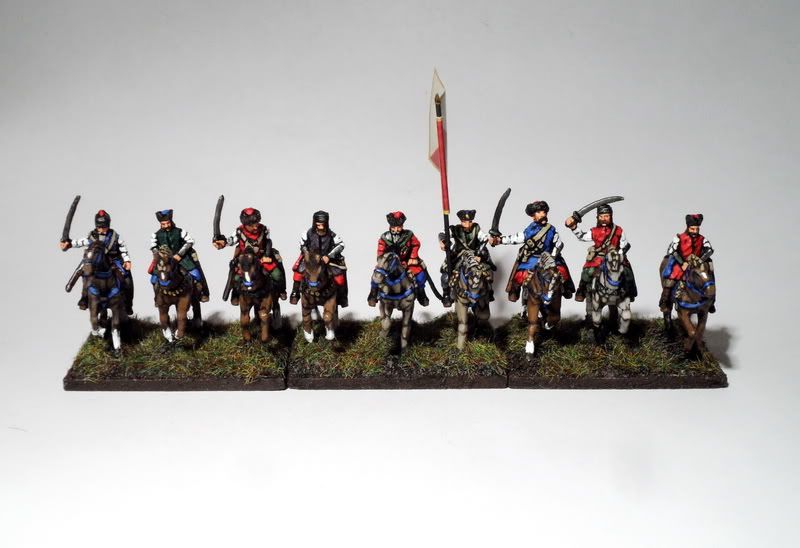
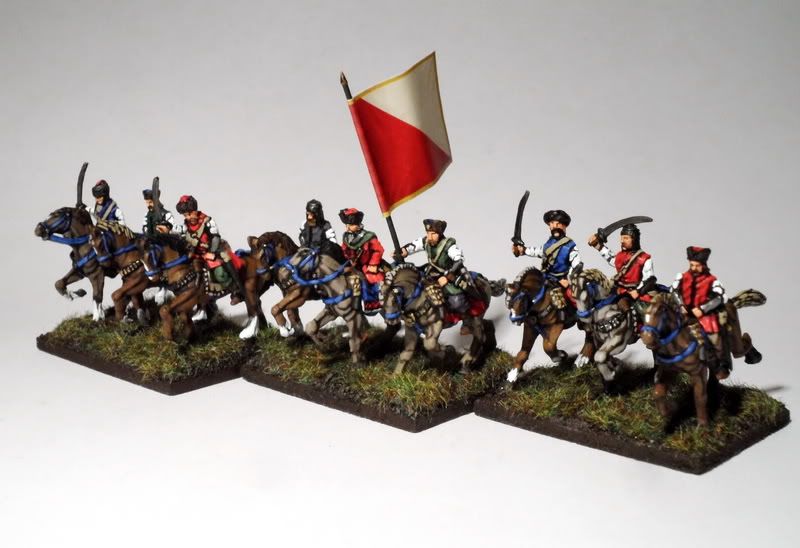
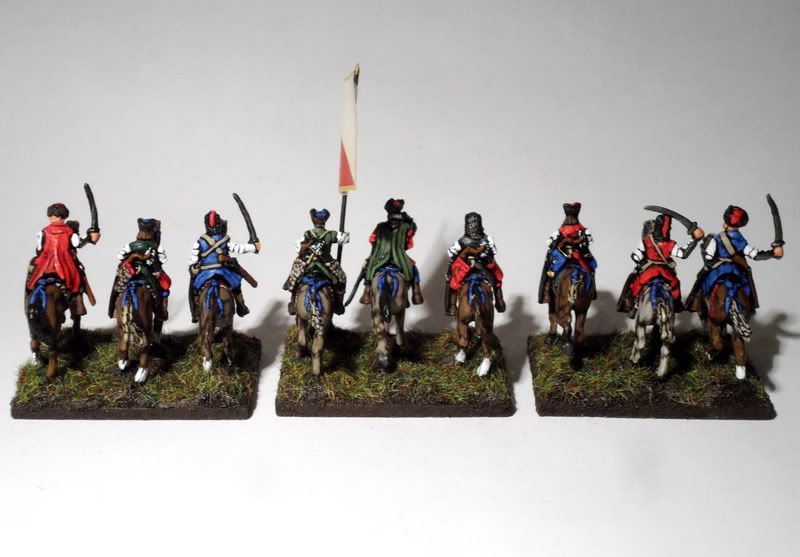
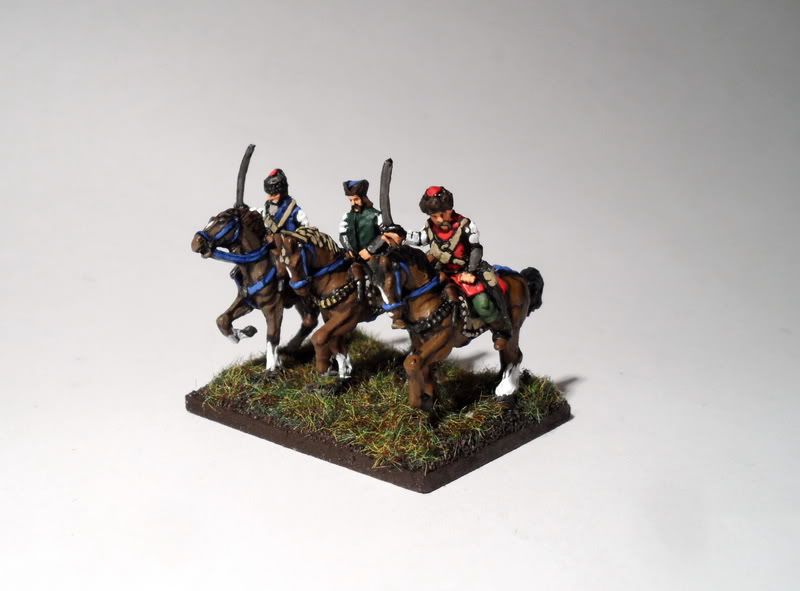
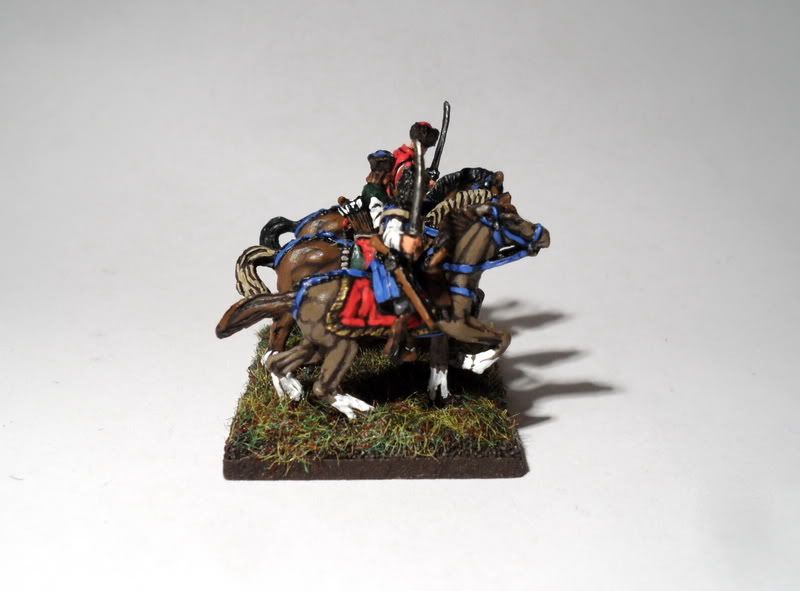
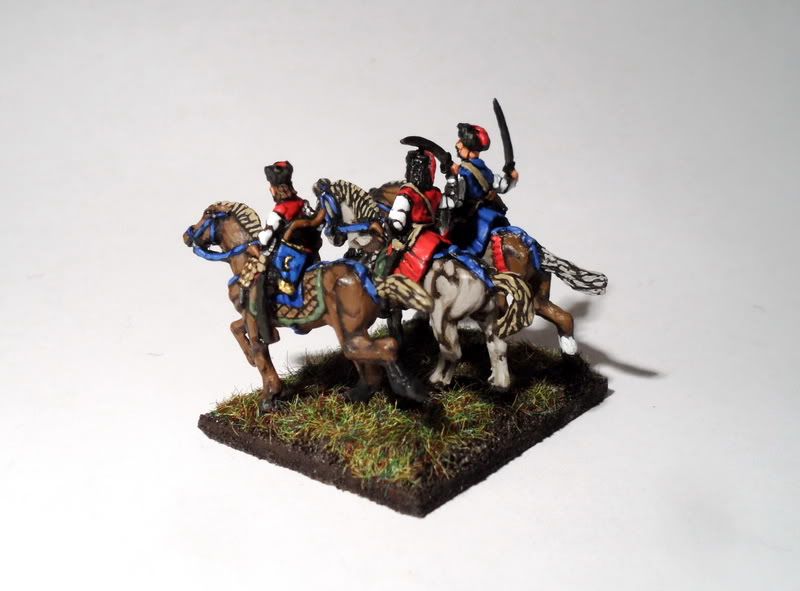
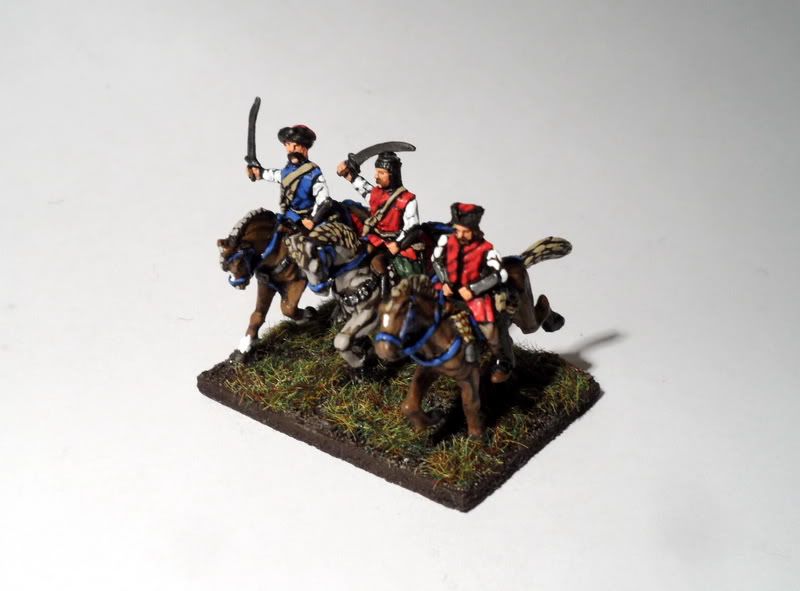
Cossack style cavalry company painted up (BF&S)

First company of the light cossack style cavalry that makes up the backbone of Polish cavalry regiments. These guys look like a band of brigands with their mixed clothing and weapons but they have pretty good close combat abilities and come with pistols, bows and short cavalry wheel lock muskets. They can fire on the move from horseback, even if that causes a pretty severe accuracy drop. Still, good for harassing and softening up slow moving enemy infantry units before they are charged by  heavier and more durable cavalry types such as Pancerni or Winged Hussars.

Despite the mixed nature of their uniforms, the riders were fast painted. The horses which I put a little more effort into this time around were the part that took most time. As I wanted to have another company ready before the weekend I painted the horses and riders over two days.

There is a bit of color coding on my part here as well, the cossack style/light cavalry horses will all have blue reins, while the medium and heavy cavalry will have red with more gold details. I'm also thinking of painting up the horses of the Winged Hussars in a single color throughout the companies - probably off white.

Next up is company of Pancerni cavalry. Painting one unit at a time like this I can cycle through all the boxes I bought and get great variation :-)

I will write down a small guide to color choices for these light cavalry stands soon as well so you get to know how I painted mine.

Midweek Video: Groundhog Day As A Horror Movie

This trailer makes me wonder if this is more in keeping with the vision of the movie Groundhog Day as it would have appeared in the Monster Squad universe.

Five things I learned from contestant stories

The faux tweets link to lots of contestant stories, mostly scrounged from Google news. After a while some common themes start to emerge. Five of them...

1) The Wheel of Fortune set is small. I mean, really small. To hear the contestants talk, they tape the show in a closet. A small closet...but with a really heavy wheel. It's hard to spin that thing.

2) Jeopardy is for nerds. Don't mean this in a bad way. I'm an actuary, which makes me practically a champion nerd. But Jeopardy contestants always talk about how they're bookworms and nerdy grubbers after all sorts of trivial knowledge. Which is good preparation for the show, after all.

3) Meredith is really nice on Millionaire. Funny thing, she always seems a little chilly to me, emotionally distant compared to folksy old Regis. But contestants swear up and down that she's super-friendly and supportive. So what do I know?

4) Steve Harvey does lots of standup on Family Feud. This is immediately apparent to anybody who watches the show. And what else do you expect from a standup comic? But contestants often talk about how long the tapings run as Steve does his shtick. The episodes get edited down later.

5) Lots of people really want to be on game shows. Stories about auditions usually mention hordes of would-be contestants storming the talent evaluators in hopes of that precious TV appearance. We're all looking for that fifteen minutes, or twenty-two minutes plus commercials.

GroundFrog versus GroundHog

As an atmospheric scientist, my role is to interpret a wide range of information...even unconventional information...to provide new insights into meteorological phenomenon.  I will do so here.   During the last week, two animal prognosticators have provided a vision of the weather future that are seemingly at odds, but really aren't.

The Snohomish GroundFrog reveals his secrets
On one hand there is the well-known frogprognosticator of Snohomish, Washington--otherwise known as the GroundFrog.   At a solemn ceremony on Saturday, the wise frog predicted good weather for the remainder of the winter for the Northwest--a prediction that is consistent with the latest two-week forecast of the National Weather Service's Climate Prediction Center for the western U.S. shown below.  Red indicates temperatures above normal.  No snow worries here.


On the other hand, Punxsutawney Phil, the well-known groundhog of Gobbler's Knob, PA, saw his shadow today, which implies 6 more weeks of winter.

Let me assure you that these forecasts are not inconsistent, considered their locations.  An atmospheric upper level pattern with a ridge over the West Coast and a trough over the eastern U.S. is consistent with their predictions and is quite reasonable.  In fact, here is the latest 15 day forecast at 500 hPa from the NWS GFS model that is showing such a feature--ridge over the west, trough over the east.

 Clearly, the innate wisdom of animals has something to teach us.