Not much ratings movement among syndicated game shows for the week ending January 22. But TVNewsCheck does say that a couple shows hit new season highs. The good news for Alex and Meredith...
Wheel of Fortune 7.7 - down a tick but still leads all syndies in household ratings
Jeopardy 6.4 - up a tick to that season high
Family Feud 3.2 - flat but at a nice level
Millionaire 2.7 - also up a tick to a season high
All four shows made the top 25 syndie list at TV by the Numbers. The viewership averages: Wheel of Fortune 12.5 million (weekend repeat 5.9 million), Jeopardy 10.2 million, Family Feud 4.8 million, Millionaire 3.9 million. Everybody can be happy about these audiences.
In other Nielsen news, the game show pair on Monday night at NBC went out with subdued ratings. Who's Still Standing, in its last hurrah, pulled a 1.7 18-49 rating with 6.5 million total viewers. The corresponding numbers for the Fear Factor repeat were 1.5 and 4.0 million. Fear Factor got a rerun because NBC chickened out on a literally ass-inine stunt. But the show will reappear now and then.
UPDATE: Dancing With the Stars is really bombing on GSN. The best it did was 264K for one of the Friday night runs. The bad numbers dragged GSN's overall prime time/total day viewership averages down to 287K/217K for the week of January 23-29. Look for Dancing to get cut back soon. Gotta admit I'm surprised. I thought it was a great demo fit for GSN.
Tuesday, January 31, 2012
Simpsons Marathon
In Los Angeles, Fox is going to be celebrating the upcoming 500th episode of The Simpsons by showing every episode in order and having people try to set a Guinness Book of World Records for the longest continuous television watching session (the previous record is about 86 hours).
My question is, do you think that if someone watched The Simpsons that way, that they would notice the exact moment where the show started to go downhill?
Angry Birds Chrome now uses the Web Audio API

By Fred Sauer, Developer Advocate
Cross-posted with the Google Web Toolkit Blog
Last week Angry Birds for Chrome was updated to use the Web Audio API for all its in-game audio for Chrome users, which means Chrome users get the full Angry Birds experience, without any plugins. The Web Audio API supports a wide variety of use cases, including the high fidelity and low latency requirements of games. Users of other supported browsers will still get sound via Flash or HTML5 audio.
How does this cross-browser audio magic work? As you may have seen or heard, Angry Birds was in no small part made possible by the cross-platform open source PlayN library. When building for the HTML platform, PlayN in turn relies heavily on Google Web Toolkit (GWT) to delivery a highly optimized web experience for users, and on gwt-voices to easily deliver a cross-browser audio experience.
The responsibility of choosing the appropriate audio API for the game's sound is (mostly) left up to gwt-voices, which chooses the audio API that will give the best experience. If you'd like to hear how other audio APIs perform, you can ask gwt-voices to try to use the Web Audio API, Flash, HTML5 Audio, or even native audio. Your mileage will vary by browser and platform and which plugins you have installed. Also, gwt-voices will select the best available fallback, if the desired audio API is not going to work at all in your environment.
Want to learn more? Check out the Web Audio API tutorial and don't let those pigs grunt too much.
Fred Sauer is a Developer Advocate at Google where most of his time is devoted to Google App Engine and Google Web Toolkit. He is the author of various GWT related open source projects including gwt-dnd (providing in browser Drag and Drop capabilities), gwt-log (an advanced logging framework) and gwt-voices (for cross browser sound support). Fred has dedicated much of his career to Java related development, with an increasing focus on HTML5.
Posted by Scott Knaster, Editor
Location:
Mountain View, CA, USA
Bachelor Episode 5 Recap: Puerto Rico is an amazing place to, wait for it, fall into the ocean with a naked model with an imploding mouth
By Artistry
Sadly, there is no Raw Emotion Podcast this week, but please keep the angry emails coming because that means you are doing what we've always wanted you to do: be emotional.
So in light of no REP and Finesse's inexcusable failure to even watch the show, here are some rambling thoughts divided into artificial headers at 5:45 a.m. You know, for the historical record. If you still need more, you can read our coverage of the whole season here.
Courtney
"I don't doubt that it won't be fun," said a flustered Ben when Bachelor camera-time leader Courtney first suggested they prance around naked in front of an ABC camera crew.
Nikki
Nikki was fortunate to be with the man of her dreams for the "Unexpected precipitation but remember things don't always work out take it for what it is nothing can rain on this parade roll with the punches go with the flow let's shift gears and buy authentic Puerto Rican clothes I am the luckiest woman on earth I'd like to have a big wedding" date. It was like a romantic comedy, except that these actors couldn't pull it off.
Nikki also wants a second chance at the fairy tale.
Hooker with a heart of gold really let down her walls
Baseball
Baseball group date. This game is hard enough to watch at an elite level. Courtney on Blakely: "Who knew strippers could play baseball."
Jen strikes out to lose the game. Something literary folks like to call "foreshadowing." She weeps because "time with Ben is precious." She doesn't want to lose that "precious, precious time."
Helicopter
Helicopter on the horizon. Somebody makes a comment about how that helicopter better not be coming to pick up the red team. Guess which team it picks up? Only a matter of time before someone opens fire on a helicopter on this show.
Elyse
Elyse asks what she did wrong. Ben says, "nothing, you're an incredible woman." There is no evidence that he really thinks this.
The rest of the raw notes
what is going on w kacey b hair? gettin uglier
c mouth is imploding. all this is a metaphor for the season
when women see guy take elyse's bag, they act like someone was just shot. "No!"
Courtney hopes she is a vision after a long day. She isn't.
skinny dip
ben uses the word "rad."
ben says he is blindsided by blakely. she really lets down her walls.
Another classic screwup by emily talking shit on courtney again. ben warns her to tread lightly and drop it.
Jen gets sent home with elyse.
panama city
Sadly, there is no Raw Emotion Podcast this week, but please keep the angry emails coming because that means you are doing what we've always wanted you to do: be emotional.
So in light of no REP and Finesse's inexcusable failure to even watch the show, here are some rambling thoughts divided into artificial headers at 5:45 a.m. You know, for the historical record. If you still need more, you can read our coverage of the whole season here.
Courtney
"I don't doubt that it won't be fun," said a flustered Ben when Bachelor camera-time leader Courtney first suggested they prance around naked in front of an ABC camera crew.
![]() |
| Ben is a good right-hand man. |
Nikki was fortunate to be with the man of her dreams for the "Unexpected precipitation but remember things don't always work out take it for what it is nothing can rain on this parade roll with the punches go with the flow let's shift gears and buy authentic Puerto Rican clothes I am the luckiest woman on earth I'd like to have a big wedding" date. It was like a romantic comedy, except that these actors couldn't pull it off.
![]() |
| For Jurassic Park fans: "Dodgson! We've got Dodgson here!" |
![]() |
| Men shouldn't sit in baskets. |
More after the jump...
Hooker with a heart of gold really let down her walls
![]() |
| "Yeah, at times it was scary. I mean, you never knew who would be in the hotel room" |
Baseball group date. This game is hard enough to watch at an elite level. Courtney on Blakely: "Who knew strippers could play baseball."
![]() |
| Bachelor Code §101.456(A)(3)(b): Get the guy in a baseball uniform, ASAP |
Jen strikes out to lose the game. Something literary folks like to call "foreshadowing." She weeps because "time with Ben is precious." She doesn't want to lose that "precious, precious time."
![]() |
| Precious. |
Helicopter on the horizon. Somebody makes a comment about how that helicopter better not be coming to pick up the red team. Guess which team it picks up? Only a matter of time before someone opens fire on a helicopter on this show.
Elyse
![]() |
| "what IS that helicopter?!?!?!?!" |
![]() |
| Facebook profile pic candidate test: Not looking at camera? Check. Windy? Check. Tan? Check. Beach that implies you love to travel? Check. Verdict: Acceptable. |
Elyse has a brutal accent and tan. Also Ben has never talked to her and now she says she wants to get married right now. She says, "I'm sick of being single." Ben: "Just sick of being single? Er..." Then he says unfortunately 6 times in his break up speech. "Unfortunately I just met you, and unfortunately you want to marry me. Unfortunately, that makes no sense, even in this context. And unfortunately, your accent is particularly grating. Unfortunately, the other women are a little better at making me feel comfortable with them declaring me the man of their dreams after a single date, so unfortunately, I cannot give you this rose."
Elyse asks what she did wrong. Ben says, "nothing, you're an incredible woman." There is no evidence that he really thinks this.
The rest of the raw notes
what is going on w kacey b hair? gettin uglier
c mouth is imploding. all this is a metaphor for the season
when women see guy take elyse's bag, they act like someone was just shot. "No!"
Courtney hopes she is a vision after a long day. She isn't.
skinny dip
ben uses the word "rad."
ben says he is blindsided by blakely. she really lets down her walls.
Another classic screwup by emily talking shit on courtney again. ben warns her to tread lightly and drop it.
Jen gets sent home with elyse.
panama city
[In the Lab] Rulers - System Overview
Couldn't sleep this morning, so I decided to make good use of my time by writing up this system overview for Rulers, inspired in part by Rob Donoghue's commentary on the previous post.
System Inspiration
Split Decision's rich rolling, RISK for the Rule Duel mechanic, RISK: Legacy and Unknown Armies in the endgame, the storytelling elements of Do: Pilgrims of the Flying Temple without the writing, and a bit of Aeon Flux and M. Night Shyamalan's The Village in the setting.
Premise
The Crown keeps tight control over a modern kingdom. The kingdom is the only stable area within a surreal land called the DMZ. The kingdom's citizens are divided into the twelve castes to maintain order. Despite this, a random group of citizens possess a telepathic power: They can create and impose rules on the people around them. This power is called Ruling, and the Crown is the most powerful Ruler of all.
Each year, the Crown hosts a televised event called Rulers in the DMZ. The Crown exiles a handful of rulers to the Demilitarized Zone outside the kingdom's borders. Each episode highlights their deeds and obstacles in the DMZ. At the end of the series, one exile wins the grand prize:
The winner decides a new set of Rules for the Crown to impose on the kingdom.
How to Play
STUFF YOU NEED
Each player needs, a pencil and paper to record your character's details.
The group shares a separate sheet of paper to record ongoing game information.
The group shares three six-sided dice, one red, one black and one blue. It's handy if you have more than one set for the whole group.
Each player needs a Ruler character to play.
CREATING YOUR RULER
First, roll your three dice. You'll refer to these results in the following steps.
I'm Sector _______ and I'm a Ruler.
Add together the highest and lowest results and write that number in the space above. If your number matches another player's, increase it by one. Continue increasing it until you have a unique number. This number is how your character will be referred to throughout the series.
The kingdom is divided into twelve sectors, numbered from 1-12. Sectors represent strict levels of access an individual may have to resources and liberties. Only the Crown is Sector 1, meaning the Crown has access to the entire kingdom and may rule it as the Crown wishes. Each subsequent sector has less access, all the way down to lowly 12s who are often desperate, malnourished or convicted of serious crimes against the Crown. In other words, it's a caste system.
I must __________. I must __________. I must not __________.
Choose one result for each space. In each space, complete the sentence with that many words.
Each of these statements is a personal code. A Ruler's special powers come from intense commitment to three particular codes: Three things your character must or must not do. It is important that these be broadly applied and concise worded, otherwise the code has no power.
Codes come in all varieties, but generally break down into three groups. Codes of conduct are the most common, meaning a basic restriction on personal behavior. (I must heal any higher sector. I must assist all children in distress. I must not love.) There are also codes of access, meaning a restriction on personal liberty. (I must only eat meat. I must not look at women. I must not enter a place uninvited.) Lastly, there are codes of gospel, meaning a compulsion to teach or learn a particular subject. (I must teach compassion. I must learn sword fighting. I must reach inner peace.)
The Crown approves me because _______. [Crown Approval ___]
Choose one or two results. If two, add the results together. Complete the sentence with that many words.
During play, your Ruler will try to curry favor with the Crown by doing things he or she believes the Crown will like. The Crown's favor will be very helpful in the long-run, as this determines how long your prize may be at the end of the series.
The public supports me because _______. [Public Support ____]
Add together the result(s) you did not choose in step 4. Complete the sentence with that many words.
During play, your Ruler will also curry favor with the people of the kingdom, hoping to gain public support. This support is ultimately what determines who will win the series, so it's important to play to the crowd.
BEFORE EACH EPISODE...
Choose an episode synopsis to decide what this episode will be about. Each episode focuses on a test for the entire group, with three obstacles that get in the way. Your character will try to pass the test, curry favor with the Crown and the people, and all without breaking code.
Tonight, on Rulers in the DMZ...
The Rulers return a group of lost citizens to the Kingdom.
Act 1 Obstacle: The citizens are criminals who don't want to return.
Act 2 Obstacle: They're being protected by automated security systems.
Act 3 Obstacle: The leader of the group is related to one of the Rulers.
The Rulers expand the Kingdom's influence deeper into the DMZ.
Act 1 Obstacle: Invisible predators stalk the jungle.
Act 2 Obstacle: Ancient ruins reveal a dark secret about one of the Rulers.
Act 3 Obstacle: Power corrupts one of the Rulers.
The Rulers befriend a local village.
Act 1 Obstacle: The villagers speak a language that causes madness.
Act 2 Obstacle: The village's well water is poisoned.
Act 3 Obstacle: A rival village lays siege.
[This is just a short list as an example.]
The Rulers return a group of lost citizens to the Kingdom.
Act 1 Obstacle: The citizens are criminals who don't want to return.
Act 2 Obstacle: They're being protected by automated security systems.
Act 3 Obstacle: The leader of the group is related to one of the Rulers.
The Rulers expand the Kingdom's influence deeper into the DMZ.
Act 1 Obstacle: Invisible predators stalk the jungle.
Act 2 Obstacle: Ancient ruins reveal a dark secret about one of the Rulers.
Act 3 Obstacle: Power corrupts one of the Rulers.
The Rulers befriend a local village.
Act 1 Obstacle: The villagers speak a language that causes madness.
Act 2 Obstacle: The village's well water is poisoned.
Act 3 Obstacle: A rival village lays siege.
[This is just a short list as an example.]
Turn Order: Each episode lasts three acts. Each act lasts however many turns it takes for one player to overcome the obstacle in that act. Each player gets one turn, starting with the lowest Sector number and continuing sequentially.
Countdown Clock: Each act has a countdown clock noting the time remaining for Rulers to overcome the obstacle. In a three-player game, the countdown clock is set at 10. In a four-player game, the countdown clock is set at 13. In a five-player game, the countdown clock is set at 16.
ON YOUR TURN...
State what your Ruler does to overcome this act's obstacle, with some constraints based on the following steps:
Roll the three dice. Add together two of the results and set aside the third. The two results added together will be either equal to, less than, or greater than your sector number.
- If less, your Ruler attempts to overcome the obstacle but makes negligible progress. On the bright side, the people take pity on you and send you a Gift. Gifts can take many forms – food, weapons, knowledge – but they all behave the same way in play. You may spend gifts to lower your Sector for one turn. After spending a gift, it cannot be spent in this way again.
- If equal or greater, your Ruler attempts to overcome the obstacle and makes some progress. Remove your highest result from the Countdown Clock. If the Countdown Clock runs out, your Ruler successfully overcomes the obstacle. Refer to "End of the Act" for more information.
- If you set aside a blue die, your Ruler gains that much Public Support points OR Crown Approval points. Record this number on your sheet. Refer to "End of the Episode" and "Series Finale" for more information about what these mean in the long run.
- If you set aside a black die, your Ruler must break a code. Cross off the code he or she has broken.
- If you set aside a red die, your Ruler may impose a new Rule on all characters for the rest of this Act or until someone breaks that Rule. A Rule affects all applicable characters. Your character may dissolve his or her own Rule at any time. Your Ruler may only impose one Rule at a time. Refer to "Laws of Ruling" for more information on writing Rules. Refer to "Rule Duel" for more information on how to break another player's rule.
RULE DUEL
On your turn, before you write what your character does, you might wish to break a Rule. If so, your Ruler and the other player's Ruler both engage in a kind of telepathic willpower contest. It doesn't matter how far apart they are from each other, a duel can span any distance. On-screen, the televised broadcast shows the duelists' rising heart rates, dripping sweat and bulging forehead veins. Here's how to duel:
If you are trying to break the Rule, you are the Breaker. If you are trying to maintain the Rule, you are the Defender. Each player gathers one die for each of their own unbroken codes, up to a maximum of three dice. Each player rolls one die at a time.
- If the Breaker gets an equal or higher result than the Defender, the Defender loses one die.
- If the Defender gets a higher result than the Breaker, the Breaker loses one die.
The Duel is over when one player has no dice remaining. The player with dice remaining wins.
- If the Defender wins, you may not write an action that would contradict the Rule. The Defender gains his last die result in Crown Approval points.
- If you win, that Rule is vetoed. That Rule may never be imposed again for the rest of the series. The Defender gains his last die result in Public Support points.
END OF THE ACT
After a turn in which the Countdown Clock runs out, the Act is over. Any Rules imposed during this act are no longer in effect. The first act is always relatively minor in scope, the second act raises the stakes, and the third act is the climax.
END OF THE EPISODE
After three acts, the episode is over. All players may replace broken codes with new codes. The player with the most Crown Approval lowers his or her Ruler's Sector by one, to a minimum of two. The player with the least public approval raises his Sector by one, to a maximum of twelve. Public Support and Crown Approval both reset to zero. If this is the last episode, proceed to Series finale.
SERIES FINALE
The Crown awards the grand prize to the ruler with the most Public Support. The winner may write a new set of Rules for the entire kingdom, using as many words as she has Crown Approval points. The other Rulers return to the kingdom, now all bestowed with the rank of Sector 2.
In the Series Finale, it is possible for Rulers to attain Sector One or Sector Thirteen. If a Ruler reaches Sector Thirteen, she is exiled forever from the kingdom. If a Ruler reaches Sector One, she ascends to the Crown with either the support of the preceding Crown or of the Public, depending on whichever category in which she has the most points.
On the marital peril of the SAHM
Athol Kay makes the classic philosopher's mistake of relying upon logic and experience rather than statistical evidence in stressing the moral hazard and marital dangers of the Stay-At-Home-Mother:
"The labor market was flooded with the influx of female workers, thereby devaluing the current labor supply, which means the male income declined to the point where it's no longer possible for nearly all husbands to support a family on one income. Which then forces women into the workplace whether they want to be there or not."
However, where Athol goes awry is when he assumes that the moral hazard of SAHM status, which he has correctly identified, outweighs the other problems and temptations that face working mothers, which he has completely left out of the equation. This is a fundamental error, as one cannot perform a relative risk analysis and reach a meaningful conclusion while only examining the risks of one of the two options. A brief perusal of the available statistical data would have shown him that the marital risks posed by the working wife he leaves out of the equation are significantly higher than the genuine, but much smaller risks posed by the SAHM. From The Independent:
Nor is the temptation to play for ex-spousal support necessarily absent from the working mother as she only has to possess a little patience and foresight in order to quit her job, wait six months, and thereby reap very much the same benefits from her pseudo-SAHM status in divorce court as the genuine SAHM does.
Furthermore, Athol also fails to take into account the fact that homeschooling is not only advantageous to the children, but is considerably more intellectually stimulating to the mother than the vast majority of working occupations. I doubt many working mothers are learning a lot of Latin, reading European history, or wrestling with quadratic equations on a daily basis. The following statement tends to indicate that he hasn't really thought the matter through from that perspective.
"Both of our girls are very bright and I doubt they would be content at all with a SAHM lifestyle."
Given that intelligence is heritable and that the women of the cognitive elite are disproportionately inclined to a) be SAHM and b) homeschool their children, it should be readily apparent that Athol's assumption that very bright women are likely to be discontent with a SAHM lifestyle is wildly mistaken. In fact, the more elite the woman's education, (and therefore, the more intelligent she is), the more likely she is to forgo work after her children are born and choose the SAHM lifestyle. 30 percent of the women at Yale plan to stop working once their children are born and another 30 percent plan to work part time; in my experience this means that 75 percent of those who actually do get married and have children will do so. This should be obvious, as it is the wealthy and most educated class that can most easily afford to get by on a single income; this also happens to be the class with the lowest divorce rate.
On an anecdotal level, I happen to know several women with Ivy League degrees, some with graduate degrees. None of them are now in the labor force. All of them are SAHM by choice.
So, contra Athol's assumptions, SAHM are more intelligent, better educated, and present far less of a divorce risk than working mothers. Add to this the fact that their children are far more likely to be homeschooled and one can only conclude that his conclusions are entirely erroneous because they are based on a combination of false assumptions and a failure to take into account competing risks.
In a Marriage 1.0 world, alimony is a good and meaningful thing. A genuinely bad husband, should be forced to support his wife and children if she isn't the one at fault and he is. But in a Marriage 2.0 world, there may be no fault whatsoever on the part of the husband, or even either party. But there may be fault on the part of the wife. Whereupon alimony - formerly a punishment for an at fault husband - turns into a reward for an at fault wife. Divorce is incentivized for women, and thus the divorce rate skyrockets.First of all, let me point out that Athol is clearly not intending to attack family-focused mothers here and that his basic logic is correct. I also have to give him a lot of credit for understanding, as so many who write on this subject do not, the basic economic principle that an increase in labor supply lowers the price of labor, thereby creating additional financial pressure on married women to work.
The combination of an incentivized divorce plus the ease of a SAHM lifestyle creates a huge moral hazard for a husband. The wife may demand an easy SAHM life, or simply take him to the cleaners if he doesn't provide it for her. This level of threat makes her the default head of household in many cases and thanks to female hypergamy, that increasingly kills her attraction to her husband, further increasing the divorce rate.
"The labor market was flooded with the influx of female workers, thereby devaluing the current labor supply, which means the male income declined to the point where it's no longer possible for nearly all husbands to support a family on one income. Which then forces women into the workplace whether they want to be there or not."
However, where Athol goes awry is when he assumes that the moral hazard of SAHM status, which he has correctly identified, outweighs the other problems and temptations that face working mothers, which he has completely left out of the equation. This is a fundamental error, as one cannot perform a relative risk analysis and reach a meaningful conclusion while only examining the risks of one of the two options. A brief perusal of the available statistical data would have shown him that the marital risks posed by the working wife he leaves out of the equation are significantly higher than the genuine, but much smaller risks posed by the SAHM. From The Independent:
Working women are more than three times more likely to be divorced than their stay-at-home counterparts, research published this week reveals. Furthermore, the longer hours women work, the more likely they are to be divorced. "Our findings suggest that there is something about wives' work that increases the divorce risk," say the researchers who will report their findings in the Oxford-based European Sociological Review.Just as the possibility of alimony presents a moral hazard to the SAHM, the possibility of financial independence and the constant proximity to available men presents temptation the working mother. Even if Athol is entirely correct and the "level of threat makes her the default head of household in many cases and thanks to female hypergamy, that increasingly kills her attraction to her husband,", that may still be far less problematic than regular exposure to a set of men of much higher socio-sexual rank than her husband.
Nor is the temptation to play for ex-spousal support necessarily absent from the working mother as she only has to possess a little patience and foresight in order to quit her job, wait six months, and thereby reap very much the same benefits from her pseudo-SAHM status in divorce court as the genuine SAHM does.
Furthermore, Athol also fails to take into account the fact that homeschooling is not only advantageous to the children, but is considerably more intellectually stimulating to the mother than the vast majority of working occupations. I doubt many working mothers are learning a lot of Latin, reading European history, or wrestling with quadratic equations on a daily basis. The following statement tends to indicate that he hasn't really thought the matter through from that perspective.
"Both of our girls are very bright and I doubt they would be content at all with a SAHM lifestyle."
Given that intelligence is heritable and that the women of the cognitive elite are disproportionately inclined to a) be SAHM and b) homeschool their children, it should be readily apparent that Athol's assumption that very bright women are likely to be discontent with a SAHM lifestyle is wildly mistaken. In fact, the more elite the woman's education, (and therefore, the more intelligent she is), the more likely she is to forgo work after her children are born and choose the SAHM lifestyle. 30 percent of the women at Yale plan to stop working once their children are born and another 30 percent plan to work part time; in my experience this means that 75 percent of those who actually do get married and have children will do so. This should be obvious, as it is the wealthy and most educated class that can most easily afford to get by on a single income; this also happens to be the class with the lowest divorce rate.
On an anecdotal level, I happen to know several women with Ivy League degrees, some with graduate degrees. None of them are now in the labor force. All of them are SAHM by choice.
So, contra Athol's assumptions, SAHM are more intelligent, better educated, and present far less of a divorce risk than working mothers. Add to this the fact that their children are far more likely to be homeschooled and one can only conclude that his conclusions are entirely erroneous because they are based on a combination of false assumptions and a failure to take into account competing risks.
Monday, January 30, 2012
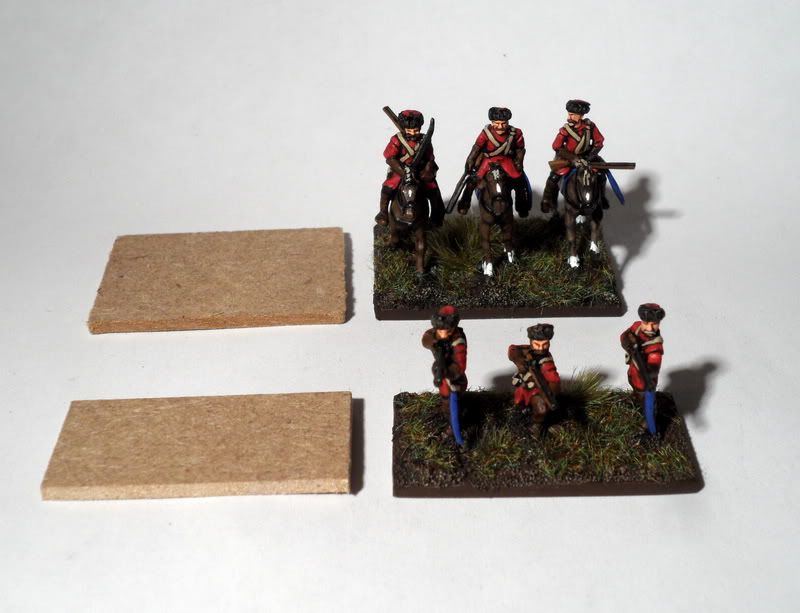
MDF bases from Warbases.co.uk
Instant reaction to everything goes something like this:
Bases are very cheap, and the shipping is equally dirt cheap. I just placed an order for two packs, 1 pack of 20 4x2cm bases and 1 pack of 18 4x3cm bases (infantry and cavalry standard for BF&S). I think I paid 5 Euro in total, shipping included (think it was 1.5 or 2 Euro).
Beside the bases being cheap Warbases.co.uk also managed to please all areas of concern. Email on order status, and again when the bases were shipped. Easy payment. Fast delivery (5 days). And overall friendly customer service.
So two thumbs up for these guys. Check them out, they have all sorts of bases for all kinds of games (FoW included) and movement trays, markers and a bunch of other stuff.
Subscribe to:
Posts (Atom)