Showing posts with label 9 Lives. Show all posts

Thursday, August 15, 2013

While the cats are away... [9 Lives]


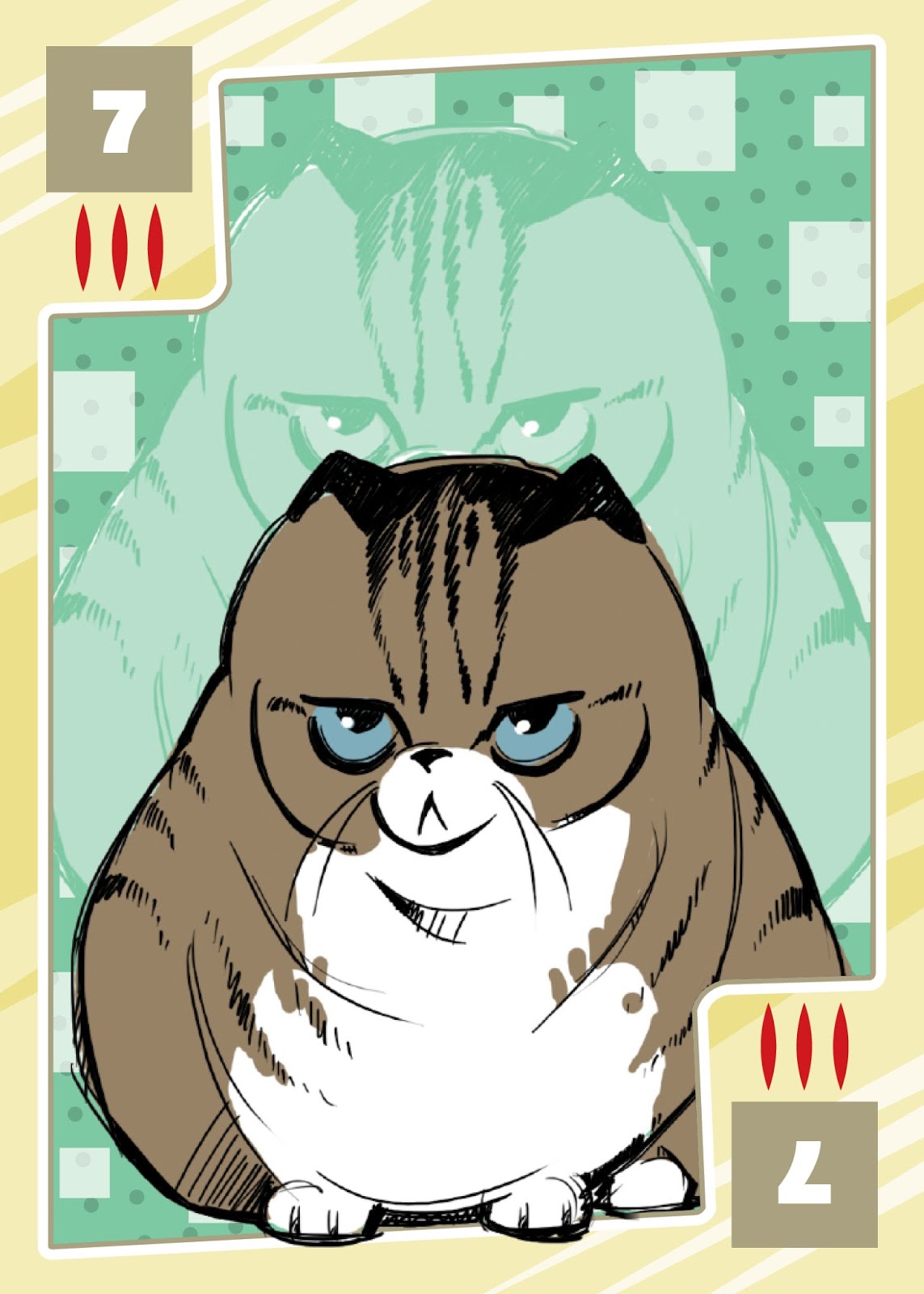
While everyone is away at Gen Con, here's a little treat for those of you like me who are staying home to catch up on work. These are the card designs in-progress for 9 Lives.

You can see a few tweaks to the rules reflected in this design. Gone are the stars you're trying to earn, in their place are cat-scratches you're trying to evade.

I've also given each cat a proper suit, so you can distinguish them at a glance while fanning your cards. I took that a step further, making the suit a color-coded background pattern reminiscent of anime and manga. I thought Kristina Stipetic's art lent itself well to this cartoony style.

Thursday, July 25, 2013

The Big, Huge Playtest Feedback for 9 Lives


Hey! Remember those cute cats I was trying to herd in the game 9 Lives? I released Prototype B for public blind playtesting a while back to some mixed results.

The response was mostly mild and quiet, which said to me that it could be put behind some other games in development that were drawing much more interest. That's mostly how I decide what to develop first, whatever strikes my interest at the moment or what seems to excite the public... hopefully both at once!

But then came this excellent, long feedback from Tournevis where he and his group dived deep into some structural problems and emergent bugs. Further feedback came from Kristina Stipetic, Scott Messer's family, Caroline-Isabel Caron.


  • There is limited engagement between players beyond the bidding phase, which itself isn't a problem except...
  • Too many cards are available once you've won the bid, meaning that there's a lot of analysis paralysis and gaps between moments of multiplayer engagement.
  • Mid-game scoring in the Reward phase interrupted the flow of play and wasn't clearly communicated in the rules, so that too created gaps between moments of engagement. 
  • Oddly, another group found the Reward phase not just easy, but vastly preferable since it earns so many more points than Adoption. Either way, that phase of play is becoming a problem.
  • With so many cards available, it became difficult or impossible to block an opponent from getting something they wanted.
  • Also, tracking turn order in the adoption phase became difficult if the bid cards were available for adoption.
  • Presently, the strategy is too thin for 2 players and the choices exponentially too many with 7-9 players. 3-6 may be the sweet spot, pending revisions. 
  • Aside from actual gameplay, cards should be designed with clearer suits instead of using the cat art shrunken down to a thumbnail. Stars should be lined along the edge.

In particular, some good ideas came out of Tournevis' group discussion that I'd like to test further in a new prototype. Below is my current revision to their suggested procedural changes.

---------------------

THEME:
Players trying to rescue nine stray cats and bring them home while getting scratched as little as possible. (I'm replacing stars with scratches.)


SETUP: 
3-6 Players. Shuffle the whole deck and deal five random cards to each player and set the rest as a deck in the center of the play area. Each player should have space for a card tableau and a method of keeping score.


PLAY:
A GAME of 9 Lives is 5 ROUNDS. Each round is three PHASES: The Search phase, the Rescue phase, and the Escape phase. A player who has most total points at the end of the five games wins.


SEARCH:
Exactly the same as the Bidding phase as in Prototype B

RESCUE:
Starting with the player with the lowest bid and proceeding in ascending order, each player takes a corresponding turn marker, indicating their turn order. 

On your turn, you may taking one card from the center of the play area, from the cards other players have bid, or from the deck. Regardless of where you take it from, acquired cards are kept FACE UP in your tableau.

Discard any remaining bid cards, but keep any cards in the center of the table in place.
ESCAPE:
In the same turn order as noted above, each player takes turns doing one four actions. On your turn, you may:
  • Exchange two cards with the same number of scratches between one opponent's tableau and your own tableau,
  • OR exchange cards with the same number of scratches between one opponent's tableau and the center.
  • OR discard a card in an opponent's collection and replace it with the top card from the deck.
  • OR do nothing.


BETWEEN ROUNDS:
Draw the top card from the deck and add it to the center of the play area. The game continues with four other rounds until all five cards in all players' hands have been played.


SCORING:
Variety Bonus: Each player scores 1 point for each sequence of two or more matching cats. Single cat cards do not count towards this score.

Reward Bonus: Now, players may score points for each cat, but only if they were scratched the least by that cat. For each cat, the player with the fewest scratches from that cat earns 1 point for each card in their tableau featuring that cat. If some players are tied for the fewest, all tied players score their respective points. 

At the end of a game, all cards are shuffled back at the bottom of the deck and a new game is set up.


ENDGAME:
The final score is tallied over the course of five games. The player with the most total points wins!

Wednesday, June 12, 2013

9 Lives Card Game - Prototype B

9-Lives-Title-Logo
Here's a new family card game I've been tinkering with over the past few months. You may recall some previous posts on the subject here and here. Well, with a bit of streamlining for the rules and a few tweaks here and there, I've managed design what I hope is a fun, fast, light strategy game that plays well with two to nine players. Yep, nine.

The premise of the game is that nine house cats have escaped. It's your job to bring them back home. The challenge is bringing them home while also making sure they're happy as possible with they return. Sometimes it's hard to do both! You know how cats are.

Players bid for cards, each featuring one of the nine cats. You're trying to claim the majority of the cards featuring a specific cat, thus allowing you to score points from that cat. However, not all cards are worth points, so simply winning a majority of those cards won't guarantee the best score.

This plus a little Baccarat-style mid-game scoring amounts to a light, tactical mini auction. Hope you enjoy! Please feel free to share your feedback.

» Download Prototype B

Friday, May 10, 2013

Rank these cats for 9 Lives!

CatRanking

You've heard me talk about my card game 9 Lives a bit already. Well, I've been fortunate enough with Koi Pond's success on DriveThruCards to have enough in my budget to order art from an actual professional rather than doing it myself. Above you can see the nine cats drawn by Kristina Stipetic, each with its own personality. Now I just need to decide, how will they be ranked?

The game's cat theme is fairly loose to begin with, so the numbers 1 through 9 don't really mean much mechanically. Though I suppose you could look at the math and say that 1s will be least likely to come into play while 9s are most likely. Note that it is not a measure of actual rarity in the deck, just how useful they are in play.

All things being equal, I figured I'd open it up to the public. So, now taking your recommendations for how to rank the cats above from 1 through 9. Feel free to use whatever logic you wish. Age? Mood? Energy level? Take your pick!

Tuesday, April 23, 2013

Exploring the Math in 9 Lives

Cat and Calculator - Top View

Last week I posted a simple casino-style game called 9 Lives. I noticed some peculiar math behind the mechanics. I bet this is one of those things mathfolk already know intuitively, but coming at it in long-hand on my notebook over a cup of coffee is still worthwhile.

To review, the game involves playing pairs of cards, each showing a digit, either 0 through 9. Added together, the highest pair is the winner for that turn. The winner earns points equal to the 'ones' digit of their play. So if you played a 12 and won, you'd win 2 points. (Tied players both score.)

So I wrote out the different pairs of digits that would make each sum, from 0 through 18. I also compared that to the value of each sum. This produced the following chart. (Click to enlarge.)


There is only one way to make 0, 1, 17, or 18. Two ways to make a 2, 3, 15, or 16. Three ways to make a 4, 5, 13, or 14. Four ways to make a 6, 7, 11, or 12. Five ways to make  8, 9, or 10.

This makes scoring strategy very peculiar indeed. From 0-9 it's easier to make a winning pair and you get more points for each pair up to 9.

Then you fall off a cliff drop at 10. Above 10, value and difficulty have an inverse relationship. It gets harder to make pairs 10-18, the points earned start again from 0, only reaching 8 at a maximum. Is that a bug or a feature? All I can say for now is that it's a prisoner's dilemma.

Everyone knows optimal play is 9. It's the easiest pair to make and worth the most points in the game. You could pursue that, even if it means sharing the top spot with another player. Or you could go for a higher pair, even if it means you will score fewer points. At least that way, only you will score points. But why ever play 10? It beats anything from 0-9, but scores the winner nothing. Spite?

It also makes me wonder if I should add some deeper auction element, to offer some long-term set-building. Of course, that's my usual go-to solution, but it's a place to start.

The highest player earns first dibs from amongst all the cards in play this turn. She collects one and adds it to a private tableau. She is followed by the next highest player, and so on, until each player has collected one card. The remainder are shuffled back to the bottom of the deck. At the end of the game, bonus points are scored for variety and for sets-of-a-kind.

So you still have a consistent, evergreen reason to pursue a high pair above 9. Plus, even if you don't get first pick at the auction, you can at least get some points as compensation.