Showing posts with label game design. Show all posts

Wednesday, July 31, 2013

"Gamer's Tic Tac Toe" #GTTT

GTTT

Picking up on yesterday's thoughts about converting classic games to something gamers might enjoy, let's talk about the one game possibly more dismissed than roll-and-move: Tic Tac Toe. It's a solved game, as any fans of Matthew Broderick movies will know. The only way to win is to not play.

Then I recently learned about Ultimate Tic Tac Toe. It's played on a 3x3 grid, with each cell containing a standard 3x3 tic tac toe board. On your turn, you place your mark on one of the tiny boards, which in turn forces the next player to make their mark on the corresponding big board. Whoever wins a tiny board lays claim to that entire cell. If you're forced to play on a cell that is already won, you can play in any cell. If you claim three cells in a row, you win! You can see why this is also called "Inception Tic Tac Toe."

Alas, like regular TTT, UTTT has been sort of solved. There are optimal moves that will eventually lead to a tie. The trick with any "Gamer's" version of Tic Tac Toe will be to un-solve it. That is, find ways to introduce random initial states and offer alternate options that make traditionally sub-optimal choices actually worthwhile.

Unexplored Emergent Properties

I wonder if there are some emergent properties yet unexplored by those mathematicians that could be tapped for deeper gameplay. I'm thinking about this in terms of yesterday's post on "Gamer's ____" games. So in this case, it would be "Gamer's Tic Tac Toe."


For example, red is losing this game but in the process has created a few long lines of five-in-a-row. Should that be worth something? Blue has also created long lines. Should that be worth something, too, or is that only the privilege of the player losing the cell strategy? What happens if a player makes a contiguous line that extends across the whole 9x9 game board?


In another scenario, Blue has managed to create a perfect square that traverses two cells. Should that mean something? What if it traverse three squares? What if it was a 4x4 square? Does that have some effect on the marks within the square? Is there some kind of Go-like surrounding mechanic? What about other shapes, like Xs or triangles?


Presently, the only effect of being forced into a claimed cell is that you may then play in any cell. This acts as a deterrent to for your opponent to give you an advantage. I rather perfer incentives over deterrents though. What if you wanted to play in a claimed cell? What if there was some value still left to tap in that cell, despite you not getting the first three-in-a-row? Does having more marks in that cell give you some other reward?

And what if each cell had its own variable reward for being the first to 3-in-a-row, majority, or to be traversed by a long line? Imagine each cell is its own card, with its own stats.


Any discussion of n-in-a-row games and area control games has a long, long history to tap. For now, let's just find a theme so these weird emergent behaviors make some kind of sense as far as gameplay goals.


Gamer's Tic Tac Toe (GTTT)
Once more, the basic gameplay is as identical to Ultimate Tic Tac Toe. The new stuff comes in assymetric mid-game goals and long-term goals.

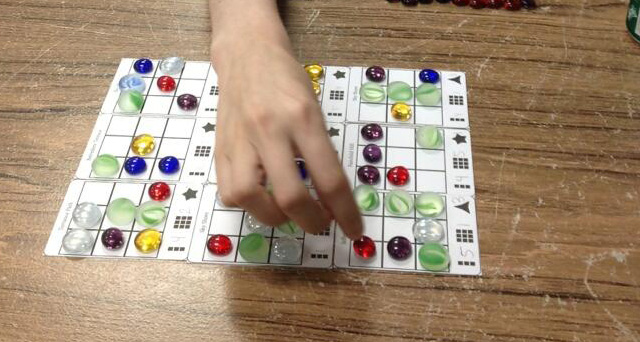
The board is comprised of nine randomly drawn cards. Each card is a city block with a real estate-sounding name. Each cell of the card represents a building up for sale. The numbers alongside the bottom of each card represent rewards based on certain conditions as described below.


The first player to get three buildings in a row on a card gets the first reward noted on the card. In this case, blue gets 2 points.

The first player to get five buildings on a card gets the majority on that card, but don't score that until the end of the game.

The round ends as soon as there is a continuous line of nine buildings. Whoever has the majority of buildings on that line gets a 3 point bonus.


Any remaining area majorities are scored for each card. Blue earns a total of 7 (3+0+4) points. Red earns a total of 10 (2+2+3+2+1) points. The tied card is not scored by either player.


Now here's a twist. That player who did not get area majority on a card collects that card. In essence, the player who loses the area majority contest wins the card, which itself is worth points as a set at the end of the game. At the end of the game, organize your collected cards by their symbols. Score the highest value of each set, plus 1 for each extra card in that set.


Or maybe islands?
I'm not really feeling the real estate theme, so maybe Islands would work better? Each cell is an island and the goal is to populate islands, building "bridges" of straight lines across the archipelago.

This suggests one more secondary mechanic. Imagine if each island offered its own resource, as shown above. I imagine these would be more island-themed eventually, so Taro, Coconuts, Mangoes, Bamboo, Shells, Fish, Pigs, Obsidian, and Water. Think of this as a worker placement game. Each time you place a stone, you acquire a resource from that island.

Resources would be noted on a separate board as shown above. Collecting the first of any resource starts you at a deficit, but eventually the reward is greater than any potential area majority or three-in-a-row.


So when your opponent leads you to one of the boards, you're not only thinking about area majority or getting three-in-a-row, you're also thinking about the resource you want to get and which one you want to avoid. Being too diversified eventually leads to a wash, as shown above. Sometimes you want to sacrifice valuable lines or areas just to make sure you don't set forth on too costly a quest for mangos.


And in conclusion...
That's my first stab at a GTTT of some kind. Un-solve the original game by adding the following ingredients to make otherwise sub-optimal choices more enticing.
  • Random starting layout: Makes memorizing opening moves less useful.
  • Points as victory condition: By removing the original victory condition and using points instead, we remove the whole logic behind the solution to the original game. Now you're not just seeking three-in-a-row, but any number of other ways to score points, which includes three-in-a-row.

The methods of scoring points are pretty standard ingredients for eurogames. The minimum and maximum possible values are noted as well. The maximums assume a very extreme circumstance though, like the game continuing until the board is full or all the cards having optimal set-collection.
  • First to Three-in-a-Row from Cards (Variable 0–45)
  • Area Majority for Triggering Endgame (3)
  • Area Majority from Cards (Variable 0–5)
  • Set Collection (Variable 0–21)
  • Worker Placement on Resources (-18 – 25)

All that being the case, three-in-a-row is still a pretty strong incentive. It's tactically easier to do and leads to higher potential rewards depending on the board layout. That keeps in the spirit of the original game, but may still be unbalanced. I hope the other bonuses and considerations would make the decisions more satisfying though.

There are plenty more directions you could take this, of course. I recommend checking out Kory Heath's Blockers as a fine example of how to shape a 9x9 grid into a fiendish puzzle game. Whether mine is any good, I don't know.

For one thing, I have this loosey goosey idea of centering the grid on each card, thus making room for two unique sets of values for either player. So one player would find it more valuable to get area majority on a card while her opponent would prefer the first three-in-a-row.

And that's not even taking into consideration background art to add yet another level of information. But for now, five ways of scoring seems like enough.

Tuesday, July 30, 2013

Augustus and the Search for the Next "Gamer's Bingo"

Augustus as Priest, Palazzo Massimo

Paolo Mori's Augustus was nominated for this year's Spiel de Jahres, and rightly so. I found it a clever and satisfying evolution of classic Bingo. In fact, it's often called Roman Bingo or Gamer's Bingo around my local gaming circles. Neither label has quite been intoned in derogatory manner, but I get the feeling it's sort of a dubious honor.

You hear that term, "Gamer's ____," applied to any game that has a mass market central mechanic at the core of otherwise more modern gameplay. You might describe dice games like Alien Frontiers or Roll Through the Ages as "Gamer's Yahtzee" for example. These "Gamer's" versions of classic games are chimeric beasts, with the heart of a mainstream game and the body of gamer's game.

Here are a few common tips for making a "Gamer's ____" game, in terms of Roman cliches for your entertainment. (Are you not entertained?)


All Roads Lead to Bingo.
Take an existing mainstream game (ideally one in the public domain) and apply a typically hobby-oriented theme. The challenge is finding the theme that complements the emergent properties of the core game. In Augustus, Roman conspirators (bingo players) are seeking clues (bingo calls) in order to effectively execute their conspiracies (bingo cards). Yeah, it's a very thin theme, but it doesn't contradict the gameplay. Bingo lends itself well to ratcheting tension, multiplayer groups, and a satisfying climax when you can yell "Bingo!" or "Ave Caesar!"

Bingo as the Romans Bingo.
Your game may be clearly based on a pre-existing classic game, but the theme is what drives all the other secondary and tertiary mechanics. For example, the cards in Augustus represent either a military campaign or a senator's influence. Each card requires a certain combination of Roman-themed bingo symbols to complete. Once complete, each is worth points and each has a unique effect that can cascade into other effects. It's easy to write a fiction around these outcomes, too. "I finally got that last legionnaire, which won the favor of this Senator, who in turn supported my campaign in Britannia."

Veni, Vidi, Bingo.
Keep the game compact. You want to be in and out within 45 minutes, including any setup/breakdown time. Longer than 45 minutes or bigger than a chess board starts going outside the bounds of a casual play experience. Augustus lasts about 30 minutes and all the components can fit in the velvet bag that comes in the rather oversized box.


Naturally this has me thinking about what the next "Gamer's ____" will be and how successful it might be in the game market. Will a gamer theme turn off anyone interested in the original inspiration? Will the original inspiration face profound disinterest among gamers? Are good production values and marketing enough get a first play? Is the game satisfying enough for its target audience to keep them coming back?

Friday, July 26, 2013

"What if someone steals your idea?"

Lightbulb

People ask this of me a lot. I get it, you're really proud of your new game mechanic or your original theme or some other thing about your precious IP that is gonna be worth bajillions. Pride in your work is good! It keeps you going in the dark times when you wonder whether you'd be better off with some other hobby, like extreme ironing or tortilla golf.

But that pride can also give you some weird expectations, like that anyone else cares nearly as much about your idea as you do. That's not meant as an insult against your idea specifically, it's just an emergent property of the creative field. If anyone cares as much about your game idea as you do, they'd already be spending the late nights and long hours it takes to playtest, develop, cry, revise, cry, and playtest again until the idea is a proper game.

Wait, you are putting in those long hours, right? Please don't tell me you're worried about someone stealing your idea before you've put in that development time. Please don't tell me you've researched patents, copyrights, NDAs and trademarks before you've even tried playtesting. Please don't tell me you're only playtesting with people closest to you, who therefore have a vested interest in not breaking your heart. You're not doing all these things, right? Of course not, that would be foolish.

That paranoia is just an excuse not to do the work.


THE TRUTH ABOUT IDEAS
Ideas aren't that special.
Seriously, a cool idea isn't a game in and of itself. Antoine Bauza didn't just roll up and say, "Hey, I want to make a game where you hold your cards backwards and have to work together!" and get the Spiel de Jahres handed to him. No, there was a ton of work and two separate publications before Hanabi became a hit.

Your ideas are stolen... from someone else
I've got a closet full of unfinished ideas that never made the final cut for whatever reason. Ideas everywhere! Seriously, here, have some, I have too many. We've all got them, and chances are that not one of them is at all original. Not mine, probably not yours. We can't escape the design milieu of our times, we can only respond to it, iterate it. Want a good example? Try thinking of a new chess piece. Go ahead, maybe it moves like a bishop, but limited to two spaces? Maybe it moves like a King, but two spaces if it moves forward, and can only capture diagonally? Okay, now take a look at the hundreds of chess pieces out there and see if you can find some white space left to explore. 

Ideas don't reveal emergence.
Even if your idea is 100% original, the idea alone isn't valuable, it's the work of revealing emergent properties that makes the idea valuable. Taking Bauza's Hanabi example again: For a game that elegant, you know there was a lot of time put into every design decision. With so few mechanics, everything becomes that much more important. How many suits should be in the deck? How many cards of each rank should be in the deck? What's an average score across one hundred games? How do people communicate with each other in play? None of these questions get answered unless the "idea" becomes a reality at the table. There are uncountable emergent properties that just don't reveal themselves until you playtest.

Your idea alone is not a game.
Let's get zen for a bit. If a game goes unplayed, is it still a game? Is it only a game while being played? These are the questions I have for you if you're more concerned about jealously guarding your precioussss instead of actually putting it in front of as many people as possible. Your idea is not a game. Only your game is a game. Even then, it's only a game if people are playing it. That means you have to actually make prototypes, write rules, and face the social awkwardness of asking strangers to play this thing with the added caveat that it may not even be fun. That is what will make your idea valuable. And guess what? When the game is fun, the victory will be so much sweeter.


VALUE TAKES A WHILE. A LONG WHILE.

All that to say... No, I'm not worried about someone stealing my ideas. Exactly the opposite, in fact. I wouldn't be here if I wasn't so open and public about my design process. I've been doing this in public for over a decade now. But when I started? Yeah, I was worried about it.

It started in 1999ish when I designed a fan-made World of Darkness RPG about sentient zombies, Zombie: the Coil. There was a gap in the WoD mythos that I thought I could fill. And boy, did I fill it with every contrived faction, inconsistent mechanic, punk-rock posturing and gothic whininess that I thought a proper RPG was supposed to have. I just copied the structures from existing White Wolf properties of the time and wrote within those constraints and posted the results on my crap website.

Then I got worried about White Wolf stealing my idea. I heard they were releasing Hunter: the Reckoning and that it featured zombies. Oh no, zombies in the World of Darkness? Crap! All my writing was for naught! Never mind that I didn't even try properly pitching it to White Wolf in the first place.

Can you imagine the naive audacity? I crib wholesale from White Wolf's books and then I get worried about them looking at my stuff? Get it together, teen Daniel. Zombie: the Coil sucks. But keep at it, you'll find your design mode in about fifteen years. (Also, teen Daniel, stop wearing a trench coat in Florida. You look like an idiot.)

Needless to say, White Wolf did just fine for itself in the 90s without my tiny contribution. But working through that fear, just getting comfortable showing my work to other people and holding it up for critique; that was valuable.

And then I went on to design plenty more rubbish games.


NO GENIUS. NO MYSTIQUE. ONLY WORK.

Don't buy into the genius mystique. It is a mirage. Maybe there are geniuses out there, but you can't go assuming that you're one. That's like living as if you're going to win the lottery on a regular basis. No, the value comes from the work and no one's going to do more of it than you. Buy a pizza for your playtesters. Agonize over game terms. Completely scrap three prototypes in a row and start over again. That is the craft, the work, of game design. So get back to it!

Thursday, July 18, 2013

What to do when your game is too balanced? Try zero-sum mechanics. [Monsoon Market]


I've playtested Monsoon Market Prototype B a few times now. It turned out to be waaaay too balanced. Ties happen all the time. It seems that any random deal across three rounds will result in some score around 20ish. That's great for new players who don't like getting thwomped in the first game, but sucks for any experienced players who find no way to break out of the pack. But first, a recap:

Monsoon Market is a drafting game set in the Indian Ocean trade network during the middle ages, before European contact. Players have a public tableau, called their Port, featuring several goods cards. Each players also have a hand of goods cards, called their Ship.

Each turn, the ships sail to a neighboring port (hands pass to the left). Then each player may trade one goods card from her port for a goods card from the ship currently at her port. When the round is over, each player's ships return to their home port with whatever cargo they've collected in their journey.

The goods cards feature a common good at the top and a rare good at the bottom. From among all the cards in port and from your ship, you can build scoring sets or set aside cards for their gold value to use at auction for special abilities between rounds.


I need zero-sum mechanics to add some texture to this smooth distribution. In other words, bonus points that only one or a few players can claim.


Add a majority-wins, winner-takes-all score bonus.

Problem: I thought I was being clever showing a common good and a rare good on the same card, thus making every card valuable in at least one way. Unfortunately, this made scoring a bit laborious as you had to cross-reference and count icons across several overlapping sets.

Solution: Instead of one of the three common goods, I'm going to depict one of the three major continents of the Indian Ocean network: Asia, India, Africa. Each round focuses on one continent. Anyone who has the most cards of that continent at the end of the round gets a major bonus. If tied, split the bonus, rounding down. This still keeps each card valuable, but in two much more different ways. It also keeps goods-scoring simpler. More importantly, it's a score that only one or a few players can claim.


Add variety to individual card value.

Problem: If I make the noted change to the common good on each goods card, that makes each card represent just one unit of one particular good. This makes building up a set a very slow and predictable process of adding one unit at a time to any set. It's time to add some leaps and jumps. I want players to feel a little more delight when they get a valuable card.

Solution: While each card only represents one type of good, it may also represent more than one unit of that good. One is most common, two is rare, and three is very rare indeed. This would allow you to build up pretty strong sets really fast with a good trade or a lucky draw. I will also make sure these high-value cards are also valuable in the auction described below, giving them divergent, mutually exclusive tactical value.


Add emergent, ascending point values to auctioned items.

Problem: Between rounds, Zheng He, the famous Chinese fleet admiral visits each player's port and offers a gift from the Chinese emperor. This is represented by an auction. Players use any remaining gold value from unscored goods cards to bid for first choice of n randomly drawn special abilities. Presently these do not have point values of their own. Most simply count as one permanent rare good, allowing more opportunity to score. Others allow you to dump cargo from an opponent's ship. Things like that.

Solution: I'm removing gold entirely. Instead, I'm giving each card a unique sequential number formatted as "Day 1, Day 2, Day 3," and so on. These represent the days of Zheng He's voyage. The player with the unscorred card with the lowest number gets first pick, because Zheng He visited her port first. The player with second-lowest number gets second pick, and one point. The player with third-lowest number gets third pick, and two points. This continues for each player, the worse their choice, the more points they get as compensation.


Add triangular awards to first-, second-, third-place finishers.

Problem: You may recall my post on triangular and square number sequences and how they're used in game design. Usually it's something like, this: "If you collect X bananas, earn Y points." In my case, my figurative numbers are the number of bananas you'd have to collect to earn a certain number of points. I'd like to do this again in a very different way that is easier to score.

Solution: I'm assigning each triangular number to a placement ranking for collecting a particular thing. Let's say some cards will feature one, two or three ship icons. These represent the fleet you're building for your trading empire. At the end of the round, before scoring and before the auction, players can set aside as many cards as they like face-down. These will be kept for the whole game. They are not scored for sets or used at the auction. Instead, at the end of the whole game whoever has the biggest fleet wins the top bonus score noted below, followed by second-place and so on.

      5 Players   4 Players   3 Players   2 Players
1st   15 Points   10 Points   6 Points    3 Points
2nd   10 Points   6 Points    3 Points    1 Point
3rd   6 Points    3 Points    1 Point
4th   3 Points    1 Point
5th   1 Point


With all these tweaks, I don't think ties will be much of a problem anymore. They all offer some interesting, divergent new tactics to explore mid-game. But testing is required to confirm if these solutions really art solutions!

Tuesday, July 9, 2013

Advice for the Playtest Hangover


This morning I woke up with a pretty killer playtest hangover. It's that mixed feeling of excitement, self-doubt, enthusiasm and despair after a playtest with less than steller results. In this particular case, I playtested Monsoon Market [Prototype B] and Espionage [Prototype E].

Monsoon Market went pretty well, with positive response from the small sample size and only some minor streamlining changes to the core gameplay.  I'm eager to test this again with different groups to get a more well-rounded sense of direction.

Espionage remains a cypher, as microgames tend to be. A good microgame is a sharp, multifaceted jewel. Alas, Espionage is still a rough lump of ore. Tactics were unclear, overall goals were muddled, and I was perhaps too eager about making it a six player game.  Playtests offered a lot of ideas though, which is very helpful. Once I've had a chance to polish off the rough spots again, I think I'll go public with Prototype F.

Games Need Sun to Grow

The key thing to remember about being a game designer is that your craft requires public input, and it's better done sooner than later. If your game is broken and you know it's broken, that is all the more reason to take it out of the lab. Don't hide it away. Explore the emergent behaviors. What tactics do people try? What wording is misunderstood?

The Genius Myth Doesn't Help

It is tough. You're asking generous strangers to offer their time on what amounts to work, when they came expecting play. On top of all that, you could come away with really negative feedback. You're often making a first impression with your ugliest babies. I still find myself buying into the idea of a mystical genius releasing a perfectly realized game fully formed, which I'm sure sometimes happens, but that ain't how I work and I bet it's not how you work either.

Step Back, Come Back

"What if my baby is uglier than most? That playtest feedback was so negative! I'm a fraud! I'm never going to make it!" Okay, that stuff? I know how that feels, believe me. It can be overwhelming at times, crippling even. You gotta deal with it as best you can. I can't speak for anyone but myself, but I do it by stepping away completely, but temporarily. Take a walk, go see a movie, or hang out with some non-gaming friends. The important thing is to get back to work not too long after. Stepping back is easy, coming back is the hard part.

Kevin Kulp once called game design and the business surrounding the game industry "worthy work." I still believe that to be the case. It is worthy, but it is also work. So I gotta get back to it!

Sunday, June 30, 2013

5 Ways to Use Triangular and Square Numbers in Game Design

stacked

It's a well-known risk of game design that in pursuit of originality, you will bump into well-studied concepts of mathematics. Some game designers come straight out of maths and sciences, so they already have a library of statistical and numerical knowledge at their disposal. The rest of us come out of a creative field where... let's just say math and logic wasn't a primary focus.

All that to say, I stumbled into the term "Triangular numbers" a while back while figuring out the scoring for Koi Pond's ribbons. In layman's terms – that is to say, my terms – triangular numbers are a sequence of numbers that increase at a predictable rate. In the example below, you can see the typical progression of 1, 3, 6, 10, 15, and so on

Ticket to Ride's scoring progression was quite clearly arranged with the balance and logic of some mysterious underlying structure. I knew it was there, but I didn't know it had a name, let alone a whole history of research. They're "figurate numbers," starting with linear numbers, then triangulars, squares, tetrahedrals, and more.

  • Linear:      1, 2, 3,  4,  5,  6,  7,  8,   9...
  • Triangular:  1, 3, 6,  10, 15, 21, 28, 36,  45...
  • Square:      1, 4, 9,  16, 25, 36, 49, 64,  81...
  • Tetrahedral: 1, 4, 10, 20, 35, 56, 84, 120, 165...

Many thanks to W. Eric Martin for actually telling me what this stuff was called. I also listened to a classic GameTek segment from Geoff Engelstein covers triangular numbers in all sorts of games. This GeekList features several games using triangular numbers, including Coloretto, Amun Re, Hare and Tortoise and more. There's also an Online Encyclopedia of Integer Sequences, that catalogs many many of these particular sequences of numbers.

So, I wanted to pitch a few ideas I had for using these number sequences in games.


#1: Triangular Values for Linear Sets
There are some obvious uses in set collection mechanics. It's common in many games that a set of two matching items would be more than double the value of one item and that three of those items would be worth more than triple the value of one item. For sake of examples to follow, let's call these red beans. In this scheme, you'd score 1 point for 1 red bean, 3 points for 2 red beans,  6 points for 3 red beans, and so on. If you went with this scheme in your own game, you'd have to make forming sets part of the tactical and strategic challenge.


#2: Linear Values for Triangular Sets
Alternately, you could make sets very easy to create, but force players to get increasingly larger quantities in order to claim higher rewards. For example, you'd score 1 point for 1 red bean, 2 points for 3 red beans, 3 points for 6 red beans, 4 points for 10 red beans, and so on. Yes, these are actually diminishing returns for each step up the ladder, but there are ways to make this an interesting play experience. See Bohnanza as a key example, which uses set limits, hand limits, and assymetrical trading to make the struggle for one more card very exciting.


#3: Triangular and Square Values for Linear Sets
Now things get really weird. Let's continue with the "red bean" example and expand that to other foods and colors, like "red apple," "yellow apple, "green apple," "red bean, "yellow bean," "green bean. Now we have a 3x2 grid of attributes, with each item in the game being either red, yellow, or green and either a bean or apple. In play, the value of a set of cards could have two cumulative values, one based on color and the other based on food. In this case, let's say you use "food" to determine the triangular value and "color" to determine the squared value: 1 point for 1 red, 4 points for 2 reds, 9 points for 3 reds, and so on, plus 1 point for 1 bean, 3 points for 2 beans, 6 points for 3 beans. Thus, a set of 3 red beans would be worth 15 points. Forming a perfectly matched set is very valuable indeed!


#4: Linear and Square Values for Linear Sets
Say you wanted to reward diversity and hegemony in your set collection game. The simplest way would simply be to use the Triangular-for-Linear scheme first described above for matched sets. Then you add a twist: for each set of one-of-a-each-kind, you gain a flat rate of around 8 points. This makes each diversity set more valuable than a set of three matches, but not quite as valuable as a set of four matches. When players reach that critical decision point, they must decide whether to pursue either of those two paths to victory.


#5: Linear, Triangular, and Square Values for Triangular Sets
Returning to our second example, let's say your game requires increasingly larger sets to gain just one more point of value. However, each component of that set had three attributes. Let's say besides just "color" and "food" there was also some other attribute, like "age," such that ripe foods were more valuable than seeds. Thus you have three divergent methods of scoring a set. Say "color" has linear value for triangular sets (1:1, 2:3, 3:6, 4:10...), "food" has triangular value for triangular sets (1:1, 3:3, 6:6, 10:10), and "age" has square value for triangular sets (1:1, 4:3, 9:6, 16:10). Now that would be a brain-burning set-collection game!

#6: Beyond Victory Points
So far, these examples focus on direct conversion of sets to victory points, but you can just as easily use a linear, triangular or square sequence for other resources. Imagine a civ game in which rare resources were earned at slower rates. For example, assuming triangular sets, the rarest goods would be earned at a linear rate, the moderate goods at a triangular rate, and most common goods at a square rate. That's the beginning of a whole economy right there. Why not set up an auction where each bid must be an increasingly higher triangular number?

I'm going to explore these last two ideas more thoroughly in future set collection games, perhaps with an eye towards keeping it intuitive and easy to comprehend mid-game. I wouldn't want players being stricken with total analysis paralysis while trying to navigate three simultaneous point trackers.

Tuesday, June 18, 2013

Burrito: Line Drafting and Action Selection

Burrito

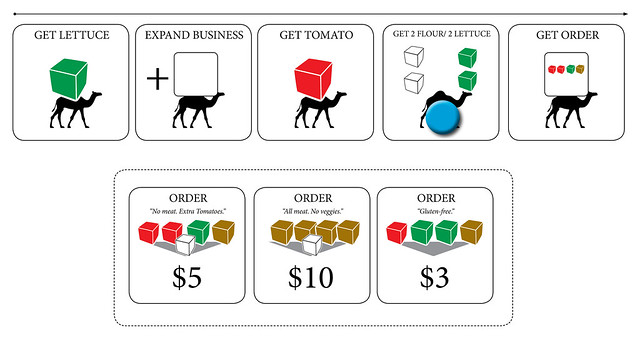
Here's a super quick idea, combining the "line drafting" structure (from SmallWorld, Guillotine, Morels and Belle of the Ball) with action selection. This came out as a possible solution to a big hurdle of line drafting games. Replacing the cards as soon as one is taken from the line can be a bit fiddly. If they're not replaced, then the initial length of the line is so long it takes up the whole table.

I thought, why not just move the card at the front of the line to back of the line? Each card simply represents one action you may take during your turn. You can take the action at the front of the line for free, or you may pay one resource to skip that action and take the next one in line. Anyone who takes an action with resources on it also gets that resource. Once an action is done, that corresponding card is simply moved to the back of the line.

This greatly reduces the size of a deck for a line drafting game and makes it a bit less fiddly. Granted, you still occasionally need to re-center the whole line to the middle of the table as it gradually creeps backward, but it's still less handling than usual. There's also still the problem of gaps in the line if players skip to the second or third action. Eh, can't solve it all.

Above is a potential theme for this mechanic, you're eagerly awaiting a supply line of burros to come into town carrying ingredients for burritos. I love puns. Unfortunately I didn't have silhouettes of mules handy, so let's make do with camels.

The line begins with some basic actions like Get Lettuce, Get Tomato, or Get Flour. You know, the typical worker placement kind of thing.

You can also Expand Business, which adds new special actions to the line, like Get 2 Flour or 2 Lettuce. I imagine this would also involve some ownership mechanics like a player chip, so when this action is taken, the owner gets whatever the active player didn't choose. If you took 2 Flour, the owner of that action would get 2 Lettuce.

You can also Get Order, which lets you take your pick of a set of orders from local customers. When you have an order, you may fulfill it as soon as you have the prerequisite ingredients, thus earning money.

I imagine there's strong potential for Waterdeep-style Intrigue cards, too. Not sure what those would be called in this context? Shady buritto business deals? Sneaking sub-par ingredients? You tell me. :)

Friday, June 14, 2013

Drafting Deduction: Making New Games Out of Emergent Behavior

Poker

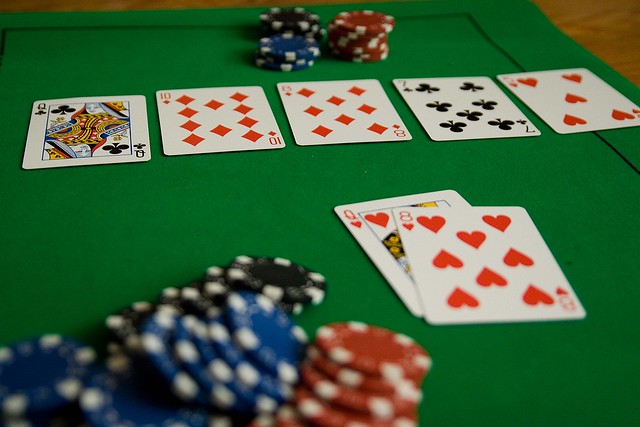
I'm a big fan of the drafting genre, like 7 Wonders, Seasons, Sushi Go!, and Among the Stars. Like the deckbuilding genre, I find it fascinating how an emergent activity from the CCG community could turn into a a full-fledged game genre of its own. I thought I'd try my hand at it today.

One of the fun things about drafting games is the tension of having too many good options, knowing that you'll have to pass some very powerful options to your neighbor. Based on their past choices, you know they're pursuing a particular strategy that will be greatly aided by this one last piece of the puzzle you have in your hand. Alas, nothing to do. You draft your own card and hope to get something better in the next hand.

But what if the game was as much about accurately guessing what your opponent would draft? And if you guess correctly, it would hinder his strategy a bit? Let's try this with a simple poker deck for sake of explanation.

To begin, each player is dealt five playing cards to their hand. The dealer then reveals two cards in the center of the table. The goal of the game is to draft cards in order to make the highest value poker hand, by combining cards drafted with the two community cards. However, there is a twist, described below.

  1. Look at your first hand carefully, but don't draft anything from it.
  2. Pass your hand to the player on your left.
  3. You will get a new hand from the player on your right.
  4. Each player drafts one card from their new hand and places it face-down.
  5. Taking turns, each player guesses which card the neighbor to his left drafted.
  6. Then the player to his left reveals his card.
  7. If the guess was half-right (either suit or rank), the guesser gets two chips.
  8. If the guess was completely right, the guesser gets three chips.
  9. If the guess was wrong, the player to the left gets one chip.
  10. Once all guesses and revelations are complete, hands pass to the left again.


Continue drafting, guessing, and revealing until there is only one card left in-hand. This last card is discarded and notes the end of the game. Each player scores points based on their poker hand.

  • High Card: 1 pts.
  • One Pair: 2 pts.
  • Two Pair: 3 pts.
  • Three of a Kind: 5 pts.
  • Straight: 8 pts.
  • Flush: 13 pts.
  • Full House: 21 pts.
  • Four-of-a-Kind: 34 pts.
  • Straight Flush: 55 pts.

Play two more rounds and then add bonus points from chips. Chips earn points equal to their quantity multiplied by itself. For example:

  • One Chip: 1 pt.
  • Two Chips: 2 pts.
  • Three Chips: 9 pts.
  • Four Chips: 16 pts.
  • Five Chips: 25 pts.

And so on. The player with the most points at the end wins!

I don't know if this is actually a fun game, but it certainly takes an emergent property of card drafting and makes it a mechanic of its own. Now when you know your opponent is going to take a particular card, you can get some benefit from that knowledge, too. What's more, the tension of drafting is even higher since you may end up double-thinking your neighbor. Do you take the card that gives you a straight flush, even though it's the obvious choice? Tense!

Thursday, June 6, 2013

Spheres of Influence: Using Rotation and Orientation as a Capture Mechanic

Senate in agony

In thinking about Triple Triad, one of the benefits of being a digital card game is that it's easy to change a card's color as its ownership changes between players. Obviously this is more fiddly in an analog game, but not impossible.

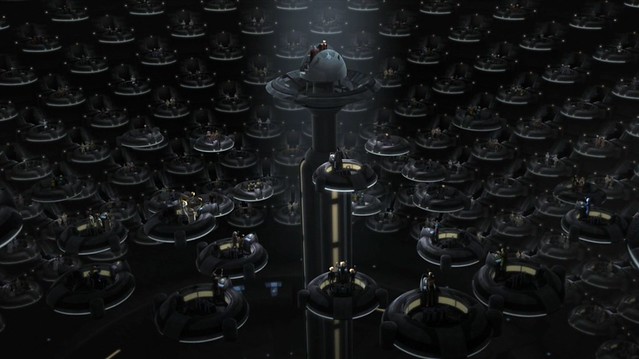
First, let's assume a theme something like the big Galactic Senate scene in Star Wars. Each player is trying to sway dozens of planets to ally with herself. Each planet is represented by cards with four numbers on each cardinal direction, just like a Triple Triad card. But, how to reflect "ownership" of those cards in play while still keeping them on the table?

You could place a coin on each card with one player being head's and another player being tails. For more players, simply use colored stones or poker chips. Unfortunately, this obscures some of the information on the card.

You might instead print double-sided cards, with identical information on each side except for a colored border. But again, the downside is that restricts some of your ability to keep information hidden, which is a great strength of cards in the first place.

Seeking an alternative, I was inspired by the new game Keyflower, which auctions hexagonal tiles in a very clever way. When you bid for a tile, you place your bid along the edge of the tile facing you. This is particularly useful in Keyflower since the meeples you're using to bid may be many different colors, so using the actual sides of the tiles makes each player's bid quite clear.

So perhaps these tiles can show their ownership by being oriented towards one player or another. I imagine tiles or cards with a small arrow pointing at whoever owns them. Here's an example of how it would work.


Spheres1

You place one tile on the table to start the game. Whenever you place a tile, you probably want to it point towards you, but it doesn't have to. As you will see, there may be times it's more advantageous to orient it a different direction.

Spheres2

Your opponent places a tile of his own. He points it towards himself. Whenever a tile is placed adjacent to another tile, check if the newly placed tile has more dots ("influence") along its edge than the adjacent tile's edge. In this case, it does not, so no further action is taken.

Spheres3

You place a new tile and it does have more influence than the opponent's adjacent tile. Because this is the case, your opponent's tile must be rotated so that it points towards you. (As shown below.)

Spheres4

In this manner, players can "capture" each other's tiles without having to actually pick them up. This would be ideal for card-based area control games where cards are often difficult to handle. Instead of picking it up, you'd simply rotate the card in place.

The other benefit, and the one I'm most intrigued by, is that capturing also changes the landscape of influence. Capturing a tile may lead to chain reactions, as stronger faces could suddenly reveal themselves to neighboring tiles. Chain reactions can be difficult to design into an analog game, but this may indeed prove a fruitful line of inquiry. HM!

Monday, May 6, 2013

The Sorting Hat Effect: Avoiding the Hazards of Endgame Scoring

Quest_Fantasy_Exhibit_Opening-3952

I've been playing Ascension on iOS for a few months and in that time I've had a lot of fun... Until the endgame, wherein I discover all my efforts have been in vain as my opponent has doubled or tripled my score. I can deal with consistent loss in a game, but consistently losing when I think I will win is frustrating.

This speaks to the value and purpose of endgame scoring in general, I think. As all modern gamers would recognize, hidden endgame scoring keeps all players engaged until the very end. There's always this chance that you'll beat the odds, because you've had a clever engine building for the whole game. There is a lot of dramatic fun in pulling back the curtain to reveal your grand idea, even if another player ends up beating your score.

When designed well, these endgame mechanics can be learning experiences for players to try again with a slight adjustment to their strategy. However, they can also appear to be black boxes, capriciously deciding a victor after the fact.

I call this the Sorting Hat effect, after the hat who decides the dormitory for each student at Hogwart's regardless of their input. Richard Garfield uses "Randochess" as an example of this phenomenon. In Randochess, players play a full game of Chess, then roll a die. If it results in a 6, the loser of the chess match actually wins the whole game. Why does this suck? The winner of Randochess doesn't feel like they earned it and the loser feels like they were cheated.

Here are some other examples of endgame scoring:

  • A lot of people dislike Carcassonne because the farm scoring is so opaque that they get blind-sided when a more experienced player wins the game thanks to some well-placed farmers. But at least in that case, the information is public, and, more importantly, can be manipulated mid-game.
  • In the case of Lords of Waterdeep, each player gets an endgame bonus for having accomplished tasks in certain categories. That can have very drastic swings in endgame, but they very rarely comprise more than a third of a player's final score, so it still feels like you have control over your fate to some extent.
  • In the case of Seasons, I also lose pretty handily every time, and the endgame score can be almost half of a player's final score. However, there is a lot of fun happening mid-game by building engines, timing actions, and interfering with opponent's engines.

So, this indicates a rule of thumb for myself when I design an endgame scoring mechanic.


  • Visible: The endgame state should be visible to all players, even if it is a little complicated for a newcomer to decipher.
  • Adjustable: The endgame state should be adjustable mid-game, so clear leaders can be recognized and targeted accordingly.
  • Small: The endgame state should comprise about a third of a player's final score. More than that makes the game too swingy, less makes it feel like an afterthought.

I can deal with an endgame score that follows at least two of those three rules of thumb. (ex: If it's too big, I can deal with that because I saw it coming and could have adjusted for it.) Those are my takeaways anyhow. What are yours?

Tuesday, April 23, 2013

Exploring the Math in 9 Lives

Cat and Calculator - Top View

Last week I posted a simple casino-style game called 9 Lives. I noticed some peculiar math behind the mechanics. I bet this is one of those things mathfolk already know intuitively, but coming at it in long-hand on my notebook over a cup of coffee is still worthwhile.

To review, the game involves playing pairs of cards, each showing a digit, either 0 through 9. Added together, the highest pair is the winner for that turn. The winner earns points equal to the 'ones' digit of their play. So if you played a 12 and won, you'd win 2 points. (Tied players both score.)

So I wrote out the different pairs of digits that would make each sum, from 0 through 18. I also compared that to the value of each sum. This produced the following chart. (Click to enlarge.)


There is only one way to make 0, 1, 17, or 18. Two ways to make a 2, 3, 15, or 16. Three ways to make a 4, 5, 13, or 14. Four ways to make a 6, 7, 11, or 12. Five ways to make  8, 9, or 10.

This makes scoring strategy very peculiar indeed. From 0-9 it's easier to make a winning pair and you get more points for each pair up to 9.

Then you fall off a cliff drop at 10. Above 10, value and difficulty have an inverse relationship. It gets harder to make pairs 10-18, the points earned start again from 0, only reaching 8 at a maximum. Is that a bug or a feature? All I can say for now is that it's a prisoner's dilemma.

Everyone knows optimal play is 9. It's the easiest pair to make and worth the most points in the game. You could pursue that, even if it means sharing the top spot with another player. Or you could go for a higher pair, even if it means you will score fewer points. At least that way, only you will score points. But why ever play 10? It beats anything from 0-9, but scores the winner nothing. Spite?

It also makes me wonder if I should add some deeper auction element, to offer some long-term set-building. Of course, that's my usual go-to solution, but it's a place to start.

The highest player earns first dibs from amongst all the cards in play this turn. She collects one and adds it to a private tableau. She is followed by the next highest player, and so on, until each player has collected one card. The remainder are shuffled back to the bottom of the deck. At the end of the game, bonus points are scored for variety and for sets-of-a-kind.

So you still have a consistent, evergreen reason to pursue a high pair above 9. Plus, even if you don't get first pick at the auction, you can at least get some points as compensation.

Wednesday, April 10, 2013

A Reliably Interesting Choice in Game Design: Chaos vs. Order

Eruption lightning

In this panel James Ernest describes what he calls the "crazy train," a risky option always available to the player when the more predictable path seems less enticing. The key word here is option. The crazy train shouldn't be mandatory.

Chaos & Order in Deadwood

James shares an anecdote from the development of Deadwood Studios. Not getting too deep into the rules, but there was once an option to take a difficult tactical path with a high reward, but it required a very high roll in order to complete. So on your turn, you'd roll and maybe you'd get lucky. Unfortunately, if you rolled poorly, you effectively wasted that turn while everyone else moves ahead with their own strategies. In essence, you were stuck on the crazy train.

In the newer edition, you have the option to "rehearse," meaning that you do not roll. Instead you build up a cumulative +1 bonus to your next roll. So you could just rehearse five times until you get a guaranteed success. Or you could just rehearse three times and take your (newly improved) chances. Either way, you get a choice in the matter.

A choice between chaos (in that case, an unmodified d6 roll) and order (a safe, predictable +1 bonus). You can spot variations of this choice in many games. For example, in Ticket to Ride, you may draw two cards, either from the face-up tableau (order) or from the face-down deck (chaos).

Relative Value of Chaos & Order

The value of the orderly or chaotic option is very situational, depending on the current game-state, an individual strategy, and any penalties for taking the wrong path. In my Princess Bride game currently in the lab, the dealer draws one card per player, plus two. (So five cards in a three-player game.)

The dealer then puts two cards face-down and the rest face-up in the center of the table. Each other player gets to draw one card from this tableau for her own collection, then the dealer must draw two from the remaining three cards.

Most of these cards have important resources you're trying to collect, but some also have one, two or three poisons. If you collect over three poisoned cards over the course of play, there are some penalties of varying severity.

Furthermore, the cards collected also determine the drafting order for the next turn and who will be the new dealer, further tempting each player to take a little poison in order to get better position. Thus, the whole game is built on an order vs. chaos choice, the twist is that a player is crafting that choice each turn for the rest of the group.

There is an orderly choice: "I could take one of the visible poisoned cards right now, because there could be far worse poisons in the hidden cards." And there is a chaotic choice: "I would rather not take any poison, and the dealer may have presented the poison card up front as a bluff so he could collect a hidden unpoisoned card when it's his turn to draw."

Choosing whether to be the dealer presents its own dilemma: Order: "I could always go for the first-pick in turn order, which means I'll never be dealer. I'll always get my choice of card, but I'll collect cards at much slower pace." Chaos: "If I'm the dealer, I'll get two cards, but I have less control over my selection. Which cards do I keep hidden, in order to confuse and tempt the other players while I get my own preferred pair of cards?"

Chaos & Order Everywhere?

This isn't to say that all games should have this choice in their core. There are plenty of fun perfect-information games without any chaotic choices (euro games tend to fall in this category). There are also very chaotic games without any orderly choices to be found (simple dice games and party games).

But... If you're ever struggling with where to go with your next game design and you're out of ideas, try adding a choice between order and chaos somewhere in there.

Monday, April 8, 2013

Using Theme to Inform Mechanics in Noodle Roll

Chef Gordon, noodle pulling #2, wavy!

Last week I posted Noodle Roll, which had a lot of clever thematic elements like creating "strands" of identical dice results or employing sous-chefs to compensate for sub-optimal rolls. Where that theme fell down was in the big group board.


Exciting. What the heck is this supposed to be anyway? Mechanically speaking, the board featured columns and rows of spaces in which you were to place cubes. Pairs of horizontally adjacent cubes in the same color-coded area granted you a 10pt bonus. One area had three columns, enough room for two pairs. The middle area had only two columns, room for one pair. The last area had only one column, meaning there was no room for any pairs.

When I came up with this board, I didn't really bother thinking about a thematic reason for its layout at the time. I just liked the clever adjacency mechanic. I hand-waved that these areas represented restaurants with broad or specialized menus. You played workers at a noodle factory delivering shipments of noodles to those restaurants. Yeah, it's about as exciting as it sounds.

This is a problem I have. I take the game's perspective too high up. This tends to make very abstract, impenetrable themes that only die-hard Euro gamers would find interesting (maybe). What's worse is that in the case of Noodle Roll, it didn't even explain the adjacency bonus very well. Time for a revision.


So, in continuing discussions Lyndsay Peters and jcdietrich, it made more sense for the game to focus on one restaurant that served many different noodle dishes, like Noodles & Co. The group board is now a floor plan of that restaurant. Instead of columns and rows, the floorplan is divided into three-seat round tables with place settings for noodles 1, 2, and 3; two-seat booths with place settings for noodles 3 and 4; and one-seat counters with place settings for noodle 5.


Now placing a cube represents serving a diner in the restaurant. The "adjacency bonus" comes from serving the same table multiple times. Now it makes more sense why players would compete to fill those table's orders fast. The adjacency bonus is a tip. With this new board, the "6" could represent the manager, who isn't as efficient as the actual wait staff but can serve any table at any time.

This board could easily have modular effects for each table as well. There are numerous things to do at a restaurant that my evoke some cool mechanical effects.

  • What is the mechanical effect of refilling a diner's water glass? It must be some modest benefit that doesn't interfere with other players, but is always available. Maybe turn order?
  • What is the mechanical effect of appetizers? Maybe it's a type of cube that you can play first, followed by an entree cube, then a dessert cube, but only in that order?
  • What is the mechanical effect of taking dishwashing duties? Maybe it's an ability to ignore one roll, as if starting from a clean slate?

Anyway, this already feels like it's going in a better direction. It's always nice to take some cues from the theme to make the game more accessible and strategically interesting, without making it simulation for simulation's sake.

Tuesday, February 12, 2013

Experimenting with Card Reveal Mechanics

Flip

I've had this post in my Drafts folder for months and never got around to posting it. The weird thing is how much of these ideas filtered into other game ideas in the mean time. So anyhoo, here is some designerly stuff to chew on today.

I'm a big fan of any players simultaneously revealing a secret choice. It creates a nice rhythm to play and keeps all players engaged at the same time. When options are limited, it creates an especially savory deductive tension. I long time ago, I noted a little hack for Rock Paper Scissors that works a little like this.

Multi-player Rock Paper Scissors
Rock: Score 1 per Scissors
Paper: Score 1pt per Rock
Scissors: Score 1pt per Paper.
Track with off-hand. First to 5 wins.

Translating that to a deck of cards would be interesting. Let's assume a generic farming theme for now. I can see some interesting data pulled from some basic ingredients:

  • Cards revealed and discarded. (Events)
  • Cards revealed and kept in a tableau. (Buildings)
  • Cards that interact with Events.
  • Cards that interact with Buildings.

Mixing and matching these ingredients, I can see a small deck of cards building already. Assume each player begins with an identical deck of cards as listed below.

The game lasts three rounds. Each round lasts five turns. At the start of each round, each player randomly draws six cards into her hand.

Each turn, all players choose one card from their hand and place it face down on the table. Then, all players reveal their chosen card and resolve each of their effects.

  • 2x RAIN (Event): Gain 1 pt per RAIN revealed this turn.
  • 2x ORCHARD (Building): Gain one FOOD when a RAIN is revealed. (You can only possess up to three FOOD.)
  • 1x STORAGE (Building): You can possess up to six FOOD.
  • 1x HOUSE (Building): At end of round, score 1pt per FOOD in your possession.
  • 2x TOUR (Event): Gain 1pt per Building in play.
  • 1x THIEVES (Event): Score 1pt per unprotected Building in play.
  • 2x GARRISON (Building): Buildings to the left and right of this card are PROTECTED.
  • 2x QUORUM: (Event): Score 3pts per QUORUM revealed this turn.
  • 1x DEMOLITION (Event): Discard one building in play. It may be yours or an opponent's.
  • 1x JUBILEE (Event): Draw one card from your discard deck back into your hand.
  • 1x COOP (Building): Gain 1pt and one FOOD per turn if this is the only CHICKEN COOP in play. Gain one FOOD per turn thereafter.
  • 1x MARKET (Building): You may discard one FOOD per turn to score 1pt.
  • 1x CAPITOL (Building): Gain 3pts at end of round if you possess CAPITOL.

Of course this basically ends up being a 7 Wonders without the card draft, which isn't nearly as interesting. Just a thought for now.

Sunday, December 30, 2012

2012: A Year in the Game Design Lab

Stone Age dice & meeplesOver the past year, I've posted numerous game ideas in various stages, but all have been considered "in the lab" because they're really not ready for prime time. I just wanted to share my thoughts a bit. Next year I'm ready to actually see some of these ideas come to fruition. Here's a pretty comprehensive list of ideas posted to this blog in 2012.


Games to Prototype and Test
These are games which are to the point where I could make a prototype and actually test at some point.
  • Dung and Dragons/Dragon Ranch has been a long-simmering theme: Hippie co-op farmers raising dragons for their valuable poop. I finally cracked a cool mechanic for this idea, it just needs to get tested and refined. I'm really excited about how these simultaneous actions could interact with each other in unpredictable ways.
  • Wine Collector: This was an experiment in deduction game design. Not sure how well it's actually going to work in practice, but I definitely like the notion of averages being on one side of a card with a single number on the face.
  • Haunted House continued that notion, replacing numbers with shapes. This was inspired by a particular sequence in the latest Mario Party games in which you must repeatedly decide between three doors, only one of which leads to safety.
  • Exodus: Earth wants to be a "worker removal" game, where effects are triggered by removing a meeple off of a space. The eventual goal is to remove all of your meeples from the board before a meteor hits Earth. I just need to figure out the basic mechanics of the thing first.
  • Sidekick Quests: The Card Game came into being when my wife and I visited Lyndsay Peters in Canada. We hacked together elements of Waterdeep, No Thanks and some other stuff to make this hodgepodge of different mechanics. This was eventually streamlined to a much simpler push-your-luck card game that you should see available for beta soon.
  • Pop n' Locke's Last Heist was released as a playtest PDF to Writer's Dice backers early this year, but never saw much testing or discussion. Thankfully Tom Cadorette had a good playtest of it in August. I need to hit the document again to see where things should be tweaked and finally release things thing to the wider public.
  • Proxima-3/3io was ostensibly a board game adaptation of Triple Town. I need to test this set and see how the game feels to play as a multiplayer experience rather than a single-player puzzle.
  • Picker began with some exploration of Libertalia's blind auction mechanics. I still need to figure out how to solve the inherent negative spiral of choices that players have available to them. As it stands, there is still a "correct" choice in every turn. That's not bad, it's just a problem when there is one optimal choice rather than several.
  • Step Right Up is a game about snake oil salesmen hawking their wares on a crowded boardwalk. They sell goods to hire different kinds of goons to do their dirty business. The mechanics feel sound, they just need testing. The theme is unfortunately getting kind of crowded lately, though.
  • Seven Minutes of Terror was inspired by the Mars Curiosity landing and its absurdly complicated landing sequence. I think with some thematic cards and stronger endgame goals, this could be a nice light 10min game.
  • Dead Weight: Parkour vs. Zombies finally got a board game execution this year. It needs testing, but I'm glad I finally put that baby out in the world.
  • The following Thanksgiving, I posted Black Friday, a racing game that was also an auction game. Your position on the race track gave you best pick of items in your space, but you also had to bring back your items to the finish line in order to have the best score without penalties.


Themes in Search of Mechanics
These are game ideas that have a strong theme, but still need mechanical refinement.
  • Swap Clops the Tile Game and Swap Clops the Card Game: I'm really itching to use this fun art that Kari Fry made for me in January. Who doesn't love floating, surly one-eyed monsters? I still think the Clops have potential as a long-term IP.
  • Rulers: This Hunger-Games-meets-Mage idea was one of the rare story games from me over the past few months. This neverseemed to hook folks much, but then again I was lax in my development efforts, too. I'm going to see what I can do to put these out in a more digestible form soon.
  • Towers of Battle was a weird letter tile and area control game idea I posted on February. In hindsight, I must have read about apps like Letterpress and Puzzlejuice when I came up with this thing.
  • Vulture Capitalist/Bird Brands was inspired by No Thanks, Amun-Re, and Empryean, Inc.  I still occasionally get some mechanical ideas that could fit in this silly theme.
  • Dr. Remedy Grove: I had thoughts about this as a game franchise, each entry focusing on ecological themes and components made from sustainable materials. Kind of a Carmen San Diego for ecology.
  • Monks of St. Honorat honor their vow of charity in an interesting way: They earn lots and lots of money from their world-famous wine, then donate it all to their various charities. "Earn more to give more" is an interesting take on Brewster's Millions.
  • Where is the Poison? is inspired by the poison scene in Princess Bride. These mechanics seem good enough, but they could be much more streamlined. I imagine that this could be even as minimal as Seiji Kenai's Love Letter, but it just needs some more attention.
  • The Everywheres was a dimension-hopping game based on the CC-licensed superhero Jenny Everywhere. I really want to explore this game further with a mashup of Split Decision, Talk Find Make, and Thanks and Complaints (below).
  • Thanks and Complaints as a replacement for the typical success/failure binary in role-playing games. It brought to mind much different reactions to typical adventure game violence.
  • This City-Building Tile game is has a reasonable theme already, but I think some more thematic tiles would do wonders to make the game more strategic, too.
  • Asteroid Mining is a pretty cool idea to me and I think I'm close to a good mechanic here. I need to decide what it is you do with the materials you're mining, though. May also need a smaller asteroid belt/card deck.


Mechanics in Search of a Theme
This is by far the biggest category in the lab. These are mechanics that as yet haven't found a good theme with which to be paired.
  • Dice Pool Action-Selection Mechanic: This was posted right after I played Yspahan and saw its very clever dice mechanic in action. I wanted to capture something similar as an action selection device.
  • Dice-matching resource management: I must have been on a dice kick last spring, because here's another dice pool based resource acquisition mechanic. No idea where this one will go, but at the time I imagined it as a game based on Maslow's Hierarchy.
  • Dice Puzzle was eventually cracked by my mathematically inclined friends, but it was a cute diversion. I may revisit the basic interaction again at some point. 
  • 3-2-1 had you roll three dice, keep two results, then give one result to the next player. It brought to mind a lot of co-op potential. Will tinker with this eventually.
  • Legacying was a popular subject last year. I even wrote three best practices for how to do it well, which got noticed by designer Rob Daviau. I look forward to seeing how others use the Risk: Legacy mechanics to design brand new games.
  • Secret Action Selection + Public Negotiation was one of the many mechanics I explored for Dung & Dragons last year. It turned out to have a critical hurdle: If you're co-operating, why keep action selection secret? I never revisited this idea long enough to answer that question, but I should.
  • Player-Controlled Resource Values struck my fancy as I explored stock market themes. In this case, buying and selling a commodity raised or lowered its value on an abstract tracker. The price you pay now influenced the price you'd pay later.
  • Memory + Action Selection was another one of those mashup ideas that never got explored too deeply. It may still have something worthwhile as a kids' game with some additional strategy for adults. Basically, if you found two matching tiles, you could do the action noted on those tiles. Thus, you're not just memorizing placement, but pursuing specific tactics.
  • Multi-Memory: I also explored multi-dimensional memory mechanics in this abstract card game, but it might be too dry a brain burner for the MENSA Select judges.
  • Vases, Crates and Barrels broke down the rarity and distribution of the Yspahan game board into a single deck of cards. I still need to suss out how best to use this information, but it's powerful mojo.
  • Then there was this Yspahan+Knizia+Cosmic Encounter mashup where you negotiated trades for certain goods with the other players. Ultra minimal, but with emergent behavior. (At least, that's the hope.)
  • Chibi Sweeper was a tabletop mashup of Minesweeper and Chibi Robo. Not sure where this one is really going, but once again, I like the idea of knowing half-information, then deciding whether to commit to the second half.
  • Recycling Decks is basically a typical deckbuilder, except your discarded cards go to your opponent. It really needed a strong theme to make that make sense, though.
  • Make Me an Offer was the first in a series of little ideas where I tried to take the basic interaction of games like Apples 2 Apples and Cards Against Humanity into the realm of a Euro board games. Not sure how successful it is without a better theme though. In hindsight, this might be a strong game with a deck of Sushi Go cards. Which led to...
  • A Co-Op/Competitive trading game that could theoretically work as a system for For The Fleet. It just needs more redshirts.
  • I had a handful of trick-taking mechanics this year, but this was the most polished. It just needs a good theme to justify and explain the mechanics.
  • And finally, this worker-placement spillover mechanic was an interesting idea that sparked a lot of discussion for themes. Scientific progress perhaps?
Phew! 2012 was a prolific year for half-assed ideas. That's being generous, most of these are quarter-assed at best. Goal for next year? Add the rest of the ass. Yes.

    Thursday, December 13, 2012

    Riverbanks: An Example of My Game Design Process [In the Lab]


    Folks ask me all the time where I get game ideas, whether it's mechanics first or theme first. Sometimes it's a little of both, as we'll see here.

    One of my favorite recent mechanics comes from Doug Bass' Garden Dice. In that game you roll four dice to plant crops on a 6x6 gridded plot of land. The dice tell you the coordinates of where you may plant. You can do other actions based on the remaining two dice results. Choosing which dice to use in which capacity is a big part of the long-term strategy.

    So I spent yesterday thinking a few ways to use this basic skeleton for other purposes, the first of which is a dice-based resource acquisition game. This begins without a theme, but in exploring the mechanics, we start to see how a theme naturally emerges.

    6x6Grid-A-1

    Play centers on a 6x6 grid from which you can acquire resources: A, B, C, D, E, and F. The intersections of each row and column show combinations of two resources and double-resources along the diagonal from top left to bottom right.

    On your turn, you roll three dice and choose two of those results to be the coordinates from which you will acquire the noted resources. The third die shows how many of those resources you will acquire.

    For example, you rolled 2 5 4. You chose to harvest from 2/5, which means you get 4 of resources E and B. If you rolled 4 4 3, you could choose to harvest from 4/4 where there are two Ds. This means you acquire resource D at twice the rate as normal. So, instead of just 3 Ds, you acquire 6.

    But towards what end? I'm not sure. Perhaps you are trying to purchase advancements that require a specific recipe of resources, Waterdeep-style? Whatever the case, there are interesting permutations in this system.

    6x6Grid-A-2

    1/1's resources can be a little more common than 6/6's resources. The likelihood of rolling 1 1 1 and 6 6 6 are equal. However, a roll of two matching numbers and a non-matching number is much more common. Thus, on a roll of 1 1, it is much more likely that the third result will be greater than 1. Conversely, on a roll of 6 6, it is much more likely that the third result will be less than 6.

    Granted, it's a small statistical difference. (EDIT: And, as Levi Middleton points out, D ends up being the more rare resource.)

    This still gives me some sense of structure for a theme. Perhaps the A resource is a common ingredient in the game's recipes whereas the F resource is something more rare but valuable, like straight victory points or perhaps wild resources that can be used as placeholders for other resources.

    The other interesting facet of this system is that each combination of resources has a twin on the opposite side of the board. 5/3 gives the same stuff as 3/5. So, perhaps there is room for adding another type of resource to acquire, based on which side of the diagonal you choose.

    6x6Grid-A-3

    Indeed, this comes to resemble the banks of a river. The river itself is abundant and fruitful. Its banks are blessed with useful combinations of resources while the far corners are dry prairies and deserts with less useful combinations of resources.

    When you acquire resources from a space, so you also lay claim to it. In choosing a space that is occupied by another player, they may ask for a "tax" to give you permission to use that space.

    Thus, our old friend the area control mechanic plays a significant part in this game. Those recipes I mentioned earlier? Those may be used to purchase advanced settlements that levee taxes on neighboring spaces; or award points to occupants of neighboring spaces; or renders a space unusable thereafter. Who knows?

    Anyhoo, this is how my game design process usually begins. I'll notice a curious wrinkle of probability that makes a decent metaphor for a real-world phenomenon. Of course, it's usually at this point that someone will point out a game that has already covered similar territory, usually designed by Reiner Knizia!

    But I hope that documenting my thought process is at least somewhat enlightening. Because geez, I just love designing games.