Showing posts with label card game. Show all posts

Wednesday, August 14, 2013

Puppy Pile: A Card Game about Puppies and Treats


Every time I play Reiner Knizia's Poison, I want to hack it into something a little more robust. But then I realize I'd probably be re-inventing Paul Peterson's Smash Up. Surely there is a middle ground somewhere between the two extremes. After all, the Hearts family of evasion trick-taking games is vast and old, so I bet we could come up with something a little gamery while still keeping it approachable. Here's a first attempt at it.

So the big thing with Poison is that you're trying to have the lowest score after a series of rounds. There are three cauldrons into which you're dropping potions and poisons. If you force the sum in a cauldron to exceed 13, you must take the cards currently in the cauldron and replace them with your new card. In the end of the round, you score 1 point per potion in your possession, 2 points per poison. You score no points for a specific type of potion if you possess the most of that potion, so you might try to "shoot the moon" once you're committed to a particular potion.

Smash Up is much more complicated, but the core of it is relatively similar. Instead of cauldrons, there are bases in which you drop minions. When the sum of Minion ranks exceeds the base's Defense rank, then the base is broken and anyone who has minions scores points as determined by that base. There are additional player-based effects by playing certain minions in certain bases, plus the bases themselves have special effects when they're broken. All this adds up to a very approachable, but distinctly gamer-oriented game.

I'm trying to figure out how we can add more depth to Poison without going so far as to make variable player powers. We can add persistent effects from round-to-round, which would make this a bit more strategic though.


PUPPY PILE
A Trick-Taking Game for 2-6 Players
This game is about piles of puppies chomping on dog treats. It has a deck of cards showing puppies in various breeds and quantities. Each card also shows a number of dog treats.


SETUP
Shuffle the whole deck and deal it all to each player. It's okay if this makes uneven hands. The youngest player takes the first turn in the first round. In each round thereafter, the first player role passes to the left.


PLAY
On your turn, take a card from your hand and place it in the middle of the table, starting or adding to the puppy pile.
  • If the sum of puppies is thus greater than the sum of treats, you take all the cards that were in the pile and replace it with the card you just played. Keep collected cards face down in front of you.

In the example above, you played 2 Malamutes, which puts the sum of puppies at 7, which is greater than the sum of treats. You take the three cards already in the pile and replace them with the card you just played.


END OF ROUND
The round ends when all players hands are empty. Any puppies left in the pile are not collected by anyone.

Count how many of each breed you've collected. You score points equal to the fewest of a breed you've taken.

So in the example above, you score 1 point because the lowest quantity of a breed you have is 1 Labrador.

Make a note of the breed(s) you scored this round, because you'll get a breed bonus for collecting that breed in future rounds.


BREED BONUS
If you score a breed that you've collected in the past, you'll score the following bonus points.

Scored Once Before: Score x2 Points Now
Scored Twice Before: Score x3 Points Now
Scored Four Times Before: Score x4 Points Now
Scored Five Times Before: Score x5 Points Now


END OF GAME
The game lasts for one round per player. The player with the most points wins!

Tuesday, July 2, 2013

Russian Nesting Doll Card Game

Indian nesting dolls

Ever get one of those ideas where you know how it ends, but you're not sure how it begins? Well, in continuing my exploration of triangular and square scoring, I've got that going on with this idea for a run-building card game themed around Russian nesting dolls. By "run-building," I mean a game in which you may play a card from your hand as long as it is a higher rank than the last card you played.

The deck's cards would be divided into several suits, each depicting a unique motif for a doll. Within a suit, cards would be ranked in sequential order. "1" would represent the smallest doll, with each higher rank increasing the size of the doll. There would be two cards of each combination of suit and rank, one card depicting the top of a doll and the other card depicting the bottom of the doll.

In play, you'd be trying to assemble as complete and well-matched set of dolls as possible within a time limit. You're trying to build two runs at once. One run represents the top of your doll set and the other represents the bottom of your doll set.

At the end of the game, you review your set of dolls and score along a Linear, Triangular, and Square sequence, based on matching suits within in the run and matching suits and ranks between the two runs as noted below.

  • You score the sum of all ranks in your collection.
  • If you have two of the same suit within a run, score 6 points. Three of the same suit, earn 10 points. Four earns 15 points. Five earns 21. Six earns 28.
  • If you have one matched pair (top and bottom), earn 4 points. Two pairs earn 16 points. Three earns 25 points. Four earns 36 points. Five earns 49 points. Six earns 64 points.


In other words, you score points equal to the sum of ranks in your run, triangular bonuses for matching suits within a run, and square bonuses for matching pairs between two runs. At the moment, the scoring seems pretty evenly weighted towards the linear bonus since it's least restrictive on its scoring condition. I wonder if I should change those to be alphabetical ranks, only awarding actual points for the upper echelons of the ranks, perhaps noted by stars.

Either way, the next step in development would be to figure out how players actually acquire these cards. Auction? Drafting? Trades? Not sure. The scoring mechanic is complicated enough that I'd want to keep the rest of the game very streamlined and simple, but it would be great if there were at least some simple trading going on, too. How about something like Jaipur?

On your turn, you can either take cards from a central public tableau or play cards from your hand into your set.

  • If you take, you may take one card for free, which is then replaced by a random card from the deck.  If you take more than one, you must replace the taken cards with an equal number from your hand.
  • If you play, the cards you play must be in sequential order. In other words, each card played must be of a higher rank than the preceding card played. To play a card, you must also discard a card from your hand. So you're not just trying to build up your run, you're also trying to build up "funds" for your run.

I'm still not sure what the endgame condition would be. When all players have played at least ten cards? That means everyone might have an incomplete run and rushing the endgame might be a viable strategy. Hm. That might work! Perhaps it's time to hit the table with this soon.

Friday, June 14, 2013

Drafting Deduction: Making New Games Out of Emergent Behavior

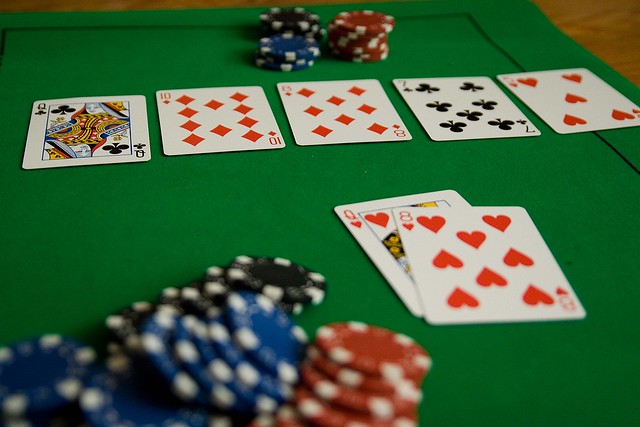
Poker

I'm a big fan of the drafting genre, like 7 Wonders, Seasons, Sushi Go!, and Among the Stars. Like the deckbuilding genre, I find it fascinating how an emergent activity from the CCG community could turn into a a full-fledged game genre of its own. I thought I'd try my hand at it today.

One of the fun things about drafting games is the tension of having too many good options, knowing that you'll have to pass some very powerful options to your neighbor. Based on their past choices, you know they're pursuing a particular strategy that will be greatly aided by this one last piece of the puzzle you have in your hand. Alas, nothing to do. You draft your own card and hope to get something better in the next hand.

But what if the game was as much about accurately guessing what your opponent would draft? And if you guess correctly, it would hinder his strategy a bit? Let's try this with a simple poker deck for sake of explanation.

To begin, each player is dealt five playing cards to their hand. The dealer then reveals two cards in the center of the table. The goal of the game is to draft cards in order to make the highest value poker hand, by combining cards drafted with the two community cards. However, there is a twist, described below.

  1. Look at your first hand carefully, but don't draft anything from it.
  2. Pass your hand to the player on your left.
  3. You will get a new hand from the player on your right.
  4. Each player drafts one card from their new hand and places it face-down.
  5. Taking turns, each player guesses which card the neighbor to his left drafted.
  6. Then the player to his left reveals his card.
  7. If the guess was half-right (either suit or rank), the guesser gets two chips.
  8. If the guess was completely right, the guesser gets three chips.
  9. If the guess was wrong, the player to the left gets one chip.
  10. Once all guesses and revelations are complete, hands pass to the left again.


Continue drafting, guessing, and revealing until there is only one card left in-hand. This last card is discarded and notes the end of the game. Each player scores points based on their poker hand.

  • High Card: 1 pts.
  • One Pair: 2 pts.
  • Two Pair: 3 pts.
  • Three of a Kind: 5 pts.
  • Straight: 8 pts.
  • Flush: 13 pts.
  • Full House: 21 pts.
  • Four-of-a-Kind: 34 pts.
  • Straight Flush: 55 pts.

Play two more rounds and then add bonus points from chips. Chips earn points equal to their quantity multiplied by itself. For example:

  • One Chip: 1 pt.
  • Two Chips: 2 pts.
  • Three Chips: 9 pts.
  • Four Chips: 16 pts.
  • Five Chips: 25 pts.

And so on. The player with the most points at the end wins!

I don't know if this is actually a fun game, but it certainly takes an emergent property of card drafting and makes it a mechanic of its own. Now when you know your opponent is going to take a particular card, you can get some benefit from that knowledge, too. What's more, the tension of drafting is even higher since you may end up double-thinking your neighbor. Do you take the card that gives you a straight flush, even though it's the obvious choice? Tense!

Wednesday, June 12, 2013

9 Lives Card Game - Prototype B

9-Lives-Title-Logo
Here's a new family card game I've been tinkering with over the past few months. You may recall some previous posts on the subject here and here. Well, with a bit of streamlining for the rules and a few tweaks here and there, I've managed design what I hope is a fun, fast, light strategy game that plays well with two to nine players. Yep, nine.

The premise of the game is that nine house cats have escaped. It's your job to bring them back home. The challenge is bringing them home while also making sure they're happy as possible with they return. Sometimes it's hard to do both! You know how cats are.

Players bid for cards, each featuring one of the nine cats. You're trying to claim the majority of the cards featuring a specific cat, thus allowing you to score points from that cat. However, not all cards are worth points, so simply winning a majority of those cards won't guarantee the best score.

This plus a little Baccarat-style mid-game scoring amounts to a light, tactical mini auction. Hope you enjoy! Please feel free to share your feedback.

» Download Prototype B

Friday, June 7, 2013

Bills: Public and Private Victory Point Conditions in "Spheres of Influence"


I'm still thinking about this card-turning Triple Triad-inspired game about lobbying an alien senate. This time, I'm thinking about some victory conditions outside of simply turning as many senators to your direction as possible. That in itself may earn you some points, but I would like to introduce a simple mission system in the spirit of Ticket to Ride or Takenoko.

Assume the game begins with an arrangement of senators on the table already. Each player is dealt a hand of five senators to play one round. The senators have various personal interests several issues, including logistics, military, culture, science, exploration, plus whatever caucus to which they identify. These would be represented by icons on their card.

At the start of the game, players also get a certain number of "Bills" that they're trying to pass through the senate. Normally, after each round, each player collects any senators pointing in his or her direction. This is the mainstream way to earn points. However, at any point during the course of the game, players may redeem Bills for which they are qualified. These are based on the game state, generally which senators are pointing in any particular direction. Here are some examples:

  • Make First Contact with Ancient Artifact: Each trio of Science, Military, and Exploration pointing your direction.
  • Explode Planet for Highway Construction: Each trio of Logistics senators pointing your direction.
  • Vote of No Confidence against Solar Federation: No Solar Federation senators pointing your direction.
  • Pledge of Impractical Idealism: No senators pointing in your direction.
  • Campaign for Speaker Seat: At least one senator of each Caucus pointing in your direction.
You have to get the card arrangement just right. Even if it's another player's turn, as long as the senators are arranged correctly, you can redeem your bill and earn those points. I would imagine this keeps all player's engaged with the board throughout the game, as they try to watch each chain reaction like a hawk.

Furthermore, I think some Bills ought to be public and out on the table, so all players are eligible to redeem them. This might divert attention in too many directions, but it's worth exploring.

Thursday, June 6, 2013

Spheres of Influence: Using Rotation and Orientation as a Capture Mechanic

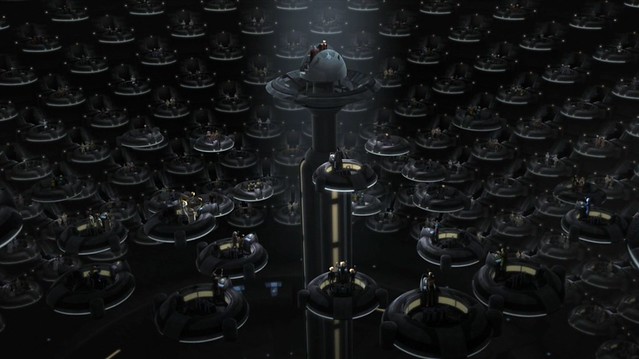
Senate in agony

In thinking about Triple Triad, one of the benefits of being a digital card game is that it's easy to change a card's color as its ownership changes between players. Obviously this is more fiddly in an analog game, but not impossible.

First, let's assume a theme something like the big Galactic Senate scene in Star Wars. Each player is trying to sway dozens of planets to ally with herself. Each planet is represented by cards with four numbers on each cardinal direction, just like a Triple Triad card. But, how to reflect "ownership" of those cards in play while still keeping them on the table?

You could place a coin on each card with one player being head's and another player being tails. For more players, simply use colored stones or poker chips. Unfortunately, this obscures some of the information on the card.

You might instead print double-sided cards, with identical information on each side except for a colored border. But again, the downside is that restricts some of your ability to keep information hidden, which is a great strength of cards in the first place.

Seeking an alternative, I was inspired by the new game Keyflower, which auctions hexagonal tiles in a very clever way. When you bid for a tile, you place your bid along the edge of the tile facing you. This is particularly useful in Keyflower since the meeples you're using to bid may be many different colors, so using the actual sides of the tiles makes each player's bid quite clear.

So perhaps these tiles can show their ownership by being oriented towards one player or another. I imagine tiles or cards with a small arrow pointing at whoever owns them. Here's an example of how it would work.


Spheres1

You place one tile on the table to start the game. Whenever you place a tile, you probably want to it point towards you, but it doesn't have to. As you will see, there may be times it's more advantageous to orient it a different direction.

Spheres2

Your opponent places a tile of his own. He points it towards himself. Whenever a tile is placed adjacent to another tile, check if the newly placed tile has more dots ("influence") along its edge than the adjacent tile's edge. In this case, it does not, so no further action is taken.

Spheres3

You place a new tile and it does have more influence than the opponent's adjacent tile. Because this is the case, your opponent's tile must be rotated so that it points towards you. (As shown below.)

Spheres4

In this manner, players can "capture" each other's tiles without having to actually pick them up. This would be ideal for card-based area control games where cards are often difficult to handle. Instead of picking it up, you'd simply rotate the card in place.

The other benefit, and the one I'm most intrigued by, is that capturing also changes the landscape of influence. Capturing a tile may lead to chain reactions, as stronger faces could suddenly reveal themselves to neighboring tiles. Chain reactions can be difficult to design into an analog game, but this may indeed prove a fruitful line of inquiry. HM!

Wednesday, May 22, 2013

This Complete Breakfast: A cereal themed card auction game [In the Lab]

i eat my sugar cereal but it makes my teeth bacterial

Fred and I are still playing Pitch Tag and this little idea came up that was too much fun not to share on its own. This has that combination of casual strategy and fun art direction potential that seems to be my sweet spot. Sweet. Heh.

Here's a very rough overview of how it would play.

Each player has a hand of Cereal cards featuring various fictional brands. (Sugar Shock. Fiber Blast. Etc.) Each card has nutritional information noting the vitamins and calories available from the featured cereal. (Each card is uniquely numbered, maybe?) To set up, each player is dealt a hand of three cards. Simultaneously, each player reveals one card from her hand and places it face-up in front of herself as a "serving" to the other players.

Thereafter, play is as follows: Each player reveals one card from her hand and places it face-up in front of her as a *second* serving. Each player only has room for two servings, so if there is ever more than two after this reveal, the oldest serving becomes "soggy" and must be discarded.

Whoever played the card with the most calories takes first turn. She may take one of another player's face-up cards or a card from the top of the deck. Then she may place it in her private collection, or into her hand, or discard it to make a space for a *third* serving in an opponent's tableau. (In other words, there are six possible moves in your turn.) (There cannot be more than three servings per player.)

Whoever played the next highest calorie cereal gets next turn, and so on, until all have had a turn. Any remaining face-up cards are discarded.

The game ends when the deck runs out. At the end of the game, check who has the most of each vitamin in his collection. (Ties are okay.) The scoring player wins the sum of calories from cereals with that vitamin in his collection. No other vitamins are scored.

Thus, you're trying to win dominance over one or two suits, but in vying for first pick, you potentially serve a high value card to the other players. Going second or third gives you opportunity to take more calories, but they may not be of a vitamin you actually want. Throughout this, you're also trying not to run out of cards in your hand, so you periodically need a "breather" round to replenish your supply.

Sunday, May 19, 2013

Koi Pond version 1.3, plus plans for Koi Pond: Moon Village!


I'm back from Toronto! Lots of stuff to share, but first I'm updating the rulebook for Koi Pond on the DriveThruCards page. I've also sent along this message of thanks to those who have picked up the game so far.

-----

Hello Koi Pond Players!

First, thanks so much for picking up this first game from Smart Play Games. I hope you've had a chance to play and enjoy it with your friends and family. With luck and spirit, this will be the first of many clever little card games to be released on DriveThruCards.

One of the great things about releasing games through DTC is that I can respond to your questions by updating the live rulebook. Version 1.3 answers two main questions that were left a little ambiguous in 1.2.

Q: If multiple players have hybrids in their rivers, who decides their hybrids' suits first?
A: This can be a tricky situation if an opponent has a turtle that could score from one of your hybrids, depending on which suit you decide. This is a somewhat rare occurence, but can happen often enough that a turn order system ought to be established. So here it is: The start player decides the suit for his earliest hybrid first, continuing clockwise until all players have decided the suits for all their hybrids, one at a time.
Q: Should the lake be a separate deck? Is there a "top" of the lake?
A: This was left far too vague in the last rulebook. To be clear, the lake is meant to be an undifferentiated loose pile of cards comprised of the previous round's river cards. There is not "top." All lake cards are accessible to the active player during their draw phase. I've revised the setup diagram on page 1 to more clearly show this pile of cards.

These notes are now incorporated into the main rulebook.

In addition, I've added a print-and-fold tuckbox for your Koi Pond cards. It's sized to fit your complete deck, plus extra space if you want to sleeve your cards. Hope you dig it! Thanks again.

Lastly, I'm testing some bits for Koi Pond: Moon Village, an expansion that would add a fifth player, add new "Villager" cards that score if they're in your house at the end of the round, and add a new Ribbon type: Challenges. They'd all be formatted as bonuses for winning a round on certain conditions:

    •    "Win a round scoring koi in all four suits."
    •    "Win a round without using a cat, crane or turtle."
    •    "Win a round scoring koi of only one suit."
    •    "Win a round scoring only scoring with a cat, crane or turtle."
    •    "Win a round with the most Koi of X suit in your house."
    •    "Win a round without drawing cards from the lake."

These are still very early in their development, but intended to be pretty modular. So if you like Challenges but not the Villagers, you can use them independently of each other.

Thanks again for your support! Please share your reviews and comments with me directly at gobi81[at]gmail[dot]com or on the official Koi Pond BoardGameGeek page!

Yours,

Daniel

-----

P.S. If you're having trouble downloading the 1.3 rulebook from DriveThruCards, you can also get it here.

Friday, May 10, 2013

Rank these cats for 9 Lives!

CatRanking

You've heard me talk about my card game 9 Lives a bit already. Well, I've been fortunate enough with Koi Pond's success on DriveThruCards to have enough in my budget to order art from an actual professional rather than doing it myself. Above you can see the nine cats drawn by Kristina Stipetic, each with its own personality. Now I just need to decide, how will they be ranked?

The game's cat theme is fairly loose to begin with, so the numbers 1 through 9 don't really mean much mechanically. Though I suppose you could look at the math and say that 1s will be least likely to come into play while 9s are most likely. Note that it is not a measure of actual rarity in the deck, just how useful they are in play.

All things being equal, I figured I'd open it up to the public. So, now taking your recommendations for how to rank the cats above from 1 through 9. Feel free to use whatever logic you wish. Age? Mood? Energy level? Take your pick!

Monday, April 29, 2013

Koi Pond is the Hot Seller on DriveThruCards!

KOI POND on DriveThruCards

I'm happy to announce that DriveThruCards is officially launching today and KOI POND is already the top seller. DriveThruCards is a print-on-demand store devoted exclusively to card games and that's it. DTC's just-the-cards focus means they can provide the best-quality print-on-demand cards you've ever handled. You'll really be surprised at how nice they are.

KOI POND is a fast, brainy, casual strategy game. Collect colorful koi fish and place them in your pond or your house. Keep your pond and house totals as equal as you can, because you only score points for the lower total! What’s more, your pond is public, but your house is secret. To win, you have to be... coy!

What's it like?
This is a quiet, fast filler game best paired with warm drinks amongst friends. Mix the elegant presentation of Coloretto with the fun decision-making of Biblios. Mix in clever scoring and garnish with lovely sumi-e inspired artwork.

Details:

2-4 Players | 20 Minutes | Ages 10+

Quality:

This game uses DriveThruCard's thickest, highest quality, Premium card stock. They feel great!

Includes:
60 Koi cards in red, blue, yellow or white, plus hybrids.

12 Cat, Turtle, Crane cards, one of each in each color.

12 Ribbon cards, three of each in each color.

4 Reference cards for ease of play.

1 Start Player card.

Buy it today!

Tuesday, April 23, 2013

Exploring the Math in 9 Lives

Cat and Calculator - Top View

Last week I posted a simple casino-style game called 9 Lives. I noticed some peculiar math behind the mechanics. I bet this is one of those things mathfolk already know intuitively, but coming at it in long-hand on my notebook over a cup of coffee is still worthwhile.

To review, the game involves playing pairs of cards, each showing a digit, either 0 through 9. Added together, the highest pair is the winner for that turn. The winner earns points equal to the 'ones' digit of their play. So if you played a 12 and won, you'd win 2 points. (Tied players both score.)

So I wrote out the different pairs of digits that would make each sum, from 0 through 18. I also compared that to the value of each sum. This produced the following chart. (Click to enlarge.)


There is only one way to make 0, 1, 17, or 18. Two ways to make a 2, 3, 15, or 16. Three ways to make a 4, 5, 13, or 14. Four ways to make a 6, 7, 11, or 12. Five ways to make  8, 9, or 10.

This makes scoring strategy very peculiar indeed. From 0-9 it's easier to make a winning pair and you get more points for each pair up to 9.

Then you fall off a cliff drop at 10. Above 10, value and difficulty have an inverse relationship. It gets harder to make pairs 10-18, the points earned start again from 0, only reaching 8 at a maximum. Is that a bug or a feature? All I can say for now is that it's a prisoner's dilemma.

Everyone knows optimal play is 9. It's the easiest pair to make and worth the most points in the game. You could pursue that, even if it means sharing the top spot with another player. Or you could go for a higher pair, even if it means you will score fewer points. At least that way, only you will score points. But why ever play 10? It beats anything from 0-9, but scores the winner nothing. Spite?

It also makes me wonder if I should add some deeper auction element, to offer some long-term set-building. Of course, that's my usual go-to solution, but it's a place to start.

The highest player earns first dibs from amongst all the cards in play this turn. She collects one and adds it to a private tableau. She is followed by the next highest player, and so on, until each player has collected one card. The remainder are shuffled back to the bottom of the deck. At the end of the game, bonus points are scored for variety and for sets-of-a-kind.

So you still have a consistent, evergreen reason to pursue a high pair above 9. Plus, even if you don't get first pick at the auction, you can at least get some points as compensation.

Monday, April 15, 2013

9 Lives: A Game for up to 9 Players. Maybe. [In the Lab]


This will be one of those loose ideas that likely has a bunch of inherent bugs right off the top, but it's too big for Twitter so I'll note it down here for future reference. The basic idea is inspired by 7 Wonders' unique niche as a game with enough depth for gamers to enjoy it, but accommodates group sizes that would normally fall into the domain of party games. It's rare to find that combination.

Of course I wanted to make one.

I thought about other mechanics and games that might fit this unique niche of group size but adequate depth. Auctions (Felix), voting (The Resistance), card drafting (7 Wonders), simultaneous action selection (Race for the Galaxy), trading (Bohnanza) all help facilitate fun, rich play with large groups. In researching further, I found a write-up on Baccarat, which I must admit I've never looked at much. It has two interesting features. (Interesting to me anyway.)

  • Baccarat can take up to 9 players, crowding around a casino table.
  • Hands are valued according to the "ones" digit of the sum of their cards. A hand of 2 and 3 is worth 5, but a 6 and 7 is worth 3 (the "ones" digit of the total is 13). Thus the highest value of a hand is 9.

Nine... Nine... Maybe this hypothetical game could be a reference to a cat's "9 lives." A loose theme, to be sure, but perhaps enough to inform the artwork and make it appealing to a broader audience. I can see a deck of cards being ranked 1 through 9, each featuring one through nine 1950s mod-style cat illustrations within or around a large numeral. I'm imagining specifically Ale Giorgini's art style, seen above. Anyway, here are my extremely loose notes on how this game would actually play.

Art by Jane Foster


9 LIVES

The deck is comprised of nine suits themed around things cats like, such as mice, fish, yarnballs, etc. Each suit has cards ranking from 1 to 9, featuring one to nine cats. In addition, there are also nine Dog cards ranked "zero", without suits. So 90 cards in the deck total.

SETUP
To set up, each player is dealt a dog card. Then each player is dealt six more cards from the rest of the deck. This is her starting hand. Each player chooses two cards to set aside into her sideboard.

PLAY
Each turn proceeds in two phases. In the first phase, each player plays one card face down in front of herself until all players have made their choices. Then all players reveal their choices at the same time. In the second phase, this is done once more, again choosing one card and revealing it at the same time. This results in a pair of face-up cards in front of each player. The turn will result in either a BUST or a SCORE on the following conditions.

BUST
If there are one, three, five, seven or nine dogs revealed, the turn is a bust and no points are scored and the turn is over. If there are two, four, six, or eight dogs, they cancel each other out and are ignored and you may proceed to scoring.

SCORE
Note the following, depending on the size of the group.
  • 2-3 players: Anyone who played the highest sum. (1st place)
  • 4-6 players: Anyone who played the highest (1st place) and second-highest (2nd place) sums.
  • 7-9 players: Anyone who played the highest (1st place), second-highest (2nd place), and third-highest (3rd place) sums.
Any 1st place players earn points equal to the "ones" digit of their paired sum. For example, if you were in first place with a sum of 13, you would score 3 points.

Any 2nd place players earn one point less than the 1st place player, to a minimum of 1 point.

Any 3rd place players earn one point less than the 2nd place players, to a minimum of 1 point.

AFTER EACH TURN...
Shuffle any played cards and place them in the bottom of the deck. Keep remaining cards in-hand. Each player replenishes her hand from her sideboard or from the deck. All sideboards are replenished from the deck. Play continues for an agreed-upon number of turns.

GOAL
The player with the most points at the end of the game wins.


A few interesting notes on this whole notion.

  • Playing a high pair gives you better chance for victory, but doesn't necessarily net you the most points.
  • The best possible pair is 18, which is the highest pair and earns the most points.
  • The average pair's sum will be 9.5, but only just barely passing that mark doesn't earn the best points. You're best option is to either vastly surpass that point or bide your time with a throwaway pair.

All this is hypothetical until it gets tested though. I'll add that to the pile of untested game ideas I've got sitting around the house.

Friday, April 12, 2013

Art Preview of Koi Pond: A Coy Card Game

KoiPond-Header-2

UPDATE: Koi Pond: A Coy Card Game is now available on DriveThruCards!

This week, I got a very good reason to hurry up and get the Koi Pond cards finalized ASAP. So the past two days have been very busy, implementing playtest-requested updates that have built up over the past couple months' testing. The game should be available for sale later this month!


  • Frames: I revised the face's backgrounds to not be full-bleed anymore. Each suit has a distinct corner decoration and background pattern. It's subtle, but I figured it couldn't hurt to have one more distinguishing mark for each suit to aid recognition.
  • Ambidextrous Layout: I've also placed suits and ranks on the left upper corner and the right upper corner instead of placing them on alternate corners. This makes it easier for people who prefer to fan their cards left or right. I was going to put suits and ranks on all corners, but it became really cluttered.
  • Increased Contrast: The frames also create the best contrast for easy recognition of suits and ranks. They were perfectly readable on the paper texture of earlier prototypes, but nothing beats black-on-white for immediate pop.
  • Color-Perception Assist: I got some notes from color-blind playtesters that while it was clear enough which two suits were represented in a hybrid, it was still difficult to recognize that it was a hybrid at a glance. So I've added an outer ring to hybrid suits.
  • Housecats, Cranes and Turtles: The most oft-requested revision was to add icona to the cranes, turtles and housecats so make it's clear from where they scored points and that they must be in your pond in order to score points at all. I've added small iconographic reminders of these facts to their respective cards.
  • Player Aides: The deck will also come with a thorough set of reference cards outlining the basic rules, how to score, the direction of scoring in each round, and how hybrids are considered when scoring. Four cards in all, the backs of which have a diagram of the play area clearly depicting the arrangement of your pond and river.
  • Ribbons: The game quite clearly notes how much one, two or three ribbons of a suit are worth. This is probably the most distinctly euro-influenced visual element. Hey, they know what they're doing.

I hope you'll enjoy Koi Pond when it's finally available later this month! It's a lovely, meditative game with subtle interaction and eye-catching art. It's also a nice, low-conflict introduction to new Knizia-style scoring for your friends and family.

Tuesday, April 2, 2013

Kakerlakenpoker + The Resistance

MT148286

I had an opportunity to play Kakerlakenpoker ("Roach Poker") recently at PAX East. It's a very clever bluffing game featuring a deck of eight different vermin, eight cards of each. In the setup, you deal the complete deck evenly as possible to the whole group of players.

On your turn, you pass a card face down to another player of your choice and state the identity if that card. You may lie about this. Then that player has two options:

  • Pass: Pass this card to another player, stating its identity. Again. That player may lie when doing so and she doesn't even have to look at the card before passing it. This passing continues until only one player has not been passed this card. Then, this last player has no choice but to proceed to the "Call a Bluff" option.
  • Call a Bluff: When you are passed a card, you can agree or disagree with the last stated identity of that card. For example, I pass you a card while stating, "This is a roach." You could say, "Yes, this is a roach." Or "No way, that is not a roach." Then you reveal the card. If you're right, I take it back and lay it face-up in front of me. If you're wrong, you take the card and lay it face-up in front of you.

The game ends when one player has taken three cards of the same type. There are no points or even any victory conditions, there is simply one loser and the game ends.

I was very impressed with how much social interaction came out of such a simple rule set and cards. I tend to design these games with minimal interaction, abstract mechanics and sometimes opaque victory conditions. It was refreshing to see another perspective on the bluffing genre.

Naturally, I got to thinking about how to hack it for team play and hidden agendas. Here are some loose thoughts.
  • Players are spies for rival factions, trying to plant different types of surveillance "bugs" in enemy hands. Microphones, GPS trackers, etc. However, the world of espionage is so paranoid that you can't be sure who is working for whom.
  • Each player's allegiance is dealt secretly during the setup, so no one knows who anyone is spying for, at least at first. There is no preparatory phase wherein players find out which team each other is on at first.
  • The goal is to force any spy from the opposing team to get three bugs and/or pass secret documents to spies on your own team.* In order to succeed at the goal, you must identify the other spies' allegiance.
  • When a card gets passed, note who originally dealt that card. When the bug finally reaches a target, the bluffing rule continues as noted above, with one addition.
  • If the target failed the bluff, he must reveal his identity to the original dealer.
  • If the target succeeds at the bluff, the original dealer must reveal her identity to the target.

So as the web of identity gradually gets unraveled, players can start kind of planning in public. "I don't know who else at this table is in the blue team, but I'm just saying, THAT guy is red team. Go get 'im!"

Of course, the way cards bounce around the table complicates matters quite a bit. You may try to indirectly plant a bug on an opposing spy and instead end up bugging one of your own team. Oh noes!

* I removed the secret documents idea for now because it was adding some unnecessary complications to what is a relatively simple game.

Wednesday, March 27, 2013

The Nature of Low-Interaction, Head-Down, Multiplayer Solitaire Games [Koi Pond]

Koi Pond

UPDATE: Koi Pond: A Coy Card Game is now available on DriveThruCards!

I tested a lot of games at PAX last weekend. Let's talk about Koi Pond Prototype C first. It was mostly well-received. People liked the fast, simultaneous gameplay, and it seemed couples liked the low-impact interaction that the predators provided. Everyone loved the "balance" scoring mechanic, too.

But there was one comment that stuck with me. A playtester found it was "fundamentally uninteresting." By that he meant there is no necessary interaction or even a desire to interact. It's very much a head-down, multiplayer solitaire game. Furthermore, in the last two turns, you have too many cards in your hand to sort through, which also contributes to the head-down nature of the game. You're so focused on organizing your mountain of assets that you have even less reason to pay attention to anyone else.

Now, I could justify this type of gameplay by simply pointing at the theme. Koi Pond tending is a different experience than in-your-face combat, after all. Those who are drawn to the theme may prefer that calm, quiet experience. Core hobby gamers are not necessarily going to be drawn to that kind of game (unless it's an app).

               HIGH INTERACTION
                        |
                        |  
                    #   |
SIMULTANEOUS -----------+----------- TURN-BASED
                        |
                        |
               *        |
                LOW INTERACTION

But that's too easy. The process of game design requires constant refinement and reflection. In this case, I sense my own desire to send Koi Pond to production as soon as possible, to ride the wave of Belle of the Ball and Suspense's success from earlier this year. Seeing that in myself, I must pause for a moment to consider alternatives for Koi Pond that won't just make the game interactive, but make the players want to interact.

If you've seen Prototype C, you've seen the Ribbons, Fishers and Dogs which I'm testing to add more in-the-moment interaction. However, I've got a potential revision to the overall flow of play that I tested at PAX that may solve several of these problems in one go.

Hopefully this moves Koi Pond from its current position on the above graph (*) slightly up into the range of higher interaction, while keeping the same fun, fast, simultaneous gameplay (#).

SLIGHTLY-MORE-INTERACTIVE KOI POND

Instead of each player having her own river of discarded cards, there is a "lake" in the middle of the table. This is a loose pile of discarded cards shared communally with all players.

The game is divided into Weeks and Days. A Day is divided into a Draw Phase, Placement Phase, Reveal Phase.

  • Draw Phase: Each player takes turns drawing three cards, which may be chosen from the face-down draw deck or the face-up cards in the lake.
  • Placement Phase: Each player places a card from their hand face-down into their pond and another card face-down into the lake. Any remaining cards stay in-hand.
  • Reveal Phase: Each player reveals their chosen cards.

If you reveal a koi in your pond, you can place it in the appropriate stack.

If you reveal a predator in your pond, you remove it from the game and choose one opponent as the predator's target. The opponent must remove any koi matching the predator's color from the game. Housecats remove matching koi from an opponent's house, Cranes remove matching koi from an opponent's pond, Turtles remove matching koi from the lake. Any player can protect pond, house or the lake by playing a Dog card. A Dog card used in this way is removed from the game.

If you reveal a Fisher in your pond, you can draw two extra cards on your next turn. Having done so, you must remove that Fisher card from the game.

A new Day begins after the last player reveals their choices. 
Each Week lasts FIVE days, at the end of which players score points and Ribbons are awarded as noted in Prototype C. 
After three Weeks, the game ends and players earn bonus points for their ribbons.

There is a lot to like in this variant. Players experience just a touch more interaction, along the lines of Lost Cities. Now you must worry about which cards you discard since your opponent can take them. Predators are much more straightforward, since they're simply action cards that have an immediate take-that effect. Furthermore, the deck doesn't run out nearly as fast, which means the deck can support up to five or six players, especially if dogs and fishers are included in the basic deck.

The downside is that the game takes about twenty minutes longer, as you must wait for each player to choose their cards. This is slightly mitigated by the fact that once a player takes his cards, he can effectively proceed with the rest of his turn while everyone else makes their own choices. By the time the last player is taking their first phase, the first player is already done with their second phase.

I'll continue testing this and other variants. I hate to make a simple, elegant game more complex than it needs to be, but I also hate leaving any stone unturned in a game's development. If Koi Pond ends up right back where it started as a low-interaction meditation game, I can at least say I tested the alternative.

Thursday, March 7, 2013

Some Thoughts on a Princess Bride Card Game

Cards

A few nights ago on Twitter, I got to thinking about a simple mechanic for replicating the poison cup scene in Princess Bride. (You may recall I've explored this theme before in a previous post: Where is the Poison?)

Each player has a supply of seven red cubes and ten blue cubes. On your turn, you place one, two or three cubes in each hand and "serve" them to your opponent. One hand is open, its contents visible. The other hand is closed, its contents hidden. Your opponent must choose one to accept. The goal is to get seven blue cubes and win, or to eliminate your opponent by forcing them to take five red cubes.

There were a number of mathematical problems with this premise, ably and quickly pointed out by Paul Owens. I've been stretching my brain to get a functional Princess Bride prototype ready before PAX East, to submit to GameSalute's license, and these mathematical issues keep getting in the way of a pure deduction game.

I think expanding the basic mechanic beyond a plain binary and removing elimination may be the key to making this idea functional as a real game. In the process, I'm exploring the two-player bluffing mechanic from Antoine Bauza's forthcoming Little Prince tile game and some familiar scoring from Sushi Go.

The cards you see above are an example of what you might see in a typical turn of a two-player game. Each card bears icons representing various elements of the Princess Bride story. On your turn, you draw as many cards as there are players, plus one. Choose one of these cards to keep face down, then present them all to the players. You choose the turn order for each player to take one card. The last player takes two cards.

At the end of the game, you score points for sets of icons.
  • Hearts to express your true love: If you have the most hearts, at the end of the game, earn Xpts.
  • A map to navigate the Fire Swamp: Each is worth Xpts. If you get five, earn +Ypts.
  • Swords to defeat Inigo: Each is worth X. If you get three, earn +Ypts.
  • Fists to defeat the Fezzik the Giant: Every pair earns you Xpts.
  • Poison for the Battle of Wits: If you have the most poison at the end of the game, lose Xpts. If you have the second most poison, lose Xpts.
  • Miracles to recover from mostly-death: Each Miracle earns you Xpt for each poison. This effect is cumulative for each Miracle in your possession.
  • Masks to hide your identity as long as possible: In play, as soon as all players have one mask, the player with the most masks earns Xpts per mask in her possession. If the game reaches the end without all players getting masks, the player with the most masks still earns Xpts per mask in her possession.
In addition, you could incorporate unique characters from the movie as cards in the deck, each rewarding bonus points for particular sets of icons in your possession at the end of the game.

And so on. I think two or three more icons would round out an initial prototype.

Tuesday, March 5, 2013

A Wagering Game Where Wagering Controls the Odds and the Payout [In the Lab]

Poker hand and Chips

After listening to James Earnest and Jason Morningstar talk about randomness in game design, I got to thinking about a peculiar mechanic. Imagine a wagering game in which the more you wagered, the less likely the odds of winning, but the greater the payout if you do win. You control (or at least partly control) the risk, though.

Supply
Each player has a supply of cards that are identical except for their suit. Each player has her own suit. Cards are numbered in ascending numerical rank. Suits are never shuffled or mixed, so one player is always Hearts, another is Clubs, and so on. Each card also lists a bonus effect.

The Wager
At the start of the turn, each player places face-down in front of them up to three cards from their supply. This is a player's wager. When all players have wagered their cards, reveal them.

The Prestige
Shuffle the remaining cards into a single deck. Draw three cards from the deck and reveal them to all players. This is the prestige.

The Score
If any of the cards from the prestige are your suit, you earn points equal to the rank of all your wagered cards.

The Effects
Each wagered card has a special effect. Players take turns resolving any special effects on wagered cards. Only one effect may be resolved per turn until all effects have been resolved. Then players discard all their wagered cards.

End of Round
Sort out all players cards from the deck and return them to their owners. Wagered cards remain discarded, however. Thus a new round begins with each players' supply of cards diminished by whatever wagers they've made in past rounds.

End of Game
The game ends when any player has only two or fewer cards left in their set. The players score bonus points for treasures (see below) and the player with the most points wins.

----

So that's the idea. I'd like to brainstorm various effects and figuring out how to wrap these into some kind of theme.

In particular, I'd be cautious about any royal, fantasy or pirate themes so as to avoid comparisons to Love Letter, Chronicle, or Libertalia. Granted, the gameplay is different from all these games, but they're also all ranked-character-cards-with-effects.

Let's get brainstorming!

A List of Conditions
  • If this is lower/higher rank than any card in the prestige.
  • If this matches the rank/suit of a card in the prestige.
  • If this does *not* match the rank/suit of a card in the prestige.
  • If you're the only player to wager this rank.
  • If another player wagered this rank.
  • If you did/did not score points from the prestige.

A List of Effects
  • Earn X bonus points, and your opponents earn Y bonus points.
  • Keep this card to face-up to your side as a Treasure. (Earn more bonus points at endgame.)
  • Earn X bonus points per opponent's Treasure.
  • All players must discard one Treasure.
  • You may keep one of your unresolved wagered card as Treasure. Do not resolve its effect.
  • Draw a discarded card back into your supply. (Don't show it to the other players.)
  • The player with the lowest ranking wager must discard a card at random from his set.
  • Resolve another player's wagered effect as if this were that card.
  • Resolve another of *your* wagered effects as if this were that card.

The game could be just fine without conditions. I worry about analysis paralysis here. These conditions do give further incentive to control the odds of the prestige in various ways: "If I wager Card A, I shouldn't wager Card B, because that will decrease the chances of Card A being resolved."

I'm not sure if that's as interesting or fun as simply saying: "I resolve Card A, which gives me treasure."

Friday, March 1, 2013

Coupling Money and Victory Points in Mansa Musa

Money Queen

So plenty of games make earning the most money your winning condition. Plenty of games make earning victory points your winning condition. Some games combine the two into one unit of currency. Others include both money and VP, but each focuses on short-term and long-term goals, often at odds with each other.

In Mansa Musa, I was initially thinking of doing the latter, money being what gives you mobility across the map but not in itself leading to victory. Instead, I'm kind of doing this wobbly halfway thing that is inspired by Jaipur's bonus tokens. Imagine a set of currency as follows:

There are $1 bills, $3 bills, $6 bills. Each individual bill has a victory point value assigned to it on the back. In play, each denomination is shuffled and sorted into its own stacks as the general supply. You only ever see the money side of each bill. You only ever look at the VP side of the bills at the very end of the game. Say for example there are nine bills in each denomination, the bills' hidden VP values would be as follows.

$1      $3      $6
1p      4p      8p
1p      4p      8p
1p      4p      9p
1p      5p      9p
2p      5p      9p
2p      5p    10p
2p      6p    10p
3p      6p    10p
3p      6p    10p

In other words, four of the $1 bills are worth 1p, three are worth 2p, and so on. As you earn money, you also earn victory points, but it's never entirely clear how many points you've earned. Collecting lots of money is still clearly a good goal though.

The tension comes when you upgrade to a higher denomination or decide to keep lower denominations. Higher denominations offer much higher point values, but also make your short-term assets less liquid. Suddenly, making change for a $6 actually has tactical importance. You could accidentally be trading 10 VP for 6.

I think balancing this mechanic with some other methods of publicly visible point acquisition will make Mansa Musa a very interesting experience for economic gamers. Now, the perennial question: Has this peculiar money-and-victory-point mechanic been done before?

Friday, February 22, 2013

Photoshop Sumi-e Tutorial Video [Koi Pond]

Koi Pond Card Back

UPDATE: Koi Pond: A Coy Card Game is now available on DriveThruCards!

Last weekend I put together some prototype art for the Koi Pond Card Game (née Coy Pond) that's been getting a lot of positive response from people. I thought I'd share with you a bit of my process. Clearly I'm not a sumi-e painter, but over the years I've learned a few tricks in Photoshop that might be useful for you. Follow along in the video below!


0:00 I start drawing the vector strokes by themselves. I have a peculiar process for doing this because I prefer to work in an increasingly obsolete program called Freehand. I'm old and stubborn.

1:15 I open a neutral watercolor background in Photoshop. Then I paste the stroke vector into photoshop as a smart object.  I select it as an outline and paste in a mottled gray texture so the strokes get an organic fill. This layer is multiplied so the background texture also seeps through the fill.

1:35 In quickmask, I use a very large, soft brush in dissolve mode and skirt the edges of the strokes. The dissolved edge adds a roughness for the next step.

1:45 With the selections made, I use gaussian blur to soften the edges of the mask. (Note: I'm not blurring the layer, just the edges of the layer mask.) I repeat the selection-blur steps several times in different areas to different degrees so it all feels a as organic as it can.

2:40 I paste in another watercolor stroke for the fill color inside the fish and use Transform > Warp to curve the stroke according to the fish's body. In particular I want to get the tail as wide and rough as possible to emphasize the roughness of that paintstroke.

3:20 To polish off the fish's silhouette, I import white-on-black watercolor strokes. These layers are screened so that they block out any color I don't want. I use transform > Warp again for final details.

4:40 For a bit of depth, I dropped in another blue watercolor texture to take up the bottom two-thirds and screened a bit at the top edge. This lets the red fish really pop out.

And that's it!

MUSIC
Song: Joma de mi vida-U joma'il in kuxtal
Album: Suut u suutuk
Artist: BALAM
License: Creative Commons Attribution (CC-BY) You can copy, distribute, advertise and play this music as long as you give credit to the artist.

Monday, February 18, 2013

Coy Pond - Prototype A

Coy Pond Art Red

» Download Coy Pond Prototype UPDATE: Koi Pond: A Coy Card Game is now available on DriveThruCards!

After tinkering with Love Me Not last week, I drifted into this other more fully fleshed out idea for a game. Draw three cards into your hand. Keep one face-up on front of you, discard the other face-up and keep the third. On your next turn, you do the same thing, gradually cultivating your hand so it is as balanced as possible with cards in front of you.

At first, I couldn't think of a theme for this. The most obvious at the time was a museum curator, keeping some works on display, but also keeping some works from the same artist in the archives. Alas, Knizia really has the definitive art museum themed card game in Modern Art. So I settled on just calling the game COY. Sometimes just the title of an otherwise abstract game is enough to get across its mood.

But then I started thinking about koi ponds and oh gosh, that led me down the borderline between rapid prototyping and reckless prototyping. I started with some old business cards to create the initial deck.


Testing several times until I got the scoring mechanics settled down into something manageable. Then I got thinking about art, which is WAY TOO SOON. Don't do this, people. Focus on your mechanics before you go polishing the look of your game. I put the cart way before the horse. But anyway, they're pretty pictures I guess.


But for now, I want to actually test the game some more, so here is a barebones print-and-play PDF for you. Coy Pond is a euro-style card game for 2 players that lasts about 15 minutes. I'm eager to hear your thoughts!

» Download Coy Pond Prototype A