 |
| This is the kind of guy people write songs about. |
Showing posts with label Best Of. Show all posts
Showing posts with label Best Of. Show all posts
Thursday, May 2, 2013
NEW GTOG Song: The Crankshaft Theme
It's didn't take Douglas Murray long to leave his imprint on the city of Pittsburgh or the playoff series against the Islanders. We've been waiting for an Ulf-like warrior defenseman for a long time. Now he's here, and he means business.
Here's GTOG's incredibly talented Chief Musical Officer Daniel Marcus, with the definitive Crankshaft theme.

Wednesday, April 24, 2013
The dumbest things we've said this season, featuring Ryan Lochte and Alex Ovechkin
By Finesse (follow me on Twitter)
We don't say a lot of things, but when we do, they're usually right. Except when they're not.
With Pens season in full calm-before-the-storm mode, we thought now was the ideal time to go back and evaluate ourselves by asking tough questions: Did we say anything dumb? Anything that later turned out to be wrong? If so, is there a way we can argue that we were not actually wrong?
We combed the archives and came up with the examples below. The scale we're using is the "Lochte," in honor of Ryan Lochte's new reality show, "What Would Ryan Lochte Do?" which is followed every night by a half-hour live after-show, "Stare Blankly At Nothing In Particular." One Lochte means our statement was kinda dumb; a full five Lochtes means we need to rethink this endeavor.
(NOTE: Nothing in this post should be construed as an apology. We do not want this post to result in us being called "classy.").
Find out whether we were dumb, after the jump...
January 17, 2013: "Is it possible that Dan Bylsma is kind of like that kid in elementary school with the enormous trapper keeper and perfect handwriting and sick organizational skills who, when you peeled away all the layers, really wasn't that smart?"
Classic tactic on display here, with Artistry taking a statement that carries a great risk of being dumb and turning it into a question so he can later deny that this was his actual opinion at the time. He's not a father by accident, people.
The thing Bylsma has going for him is that we don't really have to peel back the layers because he's working with an insanely stacked lineup that is almost bad-coach-proof.
It's also the biggest obstacle to him getting the credit that he might deserve -- we don't really know how good of a coach he is because, other than a stretch in 2011 when he performed spectacularly, he's worked with much shiner tools than his counterparts. But Phil Jackson played with shinier tools than anyone and you know what? He has 11 rings.
January 17, 2013: "This is the year of Bob Bortuzzo."
Another strong claim from Artistry in our preview (though in context it wasn't very strong). Through Wednesday, Bobby B skated in 15 games and performed at least to expectations, if not above them. He's a big body who's not afraid to stick his chin right in the mix, and he's only 24 so he has room to improve. But whether this was "the year of Bob Bortuzzo" probably depends on your answer to this question: Are you comfortable if injuries force Bortuzzo into 10-15 minutes/game in the playoffs?
January 17, 2013: "The Penguins are not the Stanley Cup favorites, so shut up already, Las Vegas."
Technically accurate at the time it was said. No longer accurate.

Coming off last spring's disaster, the Pens were not the favorites heading into the season, and early on it looked like it would stay that way. The Hawks and Ducks were unbeatable, the Devils picked up right where they left off, and everyone kept insisting that the Rangers were good. But then Crosby became Crosby again, Tomas Vokoun stole a bunch of games, and Ray Shero blackmailed like 5 different GMs at the end of March. And now we're here.
January 19, 2013: "Really liked what I saw from Brandon Sutter and Tanner Glass."
Anything positive about Tanner Glass was flagged.
As for Sutter, he definitely has his moments, but in one of the more prescient things we've written this year, "Brandon Sutter needs to find the place between greatness and invisibility and occupy it more often." Circumstances have not required him to be an every-shift player, meaning a guy who makes a positive impact every time on the ice. The playoffs are a different circumstance. He can't be so quiet for such long stretches anymore. We don't expect he will be.
January 30, 2013: "Stale, disinterested and mediocre: Your 2013 Pittsburgh Penguins?"
This was the title of a post summarizing a 4-1 loss to the Islanders that left us and everyone in the comments questioning everything. What we learned shortly after this loss, is that a team with guys in their early 30s like Kunitz, Dupuis, Cooke, and Adams, and Sidney Crosby coming off two of the most uneven years a professional athlete can experience, may need a few weeks to shake off the rust. But if every post we wrote at the beginning of the season was a caution against making judgments, well, that would be pretty boring.
January 30, 2013: "Marc-Andre Fleury. He needs to be benched."
Written by me in the same recap. Nothing frustrates the mind like bad goaltending, but to suggest that Fleury should have lost his status as the guy who gets more starts than the other guy was premature for the same reason it was premature to judge the whole team as "stale" -- sometimes you just need to get warmed up. But in my defense, Vokoun did start the next night and shut out the Rangers in New York. So there's that.
January 30, 2013: "But whatever happens, make no mistake, this is the most important week of Dan Bylsma's coaching career."
Still seething from the Islanders nightmare, we joined the chorus of people openly questioning whether Dan Bylsma's job was in jeopardy without actually suggesting that we wanted him fired. He responded with a 5-game win streak, outscoring opponents 23-8. So if it was the most important week of his coaching career, he did aiight.
Now armed with a loaded lineup that's getting healthier, starting next week, every week is the new most important week of his coaching career.
February 5, 2013: "Tanner Glass is a man."
Again, everything about Tanner Glass was flagged, even if it was merely a factual statement about his gender.

February 14, 2013: "Zach Boychuk is a terrible version of Sidney Crosby. But he looked OK on the third line."
If everything we wrote about Tanner Glass was flagged, then we dumped a gallon of highlighter liquid on everything we wrote about Zach Boychuk. He made the Janne Pesonen era feel like the Cal Ripken era in Baltimore. Did you know Boychuk is from Aridrie, Alberta?
March 21, 2013: "But this is a new year, so it's time to be optimistic again."
I said this about Pitt basketball the morning of the first day of the NCAA Tournament. I then wasted two hours of my life that I can never have back.
February 27, 2013: "If Tanner Glass is going to use his ice time to contribute nothing but bad penalties, wouldn't it be better to give that ice time to (gasp) Zach Boychuk? He hasn't shown much, but it might be helpful to have someone with some skill on the ice while Geno is out."
Nooooooooooooo!!!!!!!!!! Glass and Boychuk in the same sentence!!!!!!!!!!
February 20, 2013 and March 18, 2013: Everything we said about Alex Ovechkin.
We could take the approach that nothing in our posts highlighting Ovechkin's abnormally significant statistical decline was inaccurate when it was written. It wasn't. But that doesn't mean we should have written it.
Even though we acknowledged that our posts were going to jinx Ovechkin into getting a hat trick against the Pens (he had one goal), we didn't take seriously enough the possibility that they would single-handedly propel Ovechkin into the best stretch of his career, one so impressive that he's become a legitimate threat to steal Sidney Crosby's Hart Trophy. Amateur hour at GTOG.
We'd come across as idiotic if we didn't acknowledge the awesomeness of Ovechkin has done over the past month to lead the Caps to a division crown (23 goals, 11 assists in 21 games). As fond as we were about saying that his decline was nothing short of remarkable, the same has to be said for his re-ascendancy.
This past month's resurgence precludes us from calling Ovechkin's previous two seasons a "decline" anymore. But now they may be something worse. If Ovechkin had this in him all along, where was it the past two years when he became just another good player? Without diminishing what he's doing now, doesn't it speak volumes if he could have been doing this all along but, for whatever reason, just wasn't? Sidney Crosby basically lost two years of his prime to injury. Did Ovechkin throw away two years of his for any reason at all?
That discussion is for another day because as Ovechkin has shown, things can change rather quickly. If we could change one thing we've written this season, it would be our stuff about Ovechkin. Not because it was wrong. Because now we don't want to see him in the playoffs.
We don't say a lot of things, but when we do, they're usually right. Except when they're not.
With Pens season in full calm-before-the-storm mode, we thought now was the ideal time to go back and evaluate ourselves by asking tough questions: Did we say anything dumb? Anything that later turned out to be wrong? If so, is there a way we can argue that we were not actually wrong?
We combed the archives and came up with the examples below. The scale we're using is the "Lochte," in honor of Ryan Lochte's new reality show, "What Would Ryan Lochte Do?" which is followed every night by a half-hour live after-show, "Stare Blankly At Nothing In Particular." One Lochte means our statement was kinda dumb; a full five Lochtes means we need to rethink this endeavor.
(NOTE: Nothing in this post should be construed as an apology. We do not want this post to result in us being called "classy.").
Find out whether we were dumb, after the jump...
January 17, 2013: "Is it possible that Dan Bylsma is kind of like that kid in elementary school with the enormous trapper keeper and perfect handwriting and sick organizational skills who, when you peeled away all the layers, really wasn't that smart?"
Classic tactic on display here, with Artistry taking a statement that carries a great risk of being dumb and turning it into a question so he can later deny that this was his actual opinion at the time. He's not a father by accident, people.
The thing Bylsma has going for him is that we don't really have to peel back the layers because he's working with an insanely stacked lineup that is almost bad-coach-proof.
 |
| "I'd like to take a crack at that." |
 |
| 2 Lochtes for questioning a guy on pace to break every "fastest to __" coaching record ever |
Another strong claim from Artistry in our preview (though in context it wasn't very strong). Through Wednesday, Bobby B skated in 15 games and performed at least to expectations, if not above them. He's a big body who's not afraid to stick his chin right in the mix, and he's only 24 so he has room to improve. But whether this was "the year of Bob Bortuzzo" probably depends on your answer to this question: Are you comfortable if injuries force Bortuzzo into 10-15 minutes/game in the playoffs?
 |
| Perhaps we were a year early on Bobby B. |
Technically accurate at the time it was said. No longer accurate.

Coming off last spring's disaster, the Pens were not the favorites heading into the season, and early on it looked like it would stay that way. The Hawks and Ducks were unbeatable, the Devils picked up right where they left off, and everyone kept insisting that the Rangers were good. But then Crosby became Crosby again, Tomas Vokoun stole a bunch of games, and Ray Shero blackmailed like 5 different GMs at the end of March. And now we're here.
 |
| We didn't have enough faith. |
Anything positive about Tanner Glass was flagged.
As for Sutter, he definitely has his moments, but in one of the more prescient things we've written this year, "Brandon Sutter needs to find the place between greatness and invisibility and occupy it more often." Circumstances have not required him to be an every-shift player, meaning a guy who makes a positive impact every time on the ice. The playoffs are a different circumstance. He can't be so quiet for such long stretches anymore. We don't expect he will be.
 |
| Like I said, positive comments about Tanner Glass were flagged. |
This was the title of a post summarizing a 4-1 loss to the Islanders that left us and everyone in the comments questioning everything. What we learned shortly after this loss, is that a team with guys in their early 30s like Kunitz, Dupuis, Cooke, and Adams, and Sidney Crosby coming off two of the most uneven years a professional athlete can experience, may need a few weeks to shake off the rust. But if every post we wrote at the beginning of the season was a caution against making judgments, well, that would be pretty boring.
 |
| Should have been titled, "Stale, disinterested and mediocre: this game against the Isles." |
Written by me in the same recap. Nothing frustrates the mind like bad goaltending, but to suggest that Fleury should have lost his status as the guy who gets more starts than the other guy was premature for the same reason it was premature to judge the whole team as "stale" -- sometimes you just need to get warmed up. But in my defense, Vokoun did start the next night and shut out the Rangers in New York. So there's that.
|
| Still on a fairly short leash in the playoffs. |
Still seething from the Islanders nightmare, we joined the chorus of people openly questioning whether Dan Bylsma's job was in jeopardy without actually suggesting that we wanted him fired. He responded with a 5-game win streak, outscoring opponents 23-8. So if it was the most important week of his coaching career, he did aiight.
 |
| "It was just aiight for me." |
 |
| Are you finally remembering how bad that Islanders game was? |
Again, everything about Tanner Glass was flagged, even if it was merely a factual statement about his gender.
February 14, 2013: "Zach Boychuk is a terrible version of Sidney Crosby. But he looked OK on the third line."
If everything we wrote about Tanner Glass was flagged, then we dumped a gallon of highlighter liquid on everything we wrote about Zach Boychuk. He made the Janne Pesonen era feel like the Cal Ripken era in Baltimore. Did you know Boychuk is from Aridrie, Alberta?
|
| Most interesting thing about him. |
I said this about Pitt basketball the morning of the first day of the NCAA Tournament. I then wasted two hours of my life that I can never have back.
|
| Dixon is due. Have to stay optimistic. |
Nooooooooooooo!!!!!!!!!! Glass and Boychuk in the same sentence!!!!!!!!!!
 |
| "I wouldn't even do that." |
We could take the approach that nothing in our posts highlighting Ovechkin's abnormally significant statistical decline was inaccurate when it was written. It wasn't. But that doesn't mean we should have written it.
Even though we acknowledged that our posts were going to jinx Ovechkin into getting a hat trick against the Pens (he had one goal), we didn't take seriously enough the possibility that they would single-handedly propel Ovechkin into the best stretch of his career, one so impressive that he's become a legitimate threat to steal Sidney Crosby's Hart Trophy. Amateur hour at GTOG.
We'd come across as idiotic if we didn't acknowledge the awesomeness of Ovechkin has done over the past month to lead the Caps to a division crown (23 goals, 11 assists in 21 games). As fond as we were about saying that his decline was nothing short of remarkable, the same has to be said for his re-ascendancy.
This past month's resurgence precludes us from calling Ovechkin's previous two seasons a "decline" anymore. But now they may be something worse. If Ovechkin had this in him all along, where was it the past two years when he became just another good player? Without diminishing what he's doing now, doesn't it speak volumes if he could have been doing this all along but, for whatever reason, just wasn't? Sidney Crosby basically lost two years of his prime to injury. Did Ovechkin throw away two years of his for any reason at all?
That discussion is for another day because as Ovechkin has shown, things can change rather quickly. If we could change one thing we've written this season, it would be our stuff about Ovechkin. Not because it was wrong. Because now we don't want to see him in the playoffs.
|
| "What were you thinking?" |
Thursday, April 4, 2013
Podcast: Dave Dameshek talks Lemieux, Stanley Cup tales, and why he's Wayne Gretzky's worst nightmare
There's only one word to describe this podcast with NFL Network luminary and Pittsburgh native Dave Dameshek: epic. This is the definitive podcast about the Pittsburgh Penguins. We talk about this year's Cup chances, the triumphs of 1991 and 1992, the heartbreak of 1993, a night with the Cup in Shadyside, Mario's best goals, apologizing to The Bachelor, and the night Dameshek almost threw down with Wayne Gretzky. True story.
Set aside an hour and strap yourselves in. It's worth it.
Click here to subscribe on iTunes
**If you're listening on your smartphone, the best ways to make sure that you have an uninterrupted experience are: 1) download the podcast from iTunes OR 2) download the Spreaker app by going to the App store and searching for "Spreaker" then "Get To Our Game"**
(If you're struggling with the player above, go to our Spreaker page)
Finally, make sure to watch this first for some background.
 |
| 7:2 underdog against The Great One |
Click here to subscribe on iTunes
**If you're listening on your smartphone, the best ways to make sure that you have an uninterrupted experience are: 1) download the podcast from iTunes OR 2) download the Spreaker app by going to the App store and searching for "Spreaker" then "Get To Our Game"**
(If you're struggling with the player above, go to our Spreaker page)
Finally, make sure to watch this first for some background.
Tuesday, March 19, 2013
Podcast: Pens beat Caps 2-1, we discuss that and more with Dan Steinberg of the Washington Post
Dan Steinberg of the Washington Post Sports Bog joins the podcast to talk Pens-Caps, Ted Leonsis, internet trolling, and everything else you can think of that's entertaining. This may be the best GTOG Podcast yet. A must listen.


Monday, March 18, 2013
Alex Ovechkin's All-Time Great Statistical Decline
By GTOG Staff (follow us on Twitter)
Sometimes we have trouble letting things go.
Last month, Neil Greenberg of the Washington Post compared Alex Ovechkin's current statistical decline to the supposed decline at age 27 of the 13 other NHL players who have scored 50 goals in at least four different seasons (the "4x50 group"). Greenberg concluded:

He wanted research. We did research. Click to continue reading...
Greenberg made his claim while trying to show that Ovechkin is not "washed up," but he's conflating two distinct issues. Ovechkin can still be a very good player while he is experiencing a decline in production that is significantly worse than the all-time greats Greenberg selected for comparison. In fact, that's what's happening.
Let's break it down.
1. Before he turned 25, Ovechkin's goal-scoring was consistent with the 4x50 group, if not better. But since his 25th birthday, Ovechkin's goal scoring dropoff has been significantly worse than the 4x50 group.

2. Does it look even worse for Ovechkin when it comes to total points? Of course it does!

The players in the 4x50 group were not only maintaining their excellence at age 27; they were peaking, before tapering off modestly through age 30. Ovechkin peaked statistically 3 years ago, then fell off a cliff.
3. The most obvious problem with Greenberg's conclusion that Ovechkin's current statistical decline is "well within the confines of what we have seen from the NHL's elite in years past" is that Ovechkin's decline did not start when he turned 27. It happened at the beginning of the 2010-11 season, when he had just turned 25 years old.


Seven of the players actually got better after turning 25 and four stayed about the same. The only arguable comparable is Gretzky, but 1) Gretzky was coming down from astronomical heights; 2) he still averaged 16 more goals per 82 games than Ovechkin's current pace; and 3) wait, are we seriously comparing Ovechkin and Gretzky?
5. How do things look when it comes to overall point production pre- and post-25? Pretty terrible!

Again, Ovechkin's decline is significantly worse than the supposed "decline" of his peers. And, again, most of these guys were actually BETTER from ages 25 to 30 than they were before age 25.
To sum it up: Ovechkin's statistical decline started at age 25, not age 27. Most in the 4x50 group that Greenberg chose to compare him to actually got better after turning 25. Ovechkin's numbers are getting worse. A lot worse. Nothing about his statistical decline is "well within the confines of what we have seen from the NHL’s elite in years past."
Sometimes we have trouble letting things go.
Last month, Neil Greenberg of the Washington Post compared Alex Ovechkin's current statistical decline to the supposed decline at age 27 of the 13 other NHL players who have scored 50 goals in at least four different seasons (the "4x50 group"). Greenberg concluded:
Collectively, they reach their goal-scoring peak around the age of 23 and see a downturn after age 27. Ovechkin turned 27 this past September. So you see, this scoring performance drop is well within the confines of what we have seen from the NHL’s elite in years past.We immediately pointed out that this conclusion was completely wrong and insulting to the legacy of not only Mario Lemieux, but all 13 players in that 4x50 group. Neil incorrectly called our post "wrong and misguided on almost every level" and refused to engage us in a debate until we learned more about Corsi and Fenwick and just generally did more research.

He wanted research. We did research. Click to continue reading...
Greenberg made his claim while trying to show that Ovechkin is not "washed up," but he's conflating two distinct issues. Ovechkin can still be a very good player while he is experiencing a decline in production that is significantly worse than the all-time greats Greenberg selected for comparison. In fact, that's what's happening.
Let's break it down.
1. Before he turned 25, Ovechkin's goal-scoring was consistent with the 4x50 group, if not better. But since his 25th birthday, Ovechkin's goal scoring dropoff has been significantly worse than the 4x50 group.

2. Does it look even worse for Ovechkin when it comes to total points? Of course it does!

The players in the 4x50 group were not only maintaining their excellence at age 27; they were peaking, before tapering off modestly through age 30. Ovechkin peaked statistically 3 years ago, then fell off a cliff.
3. The most obvious problem with Greenberg's conclusion that Ovechkin's current statistical decline is "well within the confines of what we have seen from the NHL's elite in years past" is that Ovechkin's decline did not start when he turned 27. It happened at the beginning of the 2010-11 season, when he had just turned 25 years old.


So now that we've established a reality where we don't have to pretend that Ovechkin's statistical decline started two months ago, we have to ask: how does Ovechkin's actual statistical decline -- the one that started at age 25 -- compare to the supposed "decline" of the all-time greats?
4. Before turning 25, Ovechkin scored at a pace of 56 goals per 82 games. Since he's turned 25, he's scored at a pace of 36 goals per 82 games. That's a 36% drop-off, which is significantly worse than the 4x50 group.

Seven of the players actually got better after turning 25 and four stayed about the same. The only arguable comparable is Gretzky, but 1) Gretzky was coming down from astronomical heights; 2) he still averaged 16 more goals per 82 games than Ovechkin's current pace; and 3) wait, are we seriously comparing Ovechkin and Gretzky?
5. How do things look when it comes to overall point production pre- and post-25? Pretty terrible!

Again, Ovechkin's decline is significantly worse than the supposed "decline" of his peers. And, again, most of these guys were actually BETTER from ages 25 to 30 than they were before age 25.
To sum it up: Ovechkin's statistical decline started at age 25, not age 27. Most in the 4x50 group that Greenberg chose to compare him to actually got better after turning 25. Ovechkin's numbers are getting worse. A lot worse. Nothing about his statistical decline is "well within the confines of what we have seen from the NHL’s elite in years past."
Ultimately, we agree with Greenberg that Ovechkin is not washed up and obviously these numbers are subject to change if he can turn things around. But to pretend that his statistical decline is in any way normal for a player who was otherworldly during his first 5 seasons isn't just laughable. It's wrong and misguided. On every level.
Finally, we hope it is transparent that our motivation for doing this post has less to do with Greenberg than it has to do with protecting the legacy of Mario Lemieux from being lumped into a lazy comparison with a guy who averages 30% of the points that Mario did at the same age.
 |
| Next time, pick a different control group. |
Editor's note: We understand that this post guarantees Ovechkin will have a hat trick against the Pens on Tuesday night.
Monday, March 11, 2013
Raw Emotion Podcast: The Bachelor Finale Recap
The culmination of the most emotional of journeys. We recap the finale of Sean's season on this week's Raw Emotion Podcast. A must-listen.
Click here to subscribe on iTunes
iPhone/iPad
Flash
Click here to subscribe on iTunes
iPhone/iPad
Flash

Saturday, February 2, 2013
Is Kris Letang even good on the power play? The numbers may surprise you.
By Finesse (follow me on Twitter)
Over the last two-plus seasons, the Penguins' power play has been the team's most confusing, yet predictable, feature. It's confusing because it has hall-of-fame talent but feels wildly underachieving. And it's predictable because Dan Bylsma will always try ridiculous configurations in practice, Paul Coffey will always volunteer to consult even though no one is asking him to, and the Pittsburgh media will always say that either Crosby or Malkin would be upset if they were put on different units despite no evidence that their egos couldn't handle it.
The one constant on the power play during this span has been Kris Letang. So we thought it was worth asking: is Kris Letang even good on the power play?

The surprising numbers, after the jump...
We wrote on Friday about the holes in Letang's skill-set and suggested that he's not a very good point man. The numbers suggest we're right: Kris Letang is not good on the power-play. (Sort of).
(NOTE: The peer group in the comparisons below consists of any defenseman who finished in the top-30 in power-play points or goals in either 2010-11 or 2011-12. And Chris Pronger. It's a universe of 53 defensemen).
For the sake of this analysis, we're only going to look at Letang's 2010-11 and 2011-12 seasons -- "The Post-Gonchar Era" -- because his power-play opportunities changed drastically after Gonchar left. Here's Letang's average power-play ice time per game over his career. (He played only 7 games in 2006-07).

The first chart looks at Letang's power-play goal scoring productivity over the past two seasons only, during which he led all defensemen in average power-play ice time per game (2010-11, 2011-12). He's 19th among his peer group, averaging one power-play goal every 16.63 games over the past two seasons.

If you change the numbers to capture points instead of just goals, Letang jumps to 6th in his peer group, averaging one power-play point every 3.41 games over the past two seasons. That's more like it.

But it doesn't end there. As I said, Letang led the league in average power-play ice time over the last 2 years so his raw totals are at least somewhat inflated. When ice time is factored in, things look a lot bleaker.
Over the past 2 seasons, Letang averages one power-play goal for every 71.94 minutes of power-play ice time, which is 36th in his peer group.

Takeaway: Yikes. Not a goal scorer.
When it comes to points, he averages one power-play point every 14.76 minutes of power-play ice time, good for 26th in his peer group

Takeaway: It's not terrible, but far from elite.
Overall, Letang's total power-play point production is relatively strong over the past two years (6th in the peer group), but he's significantly less effective when you factor in how many minutes he's playing on the power-play (drops to 26th in the peer group). At best, he's OK. At worst, he's underachieving.
Even if you interpret his numbers as favorably as possible, there's still that feeling you get watching him on the power play that something's missing. And that is due, in large part, to our perception of the man who preceded him: Sergei Gonchar.
The next chart compares Gonchar's averages over his 5 years with the Pens to Letang's averages over the last two years (2010-11, 2011-12). It's fairly stunning -- Gonchar was almost twice as productive on the power-play on a per-game basis. Gonchar averaged one power-play goal every 8.7 games, which is 91% better than Letang. He also averaged one power-play point every 1.84 games, 85% better than Letang.

(In fact, Gonchar was such a beast that if you compare his numbers during his 5 years with the Pens against anyone's production over the past 2 seasons, Gonchar would be first in power-play goal and point productivity on a per game basis).
Letang looks a little better compared to Gonchar when you factor in ice time but he's still inferior. Gonchar was 29% more efficient at scoring goals, and 25% more efficient at scoring points.

Some closing thoughts:
1) Considering the ice time he gets on the power play, and the talent he's surrounded with, Letang's numbers suggest that we are right: he's not very good on the power-play (26th most efficient power-play defenseman in his peer group). Admittedly, however, when it comes to his overall game, there probably aren't more than 10-15 guys you'd rather have. Still ... 26th? Yuck.
2) He's no Sergei Gonchar.
3) Of course, whether Letang is getting points on the power play is less important than whether the power play is getting goals. Through 8 games this season, it's at 19.4% (Letang has two power-play assists). Last year the Pens finished at 19.7%, good for fifth in the league. So maybe we shouldn't be complaining too much.
And besides, our only better alternative isn't going to be available until next year.
Over the last two-plus seasons, the Penguins' power play has been the team's most confusing, yet predictable, feature. It's confusing because it has hall-of-fame talent but feels wildly underachieving. And it's predictable because Dan Bylsma will always try ridiculous configurations in practice, Paul Coffey will always volunteer to consult even though no one is asking him to, and the Pittsburgh media will always say that either Crosby or Malkin would be upset if they were put on different units despite no evidence that their egos couldn't handle it.
The one constant on the power play during this span has been Kris Letang. So we thought it was worth asking: is Kris Letang even good on the power play?

The surprising numbers, after the jump...
We wrote on Friday about the holes in Letang's skill-set and suggested that he's not a very good point man. The numbers suggest we're right: Kris Letang is not good on the power-play. (Sort of).
(NOTE: The peer group in the comparisons below consists of any defenseman who finished in the top-30 in power-play points or goals in either 2010-11 or 2011-12. And Chris Pronger. It's a universe of 53 defensemen).
For the sake of this analysis, we're only going to look at Letang's 2010-11 and 2011-12 seasons -- "The Post-Gonchar Era" -- because his power-play opportunities changed drastically after Gonchar left. Here's Letang's average power-play ice time per game over his career. (He played only 7 games in 2006-07).
The first chart looks at Letang's power-play goal scoring productivity over the past two seasons only, during which he led all defensemen in average power-play ice time per game (2010-11, 2011-12). He's 19th among his peer group, averaging one power-play goal every 16.63 games over the past two seasons.

If you change the numbers to capture points instead of just goals, Letang jumps to 6th in his peer group, averaging one power-play point every 3.41 games over the past two seasons. That's more like it.

But it doesn't end there. As I said, Letang led the league in average power-play ice time over the last 2 years so his raw totals are at least somewhat inflated. When ice time is factored in, things look a lot bleaker.
Over the past 2 seasons, Letang averages one power-play goal for every 71.94 minutes of power-play ice time, which is 36th in his peer group.

Takeaway: Yikes. Not a goal scorer.
When it comes to points, he averages one power-play point every 14.76 minutes of power-play ice time, good for 26th in his peer group

Takeaway: It's not terrible, but far from elite.
Even if you interpret his numbers as favorably as possible, there's still that feeling you get watching him on the power play that something's missing. And that is due, in large part, to our perception of the man who preceded him: Sergei Gonchar.
The next chart compares Gonchar's averages over his 5 years with the Pens to Letang's averages over the last two years (2010-11, 2011-12). It's fairly stunning -- Gonchar was almost twice as productive on the power-play on a per-game basis. Gonchar averaged one power-play goal every 8.7 games, which is 91% better than Letang. He also averaged one power-play point every 1.84 games, 85% better than Letang.

(In fact, Gonchar was such a beast that if you compare his numbers during his 5 years with the Pens against anyone's production over the past 2 seasons, Gonchar would be first in power-play goal and point productivity on a per game basis).
Letang looks a little better compared to Gonchar when you factor in ice time but he's still inferior. Gonchar was 29% more efficient at scoring goals, and 25% more efficient at scoring points.

Some closing thoughts:
1) Considering the ice time he gets on the power play, and the talent he's surrounded with, Letang's numbers suggest that we are right: he's not very good on the power-play (26th most efficient power-play defenseman in his peer group). Admittedly, however, when it comes to his overall game, there probably aren't more than 10-15 guys you'd rather have. Still ... 26th? Yuck.
2) He's no Sergei Gonchar.
3) Of course, whether Letang is getting points on the power play is less important than whether the power play is getting goals. Through 8 games this season, it's at 19.4% (Letang has two power-play assists). Last year the Pens finished at 19.7%, good for fifth in the league. So maybe we shouldn't be complaining too much.
And besides, our only better alternative isn't going to be available until next year.
 |
| Unrestricted free agent. |
Saturday, January 26, 2013
DOWNLOAD NOW: The Official Get To Our Game Bachelor Viewing Guide
We’ve been talking about it for 3 weeks, and it’s finally ready: The Official Get To Our Game Bachelor Viewing Guide. Whenever we describe a move on The Bachelor or Bachelorette as textbook, THIS IS THE TEXTBOOK.
Quick note -- we are circulating the Guide through both GTOG and our spin-off entertainment site, TheBigKibitz.com. Moving forward, that will be the best way to read all entertainment-related posts.
Here’s how to download:
If you have an iPad: While on your iPad, click here. That will take you to the Guide’s page in the iBook Store. The Guide is free. You can also just search for "Get To Our Game" in the iBooks Store.
If you don’t have an iPad: Unfortunately, if you don’t have an iPad you won’t get the full functionality of the book (videos, slideshows, etc), BUT you can still capture about 99% of the wisdom by reading the book as a PDF. You can read it by clicking here: GTOG Official Bachelor Viewing Guide PDF.

[Special thanks to Evan from TV My Wife Watches for writing the Foreword and @lindsapple for editing help]
Quick note -- we are circulating the Guide through both GTOG and our spin-off entertainment site, TheBigKibitz.com. Moving forward, that will be the best way to read all entertainment-related posts.
Here’s how to download:
If you have an iPad: While on your iPad, click here. That will take you to the Guide’s page in the iBook Store. The Guide is free. You can also just search for "Get To Our Game" in the iBooks Store.
If you don’t have an iPad: Unfortunately, if you don’t have an iPad you won’t get the full functionality of the book (videos, slideshows, etc), BUT you can still capture about 99% of the wisdom by reading the book as a PDF. You can read it by clicking here: GTOG Official Bachelor Viewing Guide PDF.

[Special thanks to Evan from TV My Wife Watches for writing the Foreword and @lindsapple for editing help]
Monday, January 7, 2013
COMING VERY SOON: The Official GTOG Bachelor(ette) Viewing Guide
By GTOG Staff
As you strap yourselves in for Season 17 of the Bachelor (premiering tonight on ABC at 8/7c), you may be a touch concerned that you won't be able to stomach a lengthy stretch of two hour visits with Sean, maybe the most generic Bachelor since Brad. Wait, that was only two seasons ago. In any event, put your worries aside. There's one thing that's about to become clear: you'll never watch this show in the same way again.
We created an iBook previewing this season, and really every other season, that is finished and loaded into iTunes. It's just not available yet as of 4:27pm. Apparently the Apple people are confirming its authenticity or something, which is strange because GTOG is the most trusted name in the blogging business. Anyway, here's the cover:

It's pretty cool. This is what our announcement was going to be because we assumed it would be ready by now:
As you strap yourselves in for Season 17 of the Bachelor (premiering tonight on ABC at 8/7c), you may be a touch concerned that you won't be able to stomach a lengthy stretch of two hour visits with Sean, maybe the most generic Bachelor since Brad. Wait, that was only two seasons ago. In any event, put your worries aside. There's one thing that's about to become clear: you'll never watch this show in the same way again.
 |
| THREE black ladies? |

It's pretty cool. This is what our announcement was going to be because we assumed it would be ready by now:
Ladies and Gentleman, we present to you the Official GTOG Bachelor(ette) Viewing Guide, which you can download here on iTunes. From the introductory cocktail party tonight right through to moment Sean breaks up with Brook, the 25-year-old community organizer from Pittsburgh, in June, you will learn to study, rely on, and possibly sleep with this book. We're not asking for thanks, and we're not asking for money. Just be true to your Journey.We will post/tweet/etc as soon as it's ready. GTOG Everybody.
Tuesday, November 27, 2012
Ted Leonsis's Wizards Remain Winless; Experience Their Historic Futility with a Garbage-Time Live-Blog
By Finesse
For those who haven't been paying attention, the Washington Wizards are a team in the NBA. They used to be called the Bullets but then-owner Abe Pollin decided that "Bullets" had too many violent overtones so he decided to let the fans submit alternative names. According to Wikipedia, the five other finalists for a new name were Dragons, Express, Gingivitis, Stallions, or Sea Dogs. Only one of those is fake.
Pollin's decision to let the fans choose the name Wizards should be an asterisk on his plaque in the National Jewish Sports Hall of Fame. (After all, Steely McBeam is what happens when you let fans pick names). And just for the record, "Jewish" does not modify "Sports" in the National Jewish Sports Hall of Fame -- you do not get inducted for being good at traditional "Jewish Sports" such as kibitzing, circumcising, or having terrible breath at the Yom Kippur morning service.
The Wizards have been a heinous team since 1997, compiling a record of 97 wins and 4,786 losses. It's conventional wisdom in Washington, DC that the Wizards reached rock bottom during the winter of the 2009-10 season when star guard Gilbert Arenas pointed a loaded gun at teammate Javaris Crittenton in the Verizon Center locker room during a dispute about a gambling debt, admitted to defecating in teammate Andray Blatche's shoe during practice, and then explained the defecation incident by pointing out that "nobody is going to ask what Andray did to deserve it." That was rock bottom.

Until last night.
The 0-11 Wizards fell to 0-12 after getting walloped at the Verizon Center by the San Antonio Spurs, 118-92. I started taking notes on the Comcast Sports Net Washington coverage with 2:23 left in the 4th quarter with the Spurs ahead 112-88. Let's pick it up together after the jump and explore what happened. (All times approximate).
2:23: A graphic compares injured Wizards guard John Wall's first two seasons to those of Spurs guard Tony Parker. Wall's statistics are better than Parker's in every category except he averages 2.4 fewer Teammates' Wives Slept With Per Year than Parker did in his first two seasons with the Spurs.
2:13: Nando de Colo hits a 3-pointer to put the Spurs up by 27 points. This comes only a few minutes after the Spurs almost threw a complete Whitewash at the Wizards (you could make an argument that Matt Bonner is so white that he single-handedly completed the Whitewash). Getting fully Whitewashed would have been so demoralizing to the Wizards that it would have made Arenas's defecation into a teammate's shoe feel like winning back-to-back titles.
1:54: Wizards forward Cartier Martin, whose name sounds like something James Bond drives, teams up with Earl Barron, whose names sounds like someone James Bond kills, to miss a 3-pointer so badly that the rebound bounces into the third row. Martin, who is averaging playing time in 42% of Wizards games this season, had his breakout performance, notching his first assist of the year in the first quarter. Earl Barron struggled, however, going 0 for 3 despite getting a season high 16 minutes. But as Barron explained after the game, "Wayne Gretzky once said, 'you miss 100% of the shots you don't take.' So I figured, why not do him one better and miss 100% of the shots I do take?"
1:32: Spurs forward, and legendary ex-Pitt Panther, Dejuan Blair plays volleyball with himself on the offensive glass as Barron, the Wizards' 7-foot tall center with zero blocks on the season, stands nearby and collects his thoughts in preparation for making at attempt at getting the rebound. Blair can't convert the put back.
1:30: Wizards second-year man Jan Vesely collects the rebound, his only board of the night. Vesely, the Czech Republic native, was the Wizards first pick in the 2011 NBA Draft (6th overall). After putting up 4.7 ppg and 4.4 rpg as a rookie last year, Vesely came to training camp this season determined to up his game. "My goal is to be the first player in NBA history to play over 14 minutes per game and finish the year with more total fouls than total points," he said before the season. He's living up to his promise with 29 total points scored and 30 fouls committed.
1:24: Cartier Martin shouts, "F**k passing!!!" as he drives the lane and gets fouled by Blair. He hits both free throws to cut the lead to 25.
1:06: As Wizards play-by-play guy Steve Buckhantz and color-man Phil Chenier (Buck and Phil, familiarly) wrap up a discussion about how all the Wizards can hope for at this point in the season is to "come to work the next day," Cartier Martin draws an offensive foul on the Spurs, or as he calls it, "a chance to shoot again."
0:56: Jan Vesely goes 0 for 2 on setting screens.
0:50: Cartier Martin shoots again. Jan Vesely stands idly by the rebound as he watches two Spurs debate which one of them should take the ball. The Spurs still lead by 25.
0:47: I hear something resembling crowd noise.
0:46: Check that. It's just Ted Leonsis's acid reflux.
0:37: Cory Joseph hits an open James Anderson who nails a 3 to put the Spurs up by 28. It's the Spurs' 13th 3-pointer of the game.
0:24: Wizards rookie first-round pick Bradley Beal misses a 3-pointer. Beal, a shooting-guard, was the 3rd overall pick out of Florida and his scouting report described him as "a pure shooter that draws favorable comparisons to Ray Allen." It may have been worth noting that Beal shot 34% on threes in college and the college three-point line is three feet closer than the NBA line. But yeah, he's just like Ray Allen!

(There is at least one reason to be optimistic about Beal. Based on the NBA three-point line being about 18% farther than the college three-point line, Beal should be shooting about 27% on threes in the pros. But he's actually shooting 33%! So there's that.)
0:23: After Beal's miss, Buckhantz exclaims that Vesely "keeps it alive" by tipping the rebound back into the air. By "it," we can only assume that Buckhantz was referring to something other than Vesely's career.
0:19: Cartier Martin scoops up the loose ball and passes it to an open teammate. LOL JK. He shot it. Wiz cut the lead to 26.

0:09: When asked whether he's leaving the game early in order to beat the traffic, a season-ticket holder looked around the barren arena and sighed, "What traffic?"
0:00: The Spurs dribble out the remaining seconds and improve to 12-3 with the 118-92 victory. The Wizards fall to 0-12.
Postgame Show
9:25 pm: Nicole Darin is in the CSN studio and previews the night's agenda with talk of RGIII and Ray Lewis. No mention of the Wizards until she throws it across studio to Wizards Post-Game Live with Christy Winters Scott and Ron Thompson. Given that not more than 150 people can be watching the post-game show on any given night, Winters Scott should change her last name for each show just to see if anyone is paying attention.
The theme of the night on the Wizards Post-Game Live is "Anything but the Wizards." Winters Scott and Thompson seem determined to filibuster all discussion of how terrible the Wizards are by only discussing how good the Spurs are. Here are the first 4 questions that Winters Scott fed to Thompson, summarized.
1. "The Spurs were playing patty-cake out there, Ron?"
2. "Matt Bonner, the white guy who makes every 3-pointer he shoots. Ron, your thoughts?"
3. "Tiago Splitter, white guy, Spurs. Ron?"
4. "The Spurs won their last game in triple overtime. Ron, say something about the Spurs."
After Ron confirms Winters Scott's assertion that the Spurs "don't get tired," Winters Scott throws it back to the Verizon Center to Buck and Phil for their analysis. She essentially asks, "There was no chance the Spurs were going to lose this game, right Buck?"
9:32 pm: After 5 minutes of discussion about the Spurs, they finally get to a highlight package showing Wizards second-year forward Kevin Seraphin making a couple layups (Seraphin finished the game a -16). Phil ends his analysis by saying, "you really have to feel for coach Randy Wittman."
9:34 pm: Ron chimes in from the studio that the Wizards "were in control of the game until the end of the third-quarter." (The Wizards were down 12 at halftime and down 18 with 7:45 left in the third). One of the positive takeaways from the game for Ron was the performance of Martell Webster, who pumped in 16 points. Webster finished a team-worst -23.
9:37 pm: The game highlight package starts by showing the Wizards taking a 15-9 lead. Is this when they had control of the game? Winters Scott notes that the Wizards were "only down four with two minutes to go in the first half," which means that the Wizards would be undefeated in a league where you get spotted 5 points and play 22-minute games.
9:40 pm: Wizards coach Randy Wittman is at the podium sharing his thoughts on the game. Like the CSN crew, he leads off with effusive praise of the Spurs, followed up by unrestrained admiration for the Spurs, and wrapped up with gushing hyperbole about the Spurs. Before fielding the next question, he adds that the Spurs took the Wizards will away and "carved us up pretty good."
9:41 pm: To paraphrase Wittman's analysis of why his team wasn't more competitive: "We dribble too much. We aren't very good at dribbling. We got very caught up in dribbling. Unfortunately, we don't have any good dribblers. Once we master dribbling, we can hopefully tackle shooting."
9:43 pm: Rik Smits texts me back to confirm that yes, Manu Ginobili would have counted toward a Whitewash.
9:44 pm: Wittman says that center Nene didn't play because he is still dealing with the lingering effects of a foot injury and is very sore because the season is harder than training camp. Nene is revered by Wizards brass as if he's a modern-day Bill Russell, the implication being that the season cannot be fairly judged because they have been without Nene for all but two games. Did Bill Russell also average fewer than 7 rebounds and one block per game for his career?
9:50 pm: Beal begins his post-game comments, "First, give my praises to God and Jesus Christ."
9:51 pm: Beal goes on to -- surprise! -- praise the way the Spurs play. He says that one of the things he envies about the Spurs is that they don't call a play on every possession and he wishes the Wizards would call less plays. This would be like Rick Perry saying he needs to do less preparation for debates.
9:52 pm: In critiquing his own play (11 points on 4-for-13 shooting), Beal says that he has become too one-dimensional and that opponents know what he's going to do on the court. Perhaps he could be more unpredictable by making more shots?
For those who haven't been paying attention, the Washington Wizards are a team in the NBA. They used to be called the Bullets but then-owner Abe Pollin decided that "Bullets" had too many violent overtones so he decided to let the fans submit alternative names. According to Wikipedia, the five other finalists for a new name were Dragons, Express, Gingivitis, Stallions, or Sea Dogs. Only one of those is fake.
 |
| Were the other proposed logos not phallic enough? |
 |
| Guy on the right gives a lethal "Good Yom Tov" |

Until last night.
The 0-11 Wizards fell to 0-12 after getting walloped at the Verizon Center by the San Antonio Spurs, 118-92. I started taking notes on the Comcast Sports Net Washington coverage with 2:23 left in the 4th quarter with the Spurs ahead 112-88. Let's pick it up together after the jump and explore what happened. (All times approximate).
2:23: A graphic compares injured Wizards guard John Wall's first two seasons to those of Spurs guard Tony Parker. Wall's statistics are better than Parker's in every category except he averages 2.4 fewer Teammates' Wives Slept With Per Year than Parker did in his first two seasons with the Spurs.
 |
| There is no word for "platonic" in French. |
 |
| Matt Bonner, the One-Man Whitewash |
 |
| Earl Barron attempts a layup during a preseason game. |
1:30: Wizards second-year man Jan Vesely collects the rebound, his only board of the night. Vesely, the Czech Republic native, was the Wizards first pick in the 2011 NBA Draft (6th overall). After putting up 4.7 ppg and 4.4 rpg as a rookie last year, Vesely came to training camp this season determined to up his game. "My goal is to be the first player in NBA history to play over 14 minutes per game and finish the year with more total fouls than total points," he said before the season. He's living up to his promise with 29 total points scored and 30 fouls committed.
 |
| The Franchise. |
1:06: As Wizards play-by-play guy Steve Buckhantz and color-man Phil Chenier (Buck and Phil, familiarly) wrap up a discussion about how all the Wizards can hope for at this point in the season is to "come to work the next day," Cartier Martin draws an offensive foul on the Spurs, or as he calls it, "a chance to shoot again."
 |
| Chucker. |
0:50: Cartier Martin shoots again. Jan Vesely stands idly by the rebound as he watches two Spurs debate which one of them should take the ball. The Spurs still lead by 25.
0:47: I hear something resembling crowd noise.
0:46: Check that. It's just Ted Leonsis's acid reflux.
 |
| Everything going according to plan. |
0:24: Wizards rookie first-round pick Bradley Beal misses a 3-pointer. Beal, a shooting-guard, was the 3rd overall pick out of Florida and his scouting report described him as "a pure shooter that draws favorable comparisons to Ray Allen." It may have been worth noting that Beal shot 34% on threes in college and the college three-point line is three feet closer than the NBA line. But yeah, he's just like Ray Allen!

(There is at least one reason to be optimistic about Beal. Based on the NBA three-point line being about 18% farther than the college three-point line, Beal should be shooting about 27% on threes in the pros. But he's actually shooting 33%! So there's that.)
0:23: After Beal's miss, Buckhantz exclaims that Vesely "keeps it alive" by tipping the rebound back into the air. By "it," we can only assume that Buckhantz was referring to something other than Vesely's career.
0:19: Cartier Martin scoops up the loose ball and passes it to an open teammate. LOL JK. He shot it. Wiz cut the lead to 26.

0:09: When asked whether he's leaving the game early in order to beat the traffic, a season-ticket holder looked around the barren arena and sighed, "What traffic?"
0:00: The Spurs dribble out the remaining seconds and improve to 12-3 with the 118-92 victory. The Wizards fall to 0-12.
Postgame Show
9:25 pm: Nicole Darin is in the CSN studio and previews the night's agenda with talk of RGIII and Ray Lewis. No mention of the Wizards until she throws it across studio to Wizards Post-Game Live with Christy Winters Scott and Ron Thompson. Given that not more than 150 people can be watching the post-game show on any given night, Winters Scott should change her last name for each show just to see if anyone is paying attention.
 |
| "Hi, I'm Christy Summers Eve and you're watching Wizards Post-Game Live." |
1. "The Spurs were playing patty-cake out there, Ron?"
2. "Matt Bonner, the white guy who makes every 3-pointer he shoots. Ron, your thoughts?"
3. "Tiago Splitter, white guy, Spurs. Ron?"
4. "The Spurs won their last game in triple overtime. Ron, say something about the Spurs."
 |
| "This is Ron Thompson for Spurs Post-Game Live on CSN Washington!" |
 |
| "You're absolutely right, Christy. No chance. Back to you in the studio." |
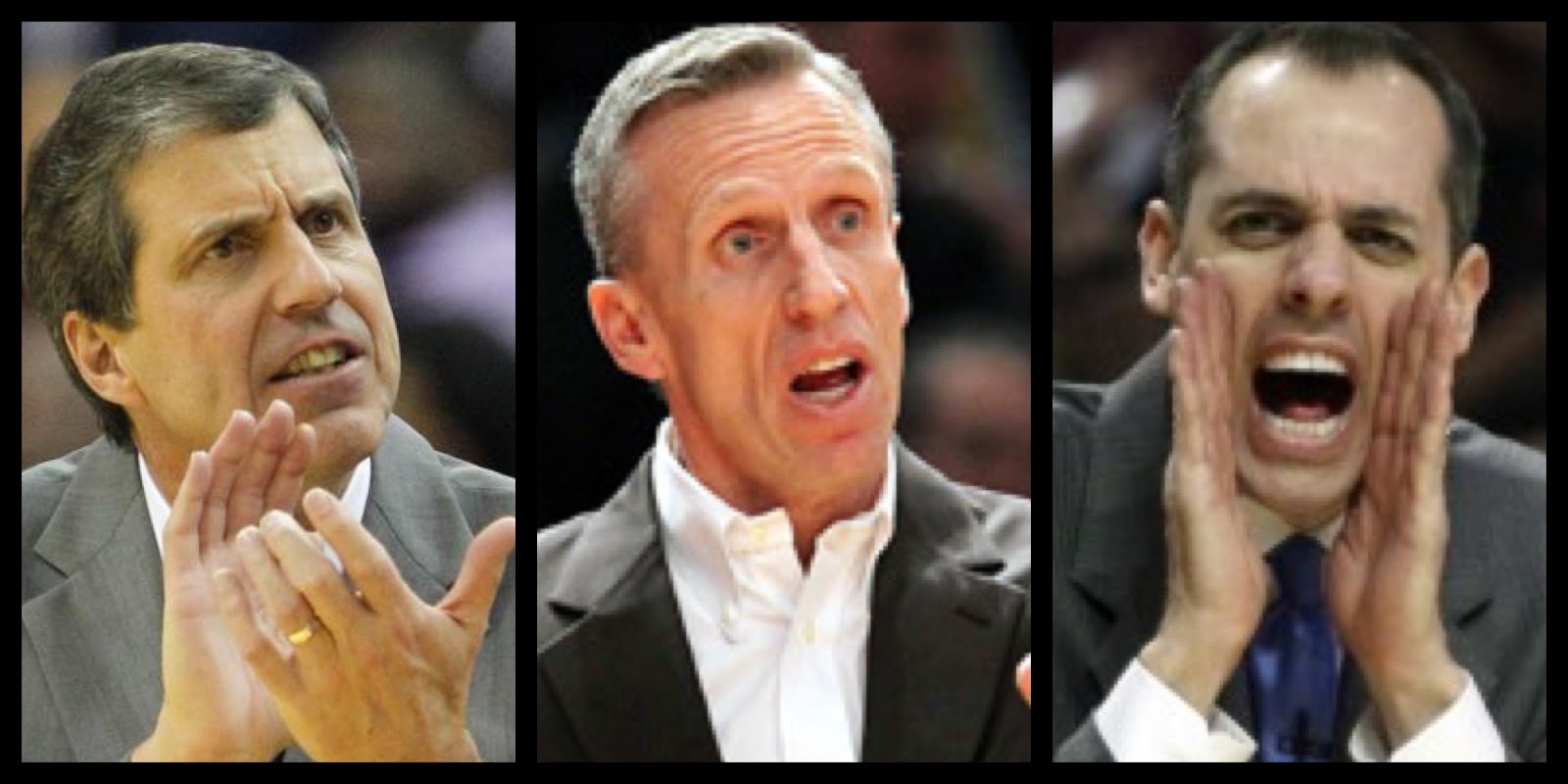 |
| One of these guys is Randy Wittman. |
9:34 pm: Ron chimes in from the studio that the Wizards "were in control of the game until the end of the third-quarter." (The Wizards were down 12 at halftime and down 18 with 7:45 left in the third). One of the positive takeaways from the game for Ron was the performance of Martell Webster, who pumped in 16 points. Webster finished a team-worst -23.
9:37 pm: The game highlight package starts by showing the Wizards taking a 15-9 lead. Is this when they had control of the game? Winters Scott notes that the Wizards were "only down four with two minutes to go in the first half," which means that the Wizards would be undefeated in a league where you get spotted 5 points and play 22-minute games.
9:40 pm: Wizards coach Randy Wittman is at the podium sharing his thoughts on the game. Like the CSN crew, he leads off with effusive praise of the Spurs, followed up by unrestrained admiration for the Spurs, and wrapped up with gushing hyperbole about the Spurs. Before fielding the next question, he adds that the Spurs took the Wizards will away and "carved us up pretty good."
|
| Guess again. |
9:43 pm: Rik Smits texts me back to confirm that yes, Manu Ginobili would have counted toward a Whitewash.
 |
| Rik Smits, International Whitewasher |
9:50 pm: Beal begins his post-game comments, "First, give my praises to God and Jesus Christ."
 |
| Jesus Christ, the original Whitewasher |
9:52 pm: In critiquing his own play (11 points on 4-for-13 shooting), Beal says that he has become too one-dimensional and that opponents know what he's going to do on the court. Perhaps he could be more unpredictable by making more shots?
Subscribe to:
Posts (Atom)