Showing posts with label koi pond. Show all posts

Monday, August 12, 2013

Where to buy Koi Pond at Gen Con: Booth 1201

Koi Pond Header 2

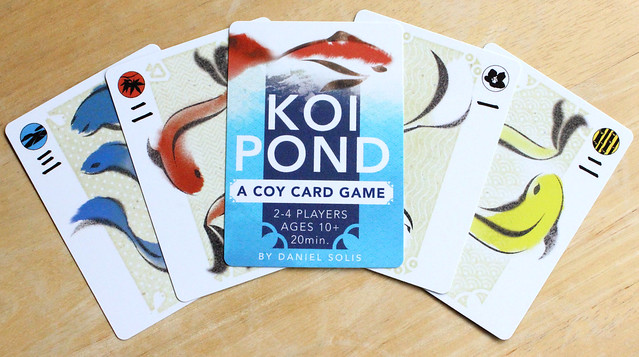
If you're going to Gen Con, you can find my card game KOI POND for sale at Booth 1201, where DriveThruRPG, White Wolf and Minion Games are sharing a space this year. Here's a map!


If you can make it there early, you can grab a free promo card made just for the occasion: FOUR WINDS. This is the first in a series of one-card promo expansions that didn't quite make the cut into the basic game.


I hear sometimes that Cats, Cranes and Turtles feel more valuable than koi, mainly because they're worth 1:1 for each koi, whereas building up your own koi collections require careful balance and planning, only to get 1 point for every two matched koi.

With FOUR WINDS, you get the full value of each of your koi, but only in one specific suit. Do you pursue the bonus, making your strategy obvious, or do you play it coy? Visit the booth at Gen Con to pick up your card and find out!

Wednesday, July 10, 2013

Watch: How to Play Koi Pond!


I just finished putting together this tutorial video for how to play Koi Pond. Hope you dig it and makes everything sound fun! Once again, you can buy Koi Pond on DriveThruCards.

And there's a really glowing review for the game on the most recent episode of Gamers with Jobs, starting at 13:05:

"Extremely elegant card game with a great art style. [...] Easy to teach. Absolutely gorgeous. It's not just that the artwork on the cards look cool, but the game space ends up taking on this artistic look. [...] It's intuitive, fluid community game. Highly recommended!"

Aw, you guys! :D

Thursday, June 13, 2013

Koi Pond & Early Thoughts on Publishing Card Games through Print-On-Demand

Koi Fish 06

It’s been about six months since I started this whole full-time game designer thing, with Koi Pond being in many ways the flagship project for this experiment. Koi Pond was designed, developed, and published all in the past half-year, thanks to the coincidental occurrence of several factors. Here’s how it all came to pass and my thoughts on where it might go in the future. This is a long post, so here are the takeaways right up front:

  •     I worked fast, playtesting and revising rapidly.
  •     I could make my own art, which greatly reduced initial expenses.
  •     I still hired an editor and got lots of outside readers to review text.
  •     Because I worked so minimally, even modest sales put me in the black.
  •     I’m re-investing those earnings to future products.
  •     POD (unpackaged) cards are still a new model, with a small audience.
  •     The market may grow if POD games get reviewed alongside bigger products.

For another POV, Dave Chalker posted his own thoughts on publishing his game Criminals through DriveThruCards here.


Background

Late last year I decided to resign from the ad agency. I’d worked my way through the creative department and was on the cusp of becoming creative director. It was a sweet gig for a long time, but having that full-time job and doing freelance and doing game design and, oh yeah, maintaining a healthy mental well-being was untenable. I made some drastic changes in my lifestyle, culminating in that resignation.

So, 2013 began with a bit of confusion about what to do next. It just so happened that the Boardroomers were holding a microgame design contest in February. The entries had to contain at least 1 of each of the following components, but no more than is allowed:

  •     Poker Cards  (20 cards at the most, you must use the poker faces)
  •     Cubes  (10 cubes at the most)
  •     Rules  (These must be written out with examples when necessary)

I was having a bit of success with Suspense, so I thought I’d try my hand at another micro.


Searching for a Theme

I designed Love Me Not, as a very, VERY abstract thought-experiment in endgame scoring. I wanted to figure out a scoring method that required you to sort resources between two places, only the lower of the two totals allowing you to score. The game itself was too limited for its form factor and rightfully didn’t win the contest. It did let me explore this notion further.

When I reach points like this in a design cycle, I look for a good meaty theme that will perhaps suggest further secondary mechanics or make the central mechanics feel more meaningful. So, I searched for a theme in which it made sense for players to sort things into different places, but only attain value for those things if instances of those things were present in all relevant locations.

In other words, it felt like being a museum curator. Players would collect precious items and decide to put them out on public display (face-up cards) or keep them in the private archives (face-down cards). Examples of those items needed to be in both the display and archives to be valuable. I explored this idea a bit further, but I was really concerned that Reiner Knizia’s Modern Art was such a prominent game with this theme that I couldn’t escape comparison.


Coy Koi

I looked further afield, examining what it felt like to play with this mechanic. Sometimes this can result in a simple title that in itself provides enough of a theme for the game to make sense. See “Can’t Stop!” as a classic example. When you play Can’t Stop, you really do feel like you can’t stop rolling those blasted dice.

When you play with this scoring mechanic, you feel like you’re keeping a secret. You feel like you’re being coy. Thus, I was tempted to leave the game at that, simply calling it Coy. But I couldn’t resist a pun, so I thought it would be clever to have koi fish on these cards. No real theme aside from that, just fish as a placeholder for a more traditional set of poker suits.

But of course, the idea of a “Coy Pond” or “Coy Koi” or just plain old “Koi Pond” was irresistible. That theme introduced lots of secondary mechanics to explore. What about pests in the pond? What about visitors? What if it’s a competition between koi pond hobbyists?

I developed the idea over the next couple of months at my local game store, UnPub, and PAX East. I got a LOT of help from outside playtesters, which was really invaluable. This is a shorter timeline than my usual development cycle, but I was actually able to fit in more playtests than usual. Actual chronological time didn’t matter so much as actually getting the game to as many table as often as possible.


DriveThruCards

Backing up a bit, throughout 2012 there was talk of DriveThruRPG branching out to print-on-demand card games in 2013. I thought this would be a great opportunity for me during this year-long experiment to try some low-risk projects. Most of the time, as you’ve seen with Belle of the Ball, even a small card game spends years in development and takes just as long to finally be published.

With DriveThruCards, I saw a sales option that could keep pace with my creative output, as long as I devoted strong enough attention to the quality of the product on sale. Originally I was going to publish Suspense with DTC. The art direction was simple and could be done in-house. The rules were easy enough to explain in a short PDF. Plus, the only actual game components were cards themselves.

A happy snag got in the way though. I was fortunate enough that Dice Hate Me decided to pick up the license as a part of the Belle of the Ball family of games, but that left me hunting for another potential product for DTC. The newly christened Koi Pond fit the bill.

Just like with Suspense, I can product the art myself. The rules were relatively simple (though a bit longer than Suspense). The cards were really the only play component (though there were quite a few more than Suspense). Plus, it was a pretty game that I hoped DTC would find valuable as a sales tool for their new POD services, thus driving more in-house sales.


Calling in the Editor

However, I used to have a bad habit of making an otherwise unfinished game look like it’s finished with some pretty graphics. I’ve avoided that pitfall over the past few years and become a better game designer for it. Still I knew I needed help to make sure this was a solid first outing and I was willing to pay for it.

Specifically, I hunted around for an editor for my rules sheet. I’m happy to say that Liz Bauman came to my rescue here. In short order, she found a lot of vagaries that needed clarification and game terms that needed more consistent application. Hire Liz a lot!

I’ve often said that no rules are too short for someone to get them wrong. Hiring an editor (and also getting lots of outside playtesters to read the rules) made the text a lot more clear. Examples of play helped, too. As a matter of fact, I’m still updating the rules sheet after further feedback from early buyers.


Prepping and Publication

With that done, I was ready to actually go live with this thing. Sending files to print is rarely a completely smooth operation. Each printer is basically its own country, with its own customs to learn as you go.

For example, one important thing to note is that the POD printers DriveThruCards hires has a 240% ink threshold limit. My cards were so colorful that their inks were in the 300 range. I needed to tone them down a bit so they’d actually produce properly. It was mainly little things like that.

Otherwise, the file setup was actually easier than with other POD printers I’ve used in the past. SuperiorPOD requires you to set up your own 18-up card sheets. Game Crafter requires you to upload each card face and back individually. DriveThruCards simply requires a multi-page PDF with alternating faces and backs for each card. The latter option is much more amenable to InDesign’s DataMerge tool.

  1. I’d lay out the cards with placeholders for variable data like rank, suit, and art, all pulled from a corresponding spreadsheet.
  2. Once done, I’d export an InDesign file through DataMerge, producing a multi-page document, with one card per page.
  3. From that, I’d export flattened images (with bleed) into a special “Renders” folder. Typically these were JPEGs since they retained the best color.
  4. Then I did a Photoshop batch action that reduced all the ink thresholds in each image file to those designated by DriveThruCards’ specs.
  5. Then I made a brand new spreadsheet. The first cell had the file name for the first card’s face. The second cell had the file name for the first card’s back. Thus, I continued alternating the file names of a card face with the file name of the card back
  6. In a brand new InDesign file, I’d link this spreadsheet with DataMerge.
  7. Again, I’d use DataMerge to export a multi-page document
  8. Finally, that multi-page document could be exported to a PDF suitable for printing.

Phew!

It’s important here to thank Brian Petkash who very patiently talked me through that file setup process and is still diligently answering my pesky questions about how to actually get the file up for sale.


Sales

Unfortunately, I missed DriveThruCards’ “soft launch” period of February through March. I understand sales were slow during this period in general, so perhaps it’s for the best. I had Koi Pond ready that April just in time for their big public debut. Here’s how the numbers break down:

4-2013
31 Sold
$288.72 Retail
$69.80 Royalties Earned*

5-2013
28 Sold
$399.19 Retail
$100.83 Royalties Earned

Grand Totals To Date
59 Sold
$687.91 Retail
$170.63 Royalties Earned

* The first month’s royalties were a bit low because I ordered review copies and expensed the cost to that month’s payout.

Koi Pond launched at the top of the hot list and stayed their for the first week. I kept up the marketing efforts through my blog, my Twitter feed and my G+ accounts. I also got a lot of help from people RTing my links.


Conclusion

Maybe I’m just too indie at heart, but I’m very happy with these numbers. I went into this experiment with a brand new game, an inordinately fast dev cycle, modest potential audience, and zero-to-minimal expenses. My investment of time and capital into this project has been quite met, I think. Anything more will contribute to further self-published card games.

Having the experience of Kickstarting three projects already, DriveThruCards offers me an appealing alternative. Yes, I have fewer sales over a longer period of time, but I also don’t have the stress of stretch goals, income taxes, and fulfillment hassles occupying my time for the next year. Instead, I can keep blowing on this little ember until it lights another fire.

Towards that end, I hope to keep up interest in Koi Pond with reviews and podcast interviews as I develop an expansion for the game, Moon Village. I’ve also already invested some of my earnings into the art for 9 Lives Card Game, currently in public beta. My game still a small fish in a very, very large ocean, but they’re growing!
Sunday, May 19, 2013

Koi Pond version 1.3, plus plans for Koi Pond: Moon Village!


I'm back from Toronto! Lots of stuff to share, but first I'm updating the rulebook for Koi Pond on the DriveThruCards page. I've also sent along this message of thanks to those who have picked up the game so far.

-----

Hello Koi Pond Players!

First, thanks so much for picking up this first game from Smart Play Games. I hope you've had a chance to play and enjoy it with your friends and family. With luck and spirit, this will be the first of many clever little card games to be released on DriveThruCards.

One of the great things about releasing games through DTC is that I can respond to your questions by updating the live rulebook. Version 1.3 answers two main questions that were left a little ambiguous in 1.2.

Q: If multiple players have hybrids in their rivers, who decides their hybrids' suits first?
A: This can be a tricky situation if an opponent has a turtle that could score from one of your hybrids, depending on which suit you decide. This is a somewhat rare occurence, but can happen often enough that a turn order system ought to be established. So here it is: The start player decides the suit for his earliest hybrid first, continuing clockwise until all players have decided the suits for all their hybrids, one at a time.
Q: Should the lake be a separate deck? Is there a "top" of the lake?
A: This was left far too vague in the last rulebook. To be clear, the lake is meant to be an undifferentiated loose pile of cards comprised of the previous round's river cards. There is not "top." All lake cards are accessible to the active player during their draw phase. I've revised the setup diagram on page 1 to more clearly show this pile of cards.

These notes are now incorporated into the main rulebook.

In addition, I've added a print-and-fold tuckbox for your Koi Pond cards. It's sized to fit your complete deck, plus extra space if you want to sleeve your cards. Hope you dig it! Thanks again.

Lastly, I'm testing some bits for Koi Pond: Moon Village, an expansion that would add a fifth player, add new "Villager" cards that score if they're in your house at the end of the round, and add a new Ribbon type: Challenges. They'd all be formatted as bonuses for winning a round on certain conditions:

    •    "Win a round scoring koi in all four suits."
    •    "Win a round without using a cat, crane or turtle."
    •    "Win a round scoring koi of only one suit."
    •    "Win a round scoring only scoring with a cat, crane or turtle."
    •    "Win a round with the most Koi of X suit in your house."
    •    "Win a round without drawing cards from the lake."

These are still very early in their development, but intended to be pretty modular. So if you like Challenges but not the Villagers, you can use them independently of each other.

Thanks again for your support! Please share your reviews and comments with me directly at gobi81[at]gmail[dot]com or on the official Koi Pond BoardGameGeek page!

Yours,

Daniel

-----

P.S. If you're having trouble downloading the 1.3 rulebook from DriveThruCards, you can also get it here.

Saturday, May 11, 2013

Koi Pond Tuck Box - Free Print-and-Fold Download

Tuckbox-Web

By popular request, here's a Koi Pond tuck box available for free download. It's sized to accommodate the complete basic Koi Pond deck, plus wiggle room for your card sleeves. Below are two PDFs. The first has the art and guides on one page. If you're feeling fancy, the second link has the art on one page on its own with the guides reversed on the second page, so you can print this PDF double-sided and have a nice clean finished product.

» Tuck Box with Guides
» Tuck Box with Guides on Other Side

Monday, April 29, 2013

Koi Pond is the Hot Seller on DriveThruCards!

KOI POND on DriveThruCards

I'm happy to announce that DriveThruCards is officially launching today and KOI POND is already the top seller. DriveThruCards is a print-on-demand store devoted exclusively to card games and that's it. DTC's just-the-cards focus means they can provide the best-quality print-on-demand cards you've ever handled. You'll really be surprised at how nice they are.

KOI POND is a fast, brainy, casual strategy game. Collect colorful koi fish and place them in your pond or your house. Keep your pond and house totals as equal as you can, because you only score points for the lower total! What’s more, your pond is public, but your house is secret. To win, you have to be... coy!

What's it like?
This is a quiet, fast filler game best paired with warm drinks amongst friends. Mix the elegant presentation of Coloretto with the fun decision-making of Biblios. Mix in clever scoring and garnish with lovely sumi-e inspired artwork.

Details:

2-4 Players | 20 Minutes | Ages 10+

Quality:

This game uses DriveThruCard's thickest, highest quality, Premium card stock. They feel great!

Includes:
60 Koi cards in red, blue, yellow or white, plus hybrids.

12 Cat, Turtle, Crane cards, one of each in each color.

12 Ribbon cards, three of each in each color.

4 Reference cards for ease of play.

1 Start Player card.

Buy it today!

Monday, April 22, 2013

Koi Pond Card Quality Preview

Printed Cards KOI POND

UPDATE: Koi Pond: A Coy Card Game is now available on DriveThruCards!

I just got proofs from DriveThruCards for the Koi Pod cards. They look and feel excellent! The colors are brightly saturated. The cards are nice and thick. The UV coating makes the whole thing the best POD cards I've seen to date. I dare say they nearly rival the card quality of an offset printer.

On top of that, the service has been very patient with me as I figure out this new line of business. I'm trying to ensure cards are formatted to take best advantage of the flexibility and limitations of the POD process. DriveThruCards' staff has been very informative in that regard.

Right, enough of that. Here's a Vine to demonstrate the card thickness. It's good stuff!

As far as I know, Koi Pond will be available for sale next week, but the product listing is will be live here. Currently only the rulebook is available for preview.

Meanwhile, if you've played Koi Pond and would like to share some praise for the game, I'm happy to quote you on the product page!

Friday, April 12, 2013

Art Preview of Koi Pond: A Coy Card Game

KoiPond-Header-2

UPDATE: Koi Pond: A Coy Card Game is now available on DriveThruCards!

This week, I got a very good reason to hurry up and get the Koi Pond cards finalized ASAP. So the past two days have been very busy, implementing playtest-requested updates that have built up over the past couple months' testing. The game should be available for sale later this month!


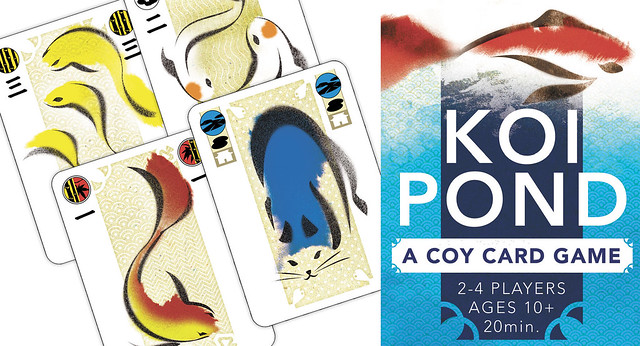
  • Frames: I revised the face's backgrounds to not be full-bleed anymore. Each suit has a distinct corner decoration and background pattern. It's subtle, but I figured it couldn't hurt to have one more distinguishing mark for each suit to aid recognition.
  • Ambidextrous Layout: I've also placed suits and ranks on the left upper corner and the right upper corner instead of placing them on alternate corners. This makes it easier for people who prefer to fan their cards left or right. I was going to put suits and ranks on all corners, but it became really cluttered.
  • Increased Contrast: The frames also create the best contrast for easy recognition of suits and ranks. They were perfectly readable on the paper texture of earlier prototypes, but nothing beats black-on-white for immediate pop.
  • Color-Perception Assist: I got some notes from color-blind playtesters that while it was clear enough which two suits were represented in a hybrid, it was still difficult to recognize that it was a hybrid at a glance. So I've added an outer ring to hybrid suits.
  • Housecats, Cranes and Turtles: The most oft-requested revision was to add icona to the cranes, turtles and housecats so make it's clear from where they scored points and that they must be in your pond in order to score points at all. I've added small iconographic reminders of these facts to their respective cards.
  • Player Aides: The deck will also come with a thorough set of reference cards outlining the basic rules, how to score, the direction of scoring in each round, and how hybrids are considered when scoring. Four cards in all, the backs of which have a diagram of the play area clearly depicting the arrangement of your pond and river.
  • Ribbons: The game quite clearly notes how much one, two or three ribbons of a suit are worth. This is probably the most distinctly euro-influenced visual element. Hey, they know what they're doing.

I hope you'll enjoy Koi Pond when it's finally available later this month! It's a lovely, meditative game with subtle interaction and eye-catching art. It's also a nice, low-conflict introduction to new Knizia-style scoring for your friends and family.

Wednesday, March 27, 2013

The Nature of Low-Interaction, Head-Down, Multiplayer Solitaire Games [Koi Pond]

Koi Pond

UPDATE: Koi Pond: A Coy Card Game is now available on DriveThruCards!

I tested a lot of games at PAX last weekend. Let's talk about Koi Pond Prototype C first. It was mostly well-received. People liked the fast, simultaneous gameplay, and it seemed couples liked the low-impact interaction that the predators provided. Everyone loved the "balance" scoring mechanic, too.

But there was one comment that stuck with me. A playtester found it was "fundamentally uninteresting." By that he meant there is no necessary interaction or even a desire to interact. It's very much a head-down, multiplayer solitaire game. Furthermore, in the last two turns, you have too many cards in your hand to sort through, which also contributes to the head-down nature of the game. You're so focused on organizing your mountain of assets that you have even less reason to pay attention to anyone else.

Now, I could justify this type of gameplay by simply pointing at the theme. Koi Pond tending is a different experience than in-your-face combat, after all. Those who are drawn to the theme may prefer that calm, quiet experience. Core hobby gamers are not necessarily going to be drawn to that kind of game (unless it's an app).

               HIGH INTERACTION
                        |
                        |  
                    #   |
SIMULTANEOUS -----------+----------- TURN-BASED
                        |
                        |
               *        |
                LOW INTERACTION

But that's too easy. The process of game design requires constant refinement and reflection. In this case, I sense my own desire to send Koi Pond to production as soon as possible, to ride the wave of Belle of the Ball and Suspense's success from earlier this year. Seeing that in myself, I must pause for a moment to consider alternatives for Koi Pond that won't just make the game interactive, but make the players want to interact.

If you've seen Prototype C, you've seen the Ribbons, Fishers and Dogs which I'm testing to add more in-the-moment interaction. However, I've got a potential revision to the overall flow of play that I tested at PAX that may solve several of these problems in one go.

Hopefully this moves Koi Pond from its current position on the above graph (*) slightly up into the range of higher interaction, while keeping the same fun, fast, simultaneous gameplay (#).

SLIGHTLY-MORE-INTERACTIVE KOI POND

Instead of each player having her own river of discarded cards, there is a "lake" in the middle of the table. This is a loose pile of discarded cards shared communally with all players.

The game is divided into Weeks and Days. A Day is divided into a Draw Phase, Placement Phase, Reveal Phase.

  • Draw Phase: Each player takes turns drawing three cards, which may be chosen from the face-down draw deck or the face-up cards in the lake.
  • Placement Phase: Each player places a card from their hand face-down into their pond and another card face-down into the lake. Any remaining cards stay in-hand.
  • Reveal Phase: Each player reveals their chosen cards.

If you reveal a koi in your pond, you can place it in the appropriate stack.

If you reveal a predator in your pond, you remove it from the game and choose one opponent as the predator's target. The opponent must remove any koi matching the predator's color from the game. Housecats remove matching koi from an opponent's house, Cranes remove matching koi from an opponent's pond, Turtles remove matching koi from the lake. Any player can protect pond, house or the lake by playing a Dog card. A Dog card used in this way is removed from the game.

If you reveal a Fisher in your pond, you can draw two extra cards on your next turn. Having done so, you must remove that Fisher card from the game.

A new Day begins after the last player reveals their choices. 
Each Week lasts FIVE days, at the end of which players score points and Ribbons are awarded as noted in Prototype C. 
After three Weeks, the game ends and players earn bonus points for their ribbons.

There is a lot to like in this variant. Players experience just a touch more interaction, along the lines of Lost Cities. Now you must worry about which cards you discard since your opponent can take them. Predators are much more straightforward, since they're simply action cards that have an immediate take-that effect. Furthermore, the deck doesn't run out nearly as fast, which means the deck can support up to five or six players, especially if dogs and fishers are included in the basic deck.

The downside is that the game takes about twenty minutes longer, as you must wait for each player to choose their cards. This is slightly mitigated by the fact that once a player takes his cards, he can effectively proceed with the rest of his turn while everyone else makes their own choices. By the time the last player is taking their first phase, the first player is already done with their second phase.

I'll continue testing this and other variants. I hate to make a simple, elegant game more complex than it needs to be, but I also hate leaving any stone unturned in a game's development. If Koi Pond ends up right back where it started as a low-interaction meditation game, I can at least say I tested the alternative.

Tuesday, March 19, 2013

Koi Pond - Prototype C


» Download the Rules
» Download the Cards
UPDATE: Koi Pond: A Coy Card Game is now available on DriveThruCards!

Howdy folks! I'm happy to show off Prototype C of Koi Pond. This includes several refinements and polishing bits to help play go a little more smoothly.

  • Predators always score from the opponent to your left. No more switching between rounds. (I mean, you can if you want to, but explaining that was cluttering the rules presentation and otherwise didn't change the game mechanically.)
  • Hybrid koi now have an extra outer circle around their suits to help color-blind players notice them more easily. Hope that's sufficient!
  • Several people wanted predator cards to have a diagram or art showing where they score points from. I'm not ruling that out yet, but I'm compromising for now by including reference cards for use during play. This explains scoring at-a-glance.
  • The scoring example diagram is more organized and clearer so you an see which suits of koi score X number of points.

Aside from those and other small tweaks, I've included some experimental cards that I'd love to see tested out more thoroughly. These do not have art yet, so they're easy to distinguish from the core deck.

  • VISITOR (x18):
    Shuffle this into the deck. Between rounds, you may keep any visitors that were played into your pond. Keep them to the side, away from the pond or river.
    End game bonus: Score 5pts if you have the most visitors at the end of the game. Lose 5 pts if you have the fewest visitors at the end of the game.
  • RIBBON (x3 of each suit):
    Keep this card to the side of the game during play. If you have the most koi of a suit in your pond at the end of a round, take one ribbon of that suit.
    End game bonus: Score 1, 4 or 9pts for a set of one, two or three matching ribbons.
  • DOG (x6):
    Shuffle this into the deck. A dog in your pond will prevent one predator of your choice from scoring from your pond, house or river.
  • FISHER (x6):
    Shuffle this into the deck. To use the fisher, play it into your pond. Then, swap it for any opponent’s koi from their river.

I hope you enjoy the refinements and the new optional cards! I plan to go to DriveThruCards for production in a couple weeks. The final card layout will be polished up so they're friendly for left-handed players. The reference cards will also be fully designed and I'll hire a proper editor to go through the rulebook. Stay tuned!

» Download the Rules
» Download the Cards

Friday, March 15, 2013

Stuff in development for Koi Pond - Prototype B

Koi pond

UPDATE: Koi Pond: A Coy Card Game is now available on DriveThruCards!

I've had Koi Pond in private beta testing for the past few weeks experimenting with various ideas to deepen the gameplay without losing the core elegance. I called this Prototype B.

One thing that's definitely going into the game are hybrid koi. These are koi which can be either of two different colors, split right down the middle: White and yellow, yellow and red, white and blue, red and blue, yellow and blue, and red and white. When you place a hybrid in your pond, you decide which color it will be immediately. When you place a hybrid in your house, you decide at the end of the round which color it will be. When you discard a hybrid into your river, you do not decide its color. In that case, it's the player who has a turtle predating your river who decides which color that hybrid will be, usually a color that turtle can score points from. (Note: hybrids always come in quantities of 1 koi, so they're a bit balanced in that way.)

In tests, the game plays well with two, three or four players. I would need to add more cards or shorten the rounds for a five- or six-player game, but that's not such a bad thing for an expansion.

Presently the game plays three times for a complete session, mainly to balance out any lucky streaks and randomness that may occur in a single game. I've gotten some wise counsel from W. Eric Martin that in such games, it never really feels like multiple rounds are necessary if they're all just identical games without anything building up between them.

I'm thinking about methods of earning points in the long-term that might transcend the individual round of gameplay. The trick, again, is not losing the core elegance of the game. I don't mind adding new cards though. So here are some options:
  • Race for Ornaments: I remember how Phil Walker-Harding's Sushi Go! tackled this problem. That's another game played multiple times, with almost identical gameplay with one exception: Pudding. You keep pudding even after the round is over and the player with the most pudding at the end of the game earns 6 points. The player with the fewest pudding loses 6. I could use the same mechanic with "Ornaments" in your pond. Bamboo, rocks, lilypads, that sort of thing. They score no points in the short-term, but lead to a positive/negative bonus score at the end of the game for the player with the most/fewest ornaments.
  • Race for Visitors: You would play visitors into your pond just like the ornaments. It's basically a parallel race to the ornaments, wherein having the most most visitors earns you bonus points and fewest visitors earns you negative points.
  • Race for Ribbons: Imagine that there are ribbons available matching each suit of koi, so a blue ribbon, a yellow ribbon, a white ribbon and a blue ribbon. When you're the player with the most koi of a suit in your pond, you earn the corresponding ribbon. For example, if you have more blue koi in your pond than any other player, you earn the blue ribbon. (In a tie, no one wins the ribbon.) The first ribbon of a suit scores 1pt, the second scores 2pts, the third scores 3 pts. Each full set of all four color ribbons earns 9pts. This creates a gentle counter-pressure to the short-term balanced scoring mechanic.

In addition, I've been experimenting with some ideas that may not make it to the base game, but which could find their way into some kind of expansion or variant.

  • Villagers: These are basically the same as predators, but which predate from your house rather than your pond. Thus, they're much more secretive than predators.
  • Guard Dog: This blocks one predator of your choice from preying upon your house, river or pond, depending on where the guard dog is played. (Think of it like a protective measure, but still balanced because the dog can't be in two places at once.)
  • Fisherman: When you play the fisherman, play it into your pond. Then, swap it for an opponent's koi from their river. (This is a way to get the Lost Cities-style of digging into someone's discard pile. It also keeps you looking at the whole play area.)

So that's all in the lab at the moment. Nothing too final yet. Just keeping you in the loop!

Tuesday, March 12, 2013

GamerChris has an early review of Suspense, Koi Pond and Unpub Mini at Atomic Empire


UPDATE: Koi Pond: A Coy Card Game is now available on DriveThruCards!

Chris Norwood was kind enough to play prototypes of Suspense: the Card Game and Koi Pond Card Game and include previews on his most recent podcast ep. He also spends some time talking about the Unpub Mini event I ran two weeks ago.

Suspense gets previewed at 10:03
The Unpub section is explained at 32:39
  • 36:14     - Roman Conquest
  • 39:22     - Duck Blind
  • 41:57     - Dorobo
  • 41:57     - Acute Care
Koi Pond (nee Coy Pond) gets mentioned at 45:26

Give it a listen!

Friday, February 22, 2013

Photoshop Sumi-e Tutorial Video [Koi Pond]

Koi Pond Card Back

UPDATE: Koi Pond: A Coy Card Game is now available on DriveThruCards!

Last weekend I put together some prototype art for the Koi Pond Card Game (née Coy Pond) that's been getting a lot of positive response from people. I thought I'd share with you a bit of my process. Clearly I'm not a sumi-e painter, but over the years I've learned a few tricks in Photoshop that might be useful for you. Follow along in the video below!


0:00 I start drawing the vector strokes by themselves. I have a peculiar process for doing this because I prefer to work in an increasingly obsolete program called Freehand. I'm old and stubborn.

1:15 I open a neutral watercolor background in Photoshop. Then I paste the stroke vector into photoshop as a smart object.  I select it as an outline and paste in a mottled gray texture so the strokes get an organic fill. This layer is multiplied so the background texture also seeps through the fill.

1:35 In quickmask, I use a very large, soft brush in dissolve mode and skirt the edges of the strokes. The dissolved edge adds a roughness for the next step.

1:45 With the selections made, I use gaussian blur to soften the edges of the mask. (Note: I'm not blurring the layer, just the edges of the layer mask.) I repeat the selection-blur steps several times in different areas to different degrees so it all feels a as organic as it can.

2:40 I paste in another watercolor stroke for the fill color inside the fish and use Transform > Warp to curve the stroke according to the fish's body. In particular I want to get the tail as wide and rough as possible to emphasize the roughness of that paintstroke.

3:20 To polish off the fish's silhouette, I import white-on-black watercolor strokes. These layers are screened so that they block out any color I don't want. I use transform > Warp again for final details.

4:40 For a bit of depth, I dropped in another blue watercolor texture to take up the bottom two-thirds and screened a bit at the top edge. This lets the red fish really pop out.

And that's it!

MUSIC
Song: Joma de mi vida-U joma'il in kuxtal
Album: Suut u suutuk
Artist: BALAM
License: Creative Commons Attribution (CC-BY) You can copy, distribute, advertise and play this music as long as you give credit to the artist.