Showing posts with label spheres of influence. Show all posts

Friday, June 7, 2013

Bills: Public and Private Victory Point Conditions in "Spheres of Influence"


I'm still thinking about this card-turning Triple Triad-inspired game about lobbying an alien senate. This time, I'm thinking about some victory conditions outside of simply turning as many senators to your direction as possible. That in itself may earn you some points, but I would like to introduce a simple mission system in the spirit of Ticket to Ride or Takenoko.

Assume the game begins with an arrangement of senators on the table already. Each player is dealt a hand of five senators to play one round. The senators have various personal interests several issues, including logistics, military, culture, science, exploration, plus whatever caucus to which they identify. These would be represented by icons on their card.

At the start of the game, players also get a certain number of "Bills" that they're trying to pass through the senate. Normally, after each round, each player collects any senators pointing in his or her direction. This is the mainstream way to earn points. However, at any point during the course of the game, players may redeem Bills for which they are qualified. These are based on the game state, generally which senators are pointing in any particular direction. Here are some examples:

  • Make First Contact with Ancient Artifact: Each trio of Science, Military, and Exploration pointing your direction.
  • Explode Planet for Highway Construction: Each trio of Logistics senators pointing your direction.
  • Vote of No Confidence against Solar Federation: No Solar Federation senators pointing your direction.
  • Pledge of Impractical Idealism: No senators pointing in your direction.
  • Campaign for Speaker Seat: At least one senator of each Caucus pointing in your direction.
You have to get the card arrangement just right. Even if it's another player's turn, as long as the senators are arranged correctly, you can redeem your bill and earn those points. I would imagine this keeps all player's engaged with the board throughout the game, as they try to watch each chain reaction like a hawk.

Furthermore, I think some Bills ought to be public and out on the table, so all players are eligible to redeem them. This might divert attention in too many directions, but it's worth exploring.

Thursday, June 6, 2013

Spheres of Influence: Using Rotation and Orientation as a Capture Mechanic

Senate in agony

In thinking about Triple Triad, one of the benefits of being a digital card game is that it's easy to change a card's color as its ownership changes between players. Obviously this is more fiddly in an analog game, but not impossible.

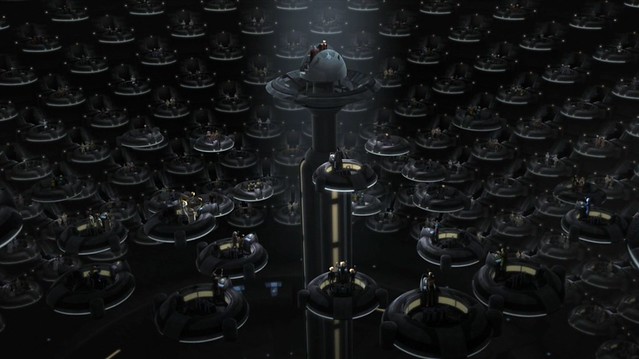
First, let's assume a theme something like the big Galactic Senate scene in Star Wars. Each player is trying to sway dozens of planets to ally with herself. Each planet is represented by cards with four numbers on each cardinal direction, just like a Triple Triad card. But, how to reflect "ownership" of those cards in play while still keeping them on the table?

You could place a coin on each card with one player being head's and another player being tails. For more players, simply use colored stones or poker chips. Unfortunately, this obscures some of the information on the card.

You might instead print double-sided cards, with identical information on each side except for a colored border. But again, the downside is that restricts some of your ability to keep information hidden, which is a great strength of cards in the first place.

Seeking an alternative, I was inspired by the new game Keyflower, which auctions hexagonal tiles in a very clever way. When you bid for a tile, you place your bid along the edge of the tile facing you. This is particularly useful in Keyflower since the meeples you're using to bid may be many different colors, so using the actual sides of the tiles makes each player's bid quite clear.

So perhaps these tiles can show their ownership by being oriented towards one player or another. I imagine tiles or cards with a small arrow pointing at whoever owns them. Here's an example of how it would work.


Spheres1

You place one tile on the table to start the game. Whenever you place a tile, you probably want to it point towards you, but it doesn't have to. As you will see, there may be times it's more advantageous to orient it a different direction.

Spheres2

Your opponent places a tile of his own. He points it towards himself. Whenever a tile is placed adjacent to another tile, check if the newly placed tile has more dots ("influence") along its edge than the adjacent tile's edge. In this case, it does not, so no further action is taken.

Spheres3

You place a new tile and it does have more influence than the opponent's adjacent tile. Because this is the case, your opponent's tile must be rotated so that it points towards you. (As shown below.)

Spheres4

In this manner, players can "capture" each other's tiles without having to actually pick them up. This would be ideal for card-based area control games where cards are often difficult to handle. Instead of picking it up, you'd simply rotate the card in place.

The other benefit, and the one I'm most intrigued by, is that capturing also changes the landscape of influence. Capturing a tile may lead to chain reactions, as stronger faces could suddenly reveal themselves to neighboring tiles. Chain reactions can be difficult to design into an analog game, but this may indeed prove a fruitful line of inquiry. HM!

Wednesday, June 5, 2013

A Dice-Based Area Control Game inspired by Guilds of Cadwallon and Triple Triad


Last week I played Guilds of Cadwallon for the first time. It's a very elegant tactical game with some clever nooks and crannies. You can check it out in the video above. It actually reminded me of Triple Triad, an old digital game from the Final Fantasy series that I've occasionally tried to hack into an analog format.

Anyway, here's a simple dice-based game you can play. Each player starts with an equal number of d6s, in their own color. To start the game, players roll all of their dice at once and leave the results as they stand.

On your turn, take one die from the supply (of either color) and place it on the table adjacent (up, down, left, right, not diagonal) to another die thus forming a grid of dice.

The round ends when all dice have been placed.

Then points are earned by surrounding an opponent's die with your die results totaling a number greater than your opponent's die result. Only orthogonal (up, down, left, right) adjacencies are considered, not diagonal. The points earned are equal to the surrounded dice result.


2013-06-05 05.20.51

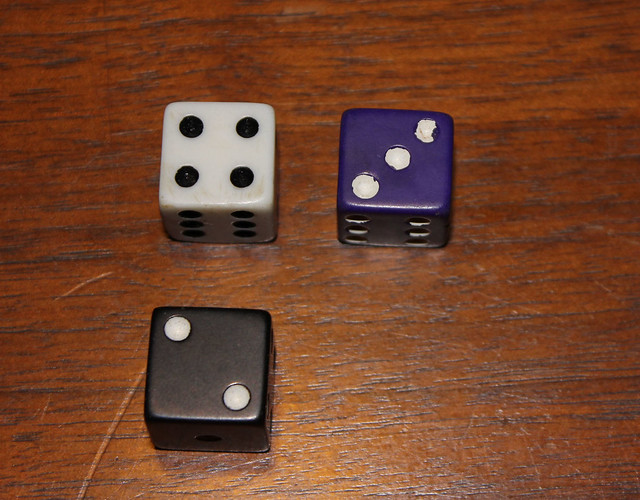
In the simplified example above, the player with dark dice has surrounded the light die with a total of 5, allowing her to score points from the light die. The light die's result is 4, so the dark player earns 4 points.


That's a fine, playable game on its own, but I also got to thinking about how to make it a little more flexible (and possibly marketable). Since going professional this year, I'm increasingly focused on making sure I can bring in some kind of income from what has been a rather idle hobby for the past decade. So, how can I make something sellable out of this idea?


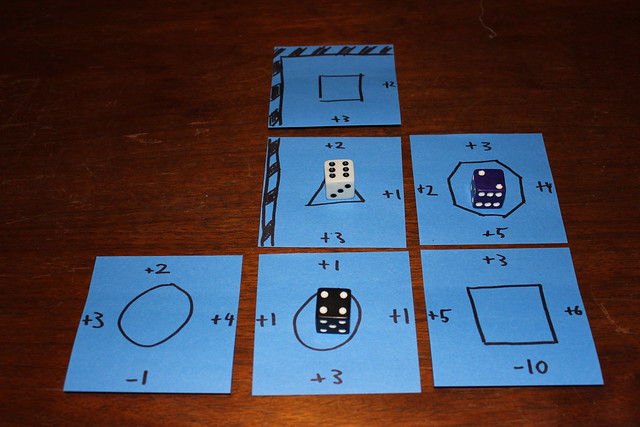
Consider a set with square tiles, a positive or negative number on each side, possibly a wall on one or two sides, and a suit icon in the center. To set up the game, each player draws a tile from the bag and must place a tile adjacent to another tile, Carcassonne style. However the placement is far less restricted than in Carcassonne. You must simply not place a tile adjacent to a walled edge, unless your tile also has a walled edge.

Then you can play the dice game described earlier, but placing the dice on the tiles instead. In considering scoring, you would add your surrounding dice results with the facing numbers on your tiles as well.

Bonus points may be earned for collecting points from spaces with certain suits, or a certain combination of suits over time.


2013-06-05 05.29.54

In the example above, the dark player surrounds a light 6 with 6. Normally this would not be sufficient to score the light dice result. However, the dark player has a +1 bonus from the tile below and a +2 bonus from the tile to the right. Thus, she has a greater sum than the light die result and can score 6 points from it. The "captured" tile also rests on a triangle, which may give the dark player some bonus points at the end of the game.


Much like Triple Triad, there are certainly ways to play this without dice. I can see a deck of cards laid out something like the example shown above. (More or less just Triple Triad cards, really.) You draw five at the start of the round, play one on your turn somewhere on the table, and use the base numbers to determine captures.

Instead of using tokens or chips to determine ownership, cards could have an arrow pointing to one edge. When you play a card, that arrow must point towards you. If a card is "captured," the card is rotated so its arrow points to the new owner, thus changing the orientation of its numbers. Perhaps even leading to a chain reaction!

Yeeeesssss. This may be worth exploring as a card game instead. But what theme? What theme, indeed.