Showing posts with label dice game. Show all posts

Thursday, August 1, 2013

Lords of Waterdice

LordsofWaterdice

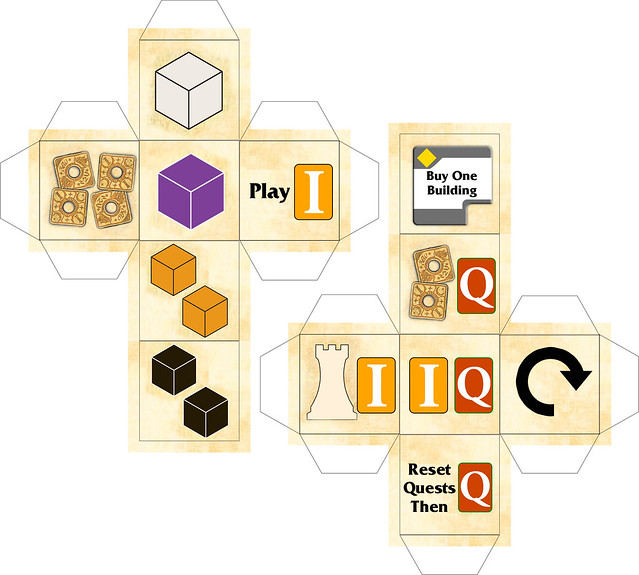
Here's a silly idea. What would happen if you took all the worker-placement spaces of the Lords of Waterdeep board and made them dice faces instead?

Download this PDF and try it out at home. The doc includes sticker templates for 16mm dice and big chunky print-and-fold paper dice. Print a set of dice for each player.


Here are the tweaks to the original game:
  • There is no board. Place all decks, quest cards and building tiles on a central play area.
  • There are agents but they're not used in the traditional manner. Players just have a number of turns in the round equal to their agents. So, players may have agents leftover at the end of the round.
  • On your turn, you may play an agent onto another player's building, roll your dice or accept the previous player's offer (see below).
  • When you use another player's building, put your agent on that building as normal.
  • Any buildings or intrigue cards that allow you to copy another player's actions work as normal.

How to use the dice:
  • If you roll, each die face corresponds to the basic spaces of the original LoW board.
  • Choose one of the actions, resolve its effects, and end your turn.
  • There is also a "reroll" face, which allows you to reroll both dice.
  • Whichever action you choose, the other action will be available to the next player. This is called your "offer."
  • If you accept a "reroll" as an offer, it means you may roll your dice and get one free reroll.

I haven't tested this, but here's what I think might happen. There is less concern about the scarcity of positions, especially since multiple players could take actions in the same round that would otherwise be cut off in a normal worker placement game. Instead, the tension is between randomness and order.

You're not sure if you'll get the specific action you actually need to take. This makes buildings the safer choice, since you know for sure that they're available. The offer mechanic also mitigates some of the randomness, but still allows some bargaining and table talk. "Come on, you don't really want those fighters. Take the gold! C'mon!"

Generally, I split up the actions on the dice into resource acquisition and card play. I didn't really follow any more guidelines than that. I just thought about what might be a tense decision between short-term gains or long-term plans.

Friday, July 12, 2013

Adding Some Spice to Roll-and-Move Games

Sorry

The "roll-and-move" category of games often gets bad rap. Sure, they're often the first games we learn as kids. And for a long time, there was a glut of games that used the mechanic any further thought to the design.

Perhaps there's also just a strain of bitterness because that's the extent of what the vast majority of people imagine a board game being: Simply rolling, moving, and following instructions wherever you landed.

Whatever the reasons, I think the stigma is unfair. The mechanic is just a neutral tool, either used well or used poorly, but has its strengths and weaknesses inherent in itself. Listening to this episode of Ludology got me thinking about ways to add just a little spice to some mass-market roll-and-move games like Monopoly and Life.

  • First, you'll need one die for each player.
  • Determine initial turn order randomly.
  • Before anyone takes a turn, roll all the dice.
  • The first player takes one result out of the pool and moves that many spaces on the board. Continue with the remaining players.
  • If players can occupy the same space, keep the latest entering player closer to the interior of the board.
  • From then on, between rounds, roll all the dice. The player who is farthest behind takes their choice of result first, followed by the second-to-last player, and so on until the player in first gets last choice.
  • If tied in position, the player furthest to the outside gets first pick.

Now you could easily take this kernel and start making a more interesting roll-and-move game all on its own. For example, imagine the game was about racing vacuum robots trying to suck up valuable goodies from the floor while avoiding tacks, spills, and other hazards.

  • Each time you land on a "penny" space, collect a penny token. You can spend three pennies at any time to double your move.
  • Each time you land on a "tack" space, collect a tack token. You can spend three tacks to get first choice during the dice selection.
  • Each time you land on a "spill" space, collect a spill token. You can spend three spills to move to an unoccupied space behind the leader.

And so on, add as many different little items as you like. The key thing is to give players a reason not to just take the highest result every time. Perhaps you want to add colored dice, to add yet another vector of decision-making? Perhaps you're trying to collect colors in a sequence or sets of colors as well? Here's an even wackier idea: Roll-and-Move Worker Placement

  • The board features a track, oriented much like the Monopoly board. The key difference is that the spaces look like what you might normally see in a worker placement game, like Lords of Waterdeep.
  • Right in front of the starting space, you'll find, say, 5 spaces that are very modest, giving you one ore, one wood, draw one card, etc.
  • The further you go beyond the starting space, the more exotic goods you can acquire or actions you can take.
  • The closer you get to making a full circuit around the board, the more straight victory points you might acquire.

Here is the key rule that I think would make this actually work as a tense, strategic game. On your turn, you may

  • Take a die result and move your pawn that many spaces, OR
  • Move your pawn back to one five earliest spaces.
  • Either way, you execute the action of the space on which you land.

So the tension is whether to go back to the modest, but predictable earliest parts of the track. The cost of doing so is losing any progress you've made on towards those lucrative upper echelons. By contrast, there is also a cost in pursuing those lofty reaches, as your acquisitions may be less predictable and the progress quite slow if you stay in the lead.

Thursday, June 20, 2013

Dice + Blackjack + Pazaak = Dizaak?


While I was looking at Triple Triad in the Final Fantasy games, I stumbled across another card-based mini-game. This one is called Pazaak, found in the Star Wars video game Knights of the Old Republic.

The goal of the game is similar to Blackjack, in that you want to play cards such that their sum is as close to 20 as possible without going over. The twist is that you have your own supply of cards, as does your opponent, and there is a randomized deck of "neutral" cards. Player cards have various ranks in negative and positive values. Neutrals are always positive. There are also special cards which double your previous card, flip between positive pr negative, and so on. See the tutorial above for more info.

I got to thinking about how this would work with dice. Your goal is still trying to reach a sum of 20 without going over, using a combination of your own dice and randomly rolled neutral dice. Here's how to play.

First, give each player a supply of dice and set aside an equal amount of neutral dice. The example above is inaccurate, but you get the idea. I think nine dice per player and 18 neutral dice is more than sufficient.

Each player rolls their entire supply of dice to find out their "hand" for the round. You can keep this secret if you like, but it's hard to not cheat with hidden dice so I think having it all be public is fine.

Set aside your personal dice and start taking turns. On your turn, roll a neutral die and keep it in front of you. You now have three choices.
  • Add one of your dice from your supply.
  • Combine two or three dice from your supply for a special action.
  • End your turn, meaning you take no further action for this turn.
  • Stand, meaning you won't take any further turns this game.

For example, if you add one of your dice from your supply, the results are added together. The sum above is now 6.

Or you may combine two identical results from your supply and set them down as a stack. This will double the previous result while also adding its own face value. The sum above is now five, because the 2 is doubled and the stack's face value is 1.

Or you may combine three identical results from your supply and set them down as a stack. This would flip the previous result to a negative. The stack's face value is still added. The sum above is -1, because the triple stack turns the 2 into -2, plus the stack's face value of 1.

Of course if you're feeling dangerous, you can simply end your turn without taking any further action whatsoever. Just keep stacking up those neutral results until you get closer to 20, then you can strike!

The winner is the player with a sum closest to 20 without going over. If tied, the player with the fewest dice in play (including in stacks) wins. If still tied, arm wrestle until someone's honor is restored.

So anyhow, that's a little idea that I'm sure is quite broken. For example, I bet rolling three sixes isn't that great because they're worth more individually than they would be doubling any other result. UNLESS, your neutral result was six, then you play a stack of double-six reach a sum of 18. Not bad for a first turn.

So there you go, a little push-your-luck strategic fun for your day.

Wednesday, June 5, 2013

A Dice-Based Area Control Game inspired by Guilds of Cadwallon and Triple Triad


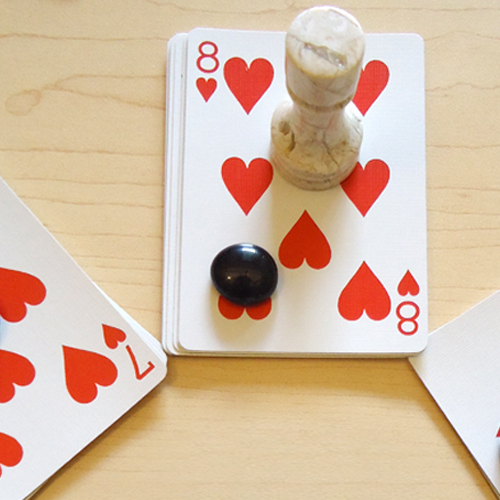
Last week I played Guilds of Cadwallon for the first time. It's a very elegant tactical game with some clever nooks and crannies. You can check it out in the video above. It actually reminded me of Triple Triad, an old digital game from the Final Fantasy series that I've occasionally tried to hack into an analog format.

Anyway, here's a simple dice-based game you can play. Each player starts with an equal number of d6s, in their own color. To start the game, players roll all of their dice at once and leave the results as they stand.

On your turn, take one die from the supply (of either color) and place it on the table adjacent (up, down, left, right, not diagonal) to another die thus forming a grid of dice.

The round ends when all dice have been placed.

Then points are earned by surrounding an opponent's die with your die results totaling a number greater than your opponent's die result. Only orthogonal (up, down, left, right) adjacencies are considered, not diagonal. The points earned are equal to the surrounded dice result.


2013-06-05 05.20.51

In the simplified example above, the player with dark dice has surrounded the light die with a total of 5, allowing her to score points from the light die. The light die's result is 4, so the dark player earns 4 points.


That's a fine, playable game on its own, but I also got to thinking about how to make it a little more flexible (and possibly marketable). Since going professional this year, I'm increasingly focused on making sure I can bring in some kind of income from what has been a rather idle hobby for the past decade. So, how can I make something sellable out of this idea?


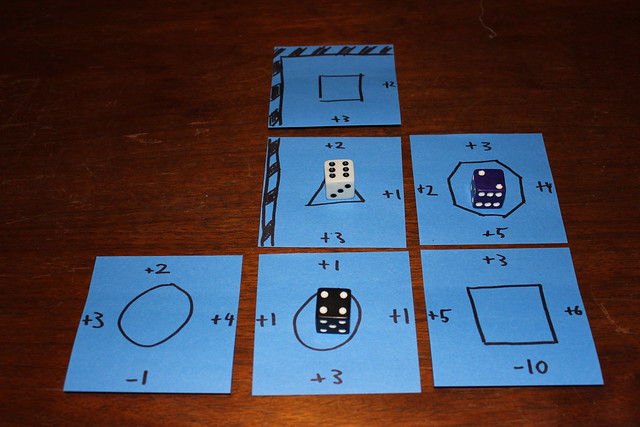
Consider a set with square tiles, a positive or negative number on each side, possibly a wall on one or two sides, and a suit icon in the center. To set up the game, each player draws a tile from the bag and must place a tile adjacent to another tile, Carcassonne style. However the placement is far less restricted than in Carcassonne. You must simply not place a tile adjacent to a walled edge, unless your tile also has a walled edge.

Then you can play the dice game described earlier, but placing the dice on the tiles instead. In considering scoring, you would add your surrounding dice results with the facing numbers on your tiles as well.

Bonus points may be earned for collecting points from spaces with certain suits, or a certain combination of suits over time.


2013-06-05 05.29.54

In the example above, the dark player surrounds a light 6 with 6. Normally this would not be sufficient to score the light dice result. However, the dark player has a +1 bonus from the tile below and a +2 bonus from the tile to the right. Thus, she has a greater sum than the light die result and can score 6 points from it. The "captured" tile also rests on a triangle, which may give the dark player some bonus points at the end of the game.


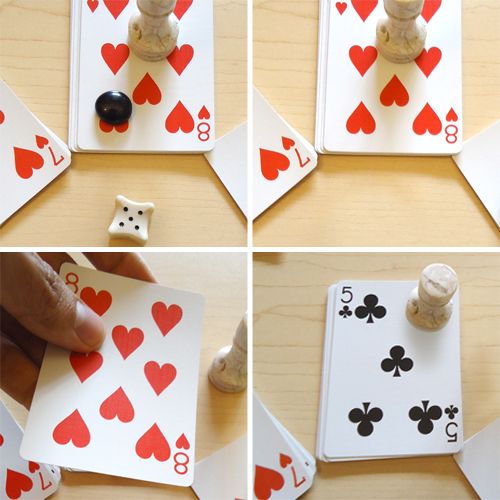
Much like Triple Triad, there are certainly ways to play this without dice. I can see a deck of cards laid out something like the example shown above. (More or less just Triple Triad cards, really.) You draw five at the start of the round, play one on your turn somewhere on the table, and use the base numbers to determine captures.

Instead of using tokens or chips to determine ownership, cards could have an arrow pointing to one edge. When you play a card, that arrow must point towards you. If a card is "captured," the card is rotated so its arrow points to the new owner, thus changing the orientation of its numbers. Perhaps even leading to a chain reaction!

Yeeeesssss. This may be worth exploring as a card game instead. But what theme? What theme, indeed.

Monday, June 3, 2013

Picking the Ingredients of Noodle Roll Dice Game

NOODLES " STRAW and HAY to the egg".

I'm still developing the dice game Noodle Roll when I get a rare moment. I'm eager to put the beta prototype through its paces before I really let it out into the wild. For the moment it's looking like a potential print-on-demand release, depending on whether that market would be willing to provide their own tokens and dice. Here are the details so far:

» Original pitch
» Further notes on revising the theme

Now I've settled on a few key elements that would make it more marketable for a POD/DriveThruCards release.

Tables
  • Each table is a card. During setup, you randomly draw a certain number of three-tops, two-tops and one-top tables to make the board.
  • Each diner is still represented by a die face, as shown in previous blog posts, but they also have one, two, or three spaces in front of them. These spaces represent the diner ordering one, two or three courses for their meal. Thus, a diner with two or three spaces may be served two or three times. This makes the game a little longer and offers players more opportunity to grab adjacency bonuses.
  • I can also possibly add some kind of suit system to these cards to embed even more data for victory conditions, but I don't know a thematic reason for those suits. I'll think about it though.

PlayerCard

  • I've revised the dice positions so that "1" is the wild cube. This allowed me to remove one exception from the rules, which is always a good thing.
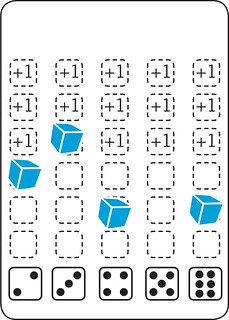
  • I've also revised the player board so that you do not have to serve a dish in the same round you make it. Instead, you can "simmer" by moving up a marker on your player board in the column corresponding to the die face. This makes "serve" its own action, in which you score the points noted by the face, plus bonuses, and then place another marker on a corresponding diner of the board.
  • This also opens up the option for "advanced" player boards in which some dishes increase their bonuses at earlier or later stages. Perhaps even negative points if the dish is "overcooked!"

SousChef 
  • And lastly the "power cards" of the game have been a sticky wicket. I wanted an economy system based on the dice, but keep them limited to the immediate moment. No currency carrying over.
  • So for now, I'm saying that you buy a card by setting aside a certain number of dice in your turn, noted by the power card. This makes a nice solid upper cap for costs based on dice pools. 
  • This also makes an unusual tension between long-term chaos and short-term order. Usually you see the long-term option being more orderly and vice versa.
So that's the current progress of Noodle Roll!

    Thursday, April 4, 2013

    Noodle Roll - A Dice Game about Making Noodles

    making noodles...

    Earlier this week I described how Lyndsay Peters and I got to talking about a little dice game inspired by my misinterpretation of a key rule in Martian Dice. After discussing several different themes, we settled on noodle-making. Here's the full game as it stands now. We're calling it Noodle Roll.


    OVERVIEW
    Players take turns rolling dice several times, keeping sets ("strands") of three or more identical faces, and scoring based on the face value of those sets, plus any bonuses. As play continues, the board’s columns get filled. When two columns are filled, the game ends.


    SETUP
    The game supports 2-4 players.

    The group shares a supply of 13 standard six-sided dice.

    Each player has a supply of cubes in her own color.

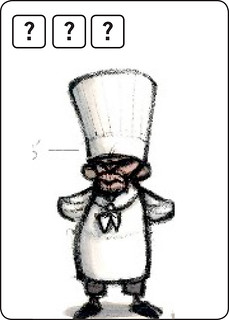
    Each player gets three Sous-Chefs cards. I imagine a different sous-chef on each card. The face shows the sous-chef standing at attention, ready to take orders. The back shows the sous-chef hard at work making a noodle dish. I'd love it to resemble Jason Deamer's concept art from Ratatouille. One can dream.

    The active player gets a player board that looks like this.


    The whole group shares a board that looks like this:


    ON YOUR TURN

    First, refresh one Sous-Chef. If none are spent (as would be the case in the first turn) then proceed as follows.

    Roll all of the dice.

    Now, you must keep one set ("Strand") of three or more identical faces. If there are more than one set available, you must choose only one to keep. Keep this set on the player board in the area designated for your "first strand."

    Next, you may roll any remaining dice in pursuit of a second set or you may end your turn. If you do roll again, you may keep another set whose face is equal to or greater than the first set you kept.

    • If you get no legal sets, you may spend one Sous-Chef to combine any pair of faces to produce another face, thereby potentially making a legal set. So if you rolled a 5/5, you could spend one Sous-Chef to combine a 2 and a 3, to make a complete trio of 5/5/5.
    • If you get no legal sets, you may spend one Sous-Chef to simply reroll all of those dice.
    • If you’ve spent all your Sous-Chefs, you cannot continue rolling. You may keep whatever sets have resulted from your last roll.

    When you spend Sous-Chefs, turn over their card face-down to indicate that they are occupied following your orders.

    Once a set is kept, no more dice may be added to it. If on a later roll you get a set whose face is identical to a set you've already kept, you must keep those sets separate from each other. For example, if you kept a set of 1/1/1, you could keep a second set of 1/1/1 from another roll in the same turn, but those two sets would be separate from each other. They are not cumulative.

    Then you can deliver your noodles to the restaurants who demand them, represented by the group board. The colored areas represent restaurants who demand certain types of noodles. On the far left, the restaurant takes noodles 1, 2, or 3. The middle restaurant takes noodles 3 or 4. The restaurant on the far right only takes noodle 5. Noodle 6 is special, as we'll explain below.

    • Deliver Noodles: Put one of your cubes on the lowest unoccupied space of the column that corresponds to the face of your sets. For example, if you get a set of 5/5/5, you would put a cube on the lowest empty space of the “5” column. If you get a set of 3/3/3, you may place your cube in either of the "3" columns of your choice. If you score two identical sets, place the first cube in the lowest unoccupied space, then the second cube on the space above that.
    • Free Cubes: In a set of 6/6/6, you earn a cube that you may place in any column of your choice. Yes, this means you could theoretically spend a Sous-Chef to make a set of sixes in order to get that free cube that would be placed in the 1 column, for example.
    • Score Points: Score a number of points for each set equal to its face value. So a set of 5/5/5 grants you 5 points. Any dice beyond the initial trio in a set scores 1pt per extra die. So a set of 2/2/2/2/2/2 scores you 5 points (2pts for the trio, then 1pt each for the extra three dice). Note: Do NOT score sets of sixes. They are only used to get free cubes.

    Pass all dice and the player board to the player to your left. Any Sous-Chefs you've spent remain so until the start of your next turn, at which point one will be refreshed.


    ENDGAME
    The game ends when two columns have reached or crossed a certain height, as noted by the line corresponding to the size of the player group. For example, in a two player game, the game would end when two columns have reached or exceeded three cubes in height.


    ENDGAME BONUS
    Score 10pts for each pair of your horizontally adjacent cubes on the board, but only if they’re in the same restaurant, as indicated by the colored backgrounds. Thus, the "5" column has no endgame bonus. Columns 3 and 4 can have an endgame bonus. Columns 1, 2, and 3 allow rows of three adjacent cubes, thus effectively being two pairs, thus two bonuses.


    In the example above, the row of three white cubes in the yellow restaurant earn a total bonus of 20pts, because they are considered two pairs of horizontally adjacent cubes. The row of black cubes in the pink restaurant earn 10pts. The single black cube in the blue restaurant earns no bonus.

    So, pursuing low-value sets in the short-term can yield big bonuses if you can make pairs on the board. Pursuing the highest value sets yields no endgame bonus at all, but they are the easiest to create with the assistance of Sous-Chefs.
    Sunday, March 31, 2013

    Playing the Fool: Getting Rules Wrong in all the Right Ways


    Yesterday morning Lyndsay Peters and I played Martian Dice via Google Hangout, which is when I discovered that I have been playing it incorrectly this whole time.

    I thought if you wanted to capture humans, you had to capture them before cows and chickens. If you captured cows or chickens first, you couldn't capture humans in a later turn. However, you could capture as many cows or chickens as you liked until you busted a roll or ended your turn.

    This wasn't the case at all, as it turns out. You may capture humans, cows and chickens in any order you like, but you couldn't take one type if you had done so earlier. I'm still not sure how I got that so wrong. I think it's because there was a line break in the sentence explaining that rule. But really, it's just silly how wrong I got that. Sheesh!

    There are no rules so short and clear that everyone will follow them as intended. In fact, the shorter rules are just as prone to misinterpretation.

    But on the bright side, this got us in a discussion of actually using my misinterpretation as the core mechanic of a new dice game. After all, I've been playing it this way for so long, I thought it was perfectly sensible. We combined with the point-dice mechanics from King of Tokyo. The basic idea was this:

    • Roll 13d6. This guarantees you'll get at least three identical results.
    • You must keep one set of three or more identical results and score their face value in points, plus 1pt for each die beyond the initial three dice in the set. (So a set of 3333 would score you 4 points.)
    • Thereafter, you can keep rolling the remaining dice and keep one set from each roll, as long as that set is of equal or greater face-value as one you've already kept. (So if you kept 333, you could not keep a 111 or 222, but you could keep another 333, 444, and so on.)
    • If your roll results in no legal sets, you get a STRIKE. Strike three times and your turn is over.

    That led to still further discussion of expanding the long-term gameplay to an area control mechanic for endgame bonuses. Something with a noodle-making theme, perhaps, describing each set as a strand of noodle. That's a subject for another post. For now, I'll just remember to check my rules knowledge more often. Who knows what new games will come?

    Friday, March 29, 2013

    What's in the egg?

    Easter Eggs | Macro

    Back in 2011, I posted this simple push-your-luck dice game called Bombs Away that could be played with one die. I soon discovered some similarities to a 1994 casino-themed dice game called Sharp Shooters, which was later reimplemented by Ravensburger as Royal Casino and Temptation.

    The basic mechanic still appeals to me, though I've since taken as a personal challenge not to design any games with violent or combat themes. So, the bomb has to go. Curious about alternate "ticking timebomb" metaphors would work with this mechanic, I kind of like the image of a mystery egg. Players are taking turns sitting on an egg until it hatches.

    The longer you sit on the egg, the more claim you have over it, but what comes out of the egg may not be what you expect! The egg is represented by one d6. You roll the die to sit on the for one day and place one of your colored cubes in an open space beside the result.

    1     [   ]    
    2     [   ]     [   ]    
    3     [   ]     [   ]     [   ]    
    4     [   ]     [   ]     [   ]     [   ]    
    5     [   ]     [   ]     [   ]     [   ]     [   ]    
    6     [   ]     [   ]     [   ]     [   ]     [   ]     [   ]   

    You can continue sitting on it, rolling once for each day, or you can pass your turn to the next player. If you ever roll a result which has no empty spaces, the egg hatches! All sorts of things might hatch from the egg, resulting in different benefits and penalties for each player who sat on the egg. There is quite a bit of information to draw from this simple system.

    • Did the egg hatch on a 1, 2, 3, 4, 5, or 6? Each might be a special group of results, with 1 being the most rare results since it's so unlikely.
    • Who sat on the egg the longest? Whatever hatches may reward this player for taking the time to incubate it.
    • Who hatched the egg? Even if you didn't spent much time sitting on the egg, whatever hatches might imprint on you, giving you some benefit in the long-term.
    • Who sat on the egg the least? Whatever hatches might resent this player for not spending enough time caring for it. Or maybe go the opposite direction and reward this cautious player!
    • Which row is most occupied when the egg hatched? This might determine the value of whatever hatches, meaning if there were a lot of 5s filled on the egg, but it hatched on a 2, it gets some special ability.

    Want to get even crazier? Make it a worker placement game where players incubate a whole roost of eggs. Each player bids to lay on a chosen egg, each being incubated at different rates based on the preceding die roles. In this case, pecking order really does matter. Neat!

    Sunday, December 30, 2012

    2012: A Year in the Game Design Lab

    Stone Age dice & meeplesOver the past year, I've posted numerous game ideas in various stages, but all have been considered "in the lab" because they're really not ready for prime time. I just wanted to share my thoughts a bit. Next year I'm ready to actually see some of these ideas come to fruition. Here's a pretty comprehensive list of ideas posted to this blog in 2012.


    Games to Prototype and Test
    These are games which are to the point where I could make a prototype and actually test at some point.
    • Dung and Dragons/Dragon Ranch has been a long-simmering theme: Hippie co-op farmers raising dragons for their valuable poop. I finally cracked a cool mechanic for this idea, it just needs to get tested and refined. I'm really excited about how these simultaneous actions could interact with each other in unpredictable ways.
    • Wine Collector: This was an experiment in deduction game design. Not sure how well it's actually going to work in practice, but I definitely like the notion of averages being on one side of a card with a single number on the face.
    • Haunted House continued that notion, replacing numbers with shapes. This was inspired by a particular sequence in the latest Mario Party games in which you must repeatedly decide between three doors, only one of which leads to safety.
    • Exodus: Earth wants to be a "worker removal" game, where effects are triggered by removing a meeple off of a space. The eventual goal is to remove all of your meeples from the board before a meteor hits Earth. I just need to figure out the basic mechanics of the thing first.
    • Sidekick Quests: The Card Game came into being when my wife and I visited Lyndsay Peters in Canada. We hacked together elements of Waterdeep, No Thanks and some other stuff to make this hodgepodge of different mechanics. This was eventually streamlined to a much simpler push-your-luck card game that you should see available for beta soon.
    • Pop n' Locke's Last Heist was released as a playtest PDF to Writer's Dice backers early this year, but never saw much testing or discussion. Thankfully Tom Cadorette had a good playtest of it in August. I need to hit the document again to see where things should be tweaked and finally release things thing to the wider public.
    • Proxima-3/3io was ostensibly a board game adaptation of Triple Town. I need to test this set and see how the game feels to play as a multiplayer experience rather than a single-player puzzle.
    • Picker began with some exploration of Libertalia's blind auction mechanics. I still need to figure out how to solve the inherent negative spiral of choices that players have available to them. As it stands, there is still a "correct" choice in every turn. That's not bad, it's just a problem when there is one optimal choice rather than several.
    • Step Right Up is a game about snake oil salesmen hawking their wares on a crowded boardwalk. They sell goods to hire different kinds of goons to do their dirty business. The mechanics feel sound, they just need testing. The theme is unfortunately getting kind of crowded lately, though.
    • Seven Minutes of Terror was inspired by the Mars Curiosity landing and its absurdly complicated landing sequence. I think with some thematic cards and stronger endgame goals, this could be a nice light 10min game.
    • Dead Weight: Parkour vs. Zombies finally got a board game execution this year. It needs testing, but I'm glad I finally put that baby out in the world.
    • The following Thanksgiving, I posted Black Friday, a racing game that was also an auction game. Your position on the race track gave you best pick of items in your space, but you also had to bring back your items to the finish line in order to have the best score without penalties.


    Themes in Search of Mechanics
    These are game ideas that have a strong theme, but still need mechanical refinement.
    • Swap Clops the Tile Game and Swap Clops the Card Game: I'm really itching to use this fun art that Kari Fry made for me in January. Who doesn't love floating, surly one-eyed monsters? I still think the Clops have potential as a long-term IP.
    • Rulers: This Hunger-Games-meets-Mage idea was one of the rare story games from me over the past few months. This neverseemed to hook folks much, but then again I was lax in my development efforts, too. I'm going to see what I can do to put these out in a more digestible form soon.
    • Towers of Battle was a weird letter tile and area control game idea I posted on February. In hindsight, I must have read about apps like Letterpress and Puzzlejuice when I came up with this thing.
    • Vulture Capitalist/Bird Brands was inspired by No Thanks, Amun-Re, and Empryean, Inc.  I still occasionally get some mechanical ideas that could fit in this silly theme.
    • Dr. Remedy Grove: I had thoughts about this as a game franchise, each entry focusing on ecological themes and components made from sustainable materials. Kind of a Carmen San Diego for ecology.
    • Monks of St. Honorat honor their vow of charity in an interesting way: They earn lots and lots of money from their world-famous wine, then donate it all to their various charities. "Earn more to give more" is an interesting take on Brewster's Millions.
    • Where is the Poison? is inspired by the poison scene in Princess Bride. These mechanics seem good enough, but they could be much more streamlined. I imagine that this could be even as minimal as Seiji Kenai's Love Letter, but it just needs some more attention.
    • The Everywheres was a dimension-hopping game based on the CC-licensed superhero Jenny Everywhere. I really want to explore this game further with a mashup of Split Decision, Talk Find Make, and Thanks and Complaints (below).
    • Thanks and Complaints as a replacement for the typical success/failure binary in role-playing games. It brought to mind much different reactions to typical adventure game violence.
    • This City-Building Tile game is has a reasonable theme already, but I think some more thematic tiles would do wonders to make the game more strategic, too.
    • Asteroid Mining is a pretty cool idea to me and I think I'm close to a good mechanic here. I need to decide what it is you do with the materials you're mining, though. May also need a smaller asteroid belt/card deck.


    Mechanics in Search of a Theme
    This is by far the biggest category in the lab. These are mechanics that as yet haven't found a good theme with which to be paired.
    • Dice Pool Action-Selection Mechanic: This was posted right after I played Yspahan and saw its very clever dice mechanic in action. I wanted to capture something similar as an action selection device.
    • Dice-matching resource management: I must have been on a dice kick last spring, because here's another dice pool based resource acquisition mechanic. No idea where this one will go, but at the time I imagined it as a game based on Maslow's Hierarchy.
    • Dice Puzzle was eventually cracked by my mathematically inclined friends, but it was a cute diversion. I may revisit the basic interaction again at some point. 
    • 3-2-1 had you roll three dice, keep two results, then give one result to the next player. It brought to mind a lot of co-op potential. Will tinker with this eventually.
    • Legacying was a popular subject last year. I even wrote three best practices for how to do it well, which got noticed by designer Rob Daviau. I look forward to seeing how others use the Risk: Legacy mechanics to design brand new games.
    • Secret Action Selection + Public Negotiation was one of the many mechanics I explored for Dung & Dragons last year. It turned out to have a critical hurdle: If you're co-operating, why keep action selection secret? I never revisited this idea long enough to answer that question, but I should.
    • Player-Controlled Resource Values struck my fancy as I explored stock market themes. In this case, buying and selling a commodity raised or lowered its value on an abstract tracker. The price you pay now influenced the price you'd pay later.
    • Memory + Action Selection was another one of those mashup ideas that never got explored too deeply. It may still have something worthwhile as a kids' game with some additional strategy for adults. Basically, if you found two matching tiles, you could do the action noted on those tiles. Thus, you're not just memorizing placement, but pursuing specific tactics.
    • Multi-Memory: I also explored multi-dimensional memory mechanics in this abstract card game, but it might be too dry a brain burner for the MENSA Select judges.
    • Vases, Crates and Barrels broke down the rarity and distribution of the Yspahan game board into a single deck of cards. I still need to suss out how best to use this information, but it's powerful mojo.
    • Then there was this Yspahan+Knizia+Cosmic Encounter mashup where you negotiated trades for certain goods with the other players. Ultra minimal, but with emergent behavior. (At least, that's the hope.)
    • Chibi Sweeper was a tabletop mashup of Minesweeper and Chibi Robo. Not sure where this one is really going, but once again, I like the idea of knowing half-information, then deciding whether to commit to the second half.
    • Recycling Decks is basically a typical deckbuilder, except your discarded cards go to your opponent. It really needed a strong theme to make that make sense, though.
    • Make Me an Offer was the first in a series of little ideas where I tried to take the basic interaction of games like Apples 2 Apples and Cards Against Humanity into the realm of a Euro board games. Not sure how successful it is without a better theme though. In hindsight, this might be a strong game with a deck of Sushi Go cards. Which led to...
    • A Co-Op/Competitive trading game that could theoretically work as a system for For The Fleet. It just needs more redshirts.
    • I had a handful of trick-taking mechanics this year, but this was the most polished. It just needs a good theme to justify and explain the mechanics.
    • And finally, this worker-placement spillover mechanic was an interesting idea that sparked a lot of discussion for themes. Scientific progress perhaps?
    Phew! 2012 was a prolific year for half-assed ideas. That's being generous, most of these are quarter-assed at best. Goal for next year? Add the rest of the ass. Yes.

      Thursday, December 13, 2012

      Riverbanks: An Example of My Game Design Process [In the Lab]


      Folks ask me all the time where I get game ideas, whether it's mechanics first or theme first. Sometimes it's a little of both, as we'll see here.

      One of my favorite recent mechanics comes from Doug Bass' Garden Dice. In that game you roll four dice to plant crops on a 6x6 gridded plot of land. The dice tell you the coordinates of where you may plant. You can do other actions based on the remaining two dice results. Choosing which dice to use in which capacity is a big part of the long-term strategy.

      So I spent yesterday thinking a few ways to use this basic skeleton for other purposes, the first of which is a dice-based resource acquisition game. This begins without a theme, but in exploring the mechanics, we start to see how a theme naturally emerges.

      6x6Grid-A-1

      Play centers on a 6x6 grid from which you can acquire resources: A, B, C, D, E, and F. The intersections of each row and column show combinations of two resources and double-resources along the diagonal from top left to bottom right.

      On your turn, you roll three dice and choose two of those results to be the coordinates from which you will acquire the noted resources. The third die shows how many of those resources you will acquire.

      For example, you rolled 2 5 4. You chose to harvest from 2/5, which means you get 4 of resources E and B. If you rolled 4 4 3, you could choose to harvest from 4/4 where there are two Ds. This means you acquire resource D at twice the rate as normal. So, instead of just 3 Ds, you acquire 6.

      But towards what end? I'm not sure. Perhaps you are trying to purchase advancements that require a specific recipe of resources, Waterdeep-style? Whatever the case, there are interesting permutations in this system.

      6x6Grid-A-2

      1/1's resources can be a little more common than 6/6's resources. The likelihood of rolling 1 1 1 and 6 6 6 are equal. However, a roll of two matching numbers and a non-matching number is much more common. Thus, on a roll of 1 1, it is much more likely that the third result will be greater than 1. Conversely, on a roll of 6 6, it is much more likely that the third result will be less than 6.

      Granted, it's a small statistical difference. (EDIT: And, as Levi Middleton points out, D ends up being the more rare resource.)

      This still gives me some sense of structure for a theme. Perhaps the A resource is a common ingredient in the game's recipes whereas the F resource is something more rare but valuable, like straight victory points or perhaps wild resources that can be used as placeholders for other resources.

      The other interesting facet of this system is that each combination of resources has a twin on the opposite side of the board. 5/3 gives the same stuff as 3/5. So, perhaps there is room for adding another type of resource to acquire, based on which side of the diagonal you choose.

      6x6Grid-A-3

      Indeed, this comes to resemble the banks of a river. The river itself is abundant and fruitful. Its banks are blessed with useful combinations of resources while the far corners are dry prairies and deserts with less useful combinations of resources.

      When you acquire resources from a space, so you also lay claim to it. In choosing a space that is occupied by another player, they may ask for a "tax" to give you permission to use that space.

      Thus, our old friend the area control mechanic plays a significant part in this game. Those recipes I mentioned earlier? Those may be used to purchase advanced settlements that levee taxes on neighboring spaces; or award points to occupants of neighboring spaces; or renders a space unusable thereafter. Who knows?

      Anyhoo, this is how my game design process usually begins. I'll notice a curious wrinkle of probability that makes a decent metaphor for a real-world phenomenon. Of course, it's usually at this point that someone will point out a game that has already covered similar territory, usually designed by Reiner Knizia!

      But I hope that documenting my thought process is at least somewhat enlightening. Because geez, I just love designing games.

      Thursday, November 8, 2012

      Mashing up Divinare with Liar's Dice

      liar's dice
      I had the good fortune of playing Divinare last weekend. ("Fortune." Get it?) It's about old-timey psychics competing to prove who's the real deal. It's a clever little deduction game with an element of take-that and push-your-luck in one elegant package. As much as I love Cards-with-Numbers, I'm especially fascinated with cards that only feature art and no other game information. I'll do a post on that soon.

      Check out Tom Vasel's review of Divinare for details of how to play. The experience reminds me a lot of playing the classic game Liar's Dice. If you haven't played that, you should too. Here are the basic rules as I play them at home. Note that there are numerous variants, I just happen to like this one.

      Each player has five standard dice and dice cups for concealment.

      Each round, each player rolls their dice under their cups. Each player looks at their results in secret. The first player guesses out loud a quantity and a face. This is called a "bid." The quantity is how many of the chosen face have been rolled in total on the table.

      For example, "Five threes," means "I think there are at least five threes on the table."

      Then the next player has three choices:

      • Raise: Increase the quantity. For example, "I think there are at least six threes on the table."
      • Challenge: You think the current bid is wrong. All players then reveal their dice. If the bid is correct, you lose one of your dice. If the bid is wrong, the bidder loses one of her dice.
      • Approve: You think the current bid is exactly correct. If the bid is correct, all other players lose a die. If the bid is wrong, you lose a die.


      When you run out of dice, you're out of the game. The last player with dice remaining wins.
      So, a fairly simple game of bluffing and deduction, with lots of on-the-spot permutations. One nice thing Divinare provides is four boards that visually show the likelihood of each suit in the deck, thus making it fairly obvious how rare it is. There are probability charts for Liar's Dice, like the spreadsheet here, but you don't get that tight sense of area-control like you do in Divinare. I see two options for hacking.

      Area Control Boards
      There is a board showing a grid of numbers and ranges. Columns represent faces, the rows represent quantities. Each player has two meeples that begin on the 0,0 corner. Instead of a bid, you have to reveal one of the dice in your hand. Upon doing so, you move your meeples along either axis of the board, landing on either a column or a row. Play continues until all dice are revealed. You can always move a meeple back to the 0,0 corner or to another space, but you cannot occupy a space with another player's meeple. In the end, players are awarded points for accuracy of their placement on the board. Correct column? x points. Correct row? y points. Exact correct? z points.

      Colored Dice
      This option is the same as the above, with an additional layer of deduction. Each player has nine dice: Two blue, three white, four red. When you reveal your die, you can only move the meeples on the board matching the color of that die. So, you only get two guesses on the blue board, three guesses on the white, four on the red. Blue: Triple points, White: Double points, Red: Normal points.

      How about you? Any deduction games you particularly enjoy? Share your thoughts in the comments!

      Sunday, October 28, 2012

      Updates to Picker

      Picker Dice Game 1.3
      Based on the math feedback from Mark Sherry, I made some changes to the core rules of Picker. Mainly this involved resolving this strange bug where being a Picker was actually more detrimental to each player's score. Based on the revised rules, the simulations show that being a Picker gives you a slight percentile advantage, which better fits the spirit of the game.

      Here are the basic changes:

      • The dice are different colors, which are now the basis of set bonuses, independent of the results.
      • There is no more SHAFT role. It was actually a greater detriment to all AIs and led to lower final scores.
      • The PICKER role always picks herself to be first player. Again, this balanced out the anti-picker bug a bit and streamlined the rules.
      • The set bonus is streamlined to a linear +3, with a maximum of +15 for a set of 6-of-a-kind.
      • Clarified that you can score bonus points for multiple sets, so long as each are a different color.

      I've updated the main page with these new rules. Test it out and see what you think! The two-player game still doesn't feel substantial enough. How would you tweak it?

      Thursday, October 18, 2012

      Picker - A Simple Pub Dice Game

      Picker Dice Game 1.3
      Here's a super simple pub game to play with normal dice, inspired by the customized dice drafting mechanic in Seasons. It's so simple, in fact, that I could fit all the rules onto one graphic. Neat, eh?

      3 or more Players
      5-10 Minutes


      EACH ROUND SETUP
      Roll 1d6 per player. Each die is a different color.

      Resolving Ties: If all the dice come up with the same result, roll them all again until there is at least one different result.

      In the first round, youngest player goes first. Thereafter, each round's turn order changes.


      ON YOUR TURN
      Keep one result. Score that many points. Keep track of your chosen color each round.

      If you are first to keep the lowest result, you will be first player in the next round.

      Clarification:  If there are ties for the lowest result, only the first player to keep that result gets this effect. For example, if there are two 1s, and you keep a 1 first, then you're the Picker. Whoever keeps the second 1 gets no benefit.

      Turns proceed clockwise for the rest of the round.


      ENDGAME
      Play 2 rounds per player.

      You will score bonus points if you keep the same color across multiple rounds.

      2: +3
      3: +6
      4: +9
      5: +12
      or 6: +15 (max)

      Of course, you may continue keeping dice of the same color after the sixth, but you won't get any further benefit.

      You may score several sets if each are a different color. For example, if you kept the red die three times and yellow die five times, you’d earn 18 bonus points total.


      VICTORY
      The player with the most points wins!

      Tuesday, September 11, 2012

      3-2-1 Dice Mechanic: Roll Three, Keep Two, Give One

      Three Three Three
      Here's another odd dice idea I tweeted last weekend. Assume you're playing a story game. Assume that each turn, players state one thing that they want to change in the story, using their characters as the means of change. And also assume that each turn, the active player will get a graduating range of complication on her stated actions.

      This range is drawn from a pair of d6 dice results, ranging from 2-12. 2 is the most complications, 12 is the fewest complications. The most common result is 6 or 7, which represent just a few complications.

      Here's the trick: You actually roll three dice on your turn. After rolling, you choose which two dice to keep as your official results. Then you pass the third dice result to the next player for their turn.

      He then rolls two dice and now has to choose among the three results: Those two he just rolled and the one result you gave him. If he takes your result, you earn a point. If he doesn't take your result, it passes to the next player, and so on until someone takes it or it comes back around to you. If it comes back to you, you lose one point.

      There are some interesting choices here: You can offer a high result to your neighbor in the hopes of tempting him to give you a point, thereby possibly complicating your turn in the short-term. You can offer a low result, thereby reducing your complications by possibly finding it come back to bite you in the end.

      And what are points for? Let's brainstorm that a bit.
      • Perhaps points are a pacing mechanic, so the "mission" ends when there are a certain number of points across the whole group.
      • Or perhaps it's competitive, so the game ends when one player has a certain number of points.
      • They could buy off complications.
      • They could buy re-rolls.
      • Maybe you can buy +1 modifiers on the lowest, middle, or highest dice.
      You tell me! Share your thoughts in the comments.

      Tuesday, April 10, 2012

      Dice Puzzle


      Here's a solo dice puzzle for you. It's an oddly hypnotic way to spend a few minutes before giving up in frustration.

      Setup
      Gather a block of 36 dice.
      Roll a die.
      Place it on the table.

      On Your Turn...
      Roll a die. Place it adjacent to a die already on the table. Gradually, you'll create a branching dice formation. As soon as you create a contiguous chain of 3 or more with matching results, remove all the matching dice in that chain. Chains do not count diagonally adjacent dice. Only vertically and horizontally adjacent dice count.

      Restrictions
      1. Your formation can't extend past a 6x6 grid. Note: There is no board. The overall formation of dice simply can't extend taller or wider than 6 dice. Thus, the first die you place is technically the center. As you add or remove dice, the outerbounds of your formation can shift dramatically. Indeed, over time, the formation may seem to crawl like an amoeba over the table.

      2. You may not remove any dice that would create "islands" of disconnected dice. Thus, you might have a chain that contains more than 3 matching results, but you may not remove those dice if it would leave behind even a single die disconnected from the rest.

      3. If you already have a contiguous chain of 3 or more matching dice on the board, it stays on the board until you can add a freshly rolled matching result to that chain. Then, you may remove that chain.

      Solution
      If you manage to remove all the dice from the table, you have solved the puzzle. If you find a reliable strategy or solution, leave it in the comments!

      Wednesday, December 21, 2011

      Low-High Dice Game


      A dice game inspired by the stock market (and playing lots of Martian Dice). Roll a bunch of dice and choose which sets to keep. Choose your strategy wisely!


      Stuff You Need
      Two-to-Six PLAYERS
      A PENCIL and PAPER to keep score
      Thirteen standard six-sided DICE


      How to Play


      The shortest player takes the first turn. On your turn, first roll all thirteen dice. Several dice will have matching results. These are called SETS. (A single die result is a set, too.) You must choose a set to keep. For example, your first roll results are 111124445555. The sets are four 1s, one 2, three 4s, and four 5s.


      After keeping a set of dice, lock them up in a row. This is called the GOOD TRACK. For example,  you could keep the set of four 1s, one 2, three 4s, or four 5s. You decide to keep the four 1s and line them up in your good track.


      After keeping a set, you may end your turn or re-roll the remaining unlocked dice. When you re-roll, immediately set aside any results that are equal to or lower than a set you’ve already kept. Lock these up in a separate row. This is called the BAD TRACK. For example, out of three previous rolls you kept four 1s and three 2s. You have six unlocked dice remaining and you decide to roll them again. The results are 112446. You must immediately set the aside the two 1s and one 2 to your bad track.


      Out of the remaining dice, keep another set and add it to your good track. You may continue re-rolling as long as you have unlocked dice available or until you choose to end your turn. For example, after losing dice to the bad track, you have the following choices: 446. You choose to keep the two 4s and end your turn.


      At the end of your turn, discard one good die for each bad die. If good dice remain, score one point per die. If bad dice remain, lose one point per die. For example, you have three dice in your bad track. That means you must discard the first three dice from your good track. Luckily, you have five dice remaining in your good track, so you get five points this turn.


      End of the Turn
      After your turn ends, clear your good and bad tracks. Hand all thirteen dice to the next player, who will begin a new turn.


      End of the Game
      The first player to earn 30 points wins.


      Variant
      For higher scores and more variance, you can score based on pips instead of dice. When canceling out dice at the end of your turn, do so in ascending order. The lowest results in your good track are canceled out first. Alternately, you can cancel out the highest results first for a lower scoring game.

      Strategy
      It's tempting to keep the lower results, but those will be quickly negated if you decide to continue rolling. Perhaps that's your strategy, to build up a defense as you pursue larger sets from future rolls. You could also play it safe by just keeping the largest set out of your first roll, but then you might get outpaced by a more aggressive player. Choose your path wisely!

      Monday, December 12, 2011

      Bombs, Away! Dice Game


      This is a quick "hot potato" game for 1-6 players. There is a bomb with a lit fuse on the table. The longer you hold it, the more points you get. Just don't hold it too long or kablooey!


      Stuff You Need
      One six-sided die
      A pencil
      A sheet of paper with the score tracker drawn as shown below.

      6     [   ]    
      5     [   ]     [   ]    
      4     [   ]     [   ]     [   ]    
      3     [   ]     [   ]     [   ]     [   ]    
      2     [   ]     [   ]     [   ]     [   ]     [   ]    
      1     [   ]     [   ]     [   ]     [   ]     [   ]     [   ]    


      How to Play
      The youngest player takes the first turn. On your turn, take the die. This is the BOMB. You may do one of two things with it.

      1) Pass it: Write your initials in the lowest open space on the score tracker. Give the bomb to the player on your left.

      2) Roll it: Roll the die. If the result is a 1, write your initials in an empty 1 space on the score tracker; if the result is a 2, write your initials in an empty 2 space; and so on. You cannot write your initials in a filled space.

      The bomb explodes if you were unable to fill in an empty spot on the score tracker. In other words, the bomb explodes if you roll a second 6, third 5, fourth 4, fifth 3, sixth 2 or seventh 1.

      If the bomb hasn't exploded, your turn is over and you're still safe. Give the die to the player on your left. That player begins a new turn.


      End of the Round and Scoring
      The round ends if all players pass or if the bomb explodes.

      You score points based on the spaces in which you wrote your initials. You score 1 point for a 1 space, 2 points for a 2 space, and so on.

      If the bomb exploded in your hand, you lose a number of points equal to that last die roll. For example, if you rolled a second 6, then you would lose six points. (In a game with four or more players, then your neighbors also lose that many points as well.)

      The next round begins with a fresh, completely empty score tracker. A new player takes the first turn.


      End of the Game and Winning
      The game ends when each player has a chance to be first player. When the game is over, add up all your points across the rounds.

      The player with the most points at the end of the game wins. (In the highly unlikely case of a player entering the final round with a 56 point lead, that player automatically wins because it would be impossible to overcome that deficit.)


      Options
      Solitaire: If you play the solitaire game, you do not gain any points for passing.

      Multi-Bomb: There are two or more bombs floating around the table. Any players with bombs roll one at a time, in order of age, from youngest to oldest. You all still use the same score tracker.

      Big Bomb: Play with a larger die, like an eight-sider, ten-sider, or twelve-sider. Revise the score tracker so the highest possible result only has one space, then add one space for each subsequent result.

      Variant Tracker: Revise the number of spaces for each result, increasing or decreasing as you like. Perhaps you want more 6s and fewer 1s?


      Notes
      This game was a result of a Pitch Tag session with Fred Hicks.

      Monday, November 7, 2011

      Particle Panic

      Torus Lab is the world's largest particle collider, unleashing new exotic particles unknown to science. Now the lab is out of control! The scientists must input the self-destruct codes or the unstable particles will endanger the world.


      Stuff You Need
      1-4 players
      A pawn for each player
      A six-sided die
      Two decks of playing cards shuffled together
      Lots of particle tokens


      Setup
      Shuffle the deck and deal three cards to each player. (Seen at the corners of the above image.)

      Cut the remaining deck into six roughly equal stacks. Arrange those stacks in a circle face-up. (Seen in the center of the above image.) Each stack represents a space on the game board.

      Each space is numbered 1 through 6, clockwise from the top as shown in the image on the right. Each player's pawn starts at the space marked 1.

      Place one particle token each in spaces 2, 3, 4, 5, and 6.

      Finally, keep the die within easy reach of all players.


      On Your Turn, you can perform one of the following basic actions and one of the following special actions. (In a two- or one-player game, you can do two of each.)

      BASIC ACTIONS

      Move your Pawn: Roll the die. Your pawn may move up to that number spaces clockwise or counterclockwise.

      Neutralize Particles: You may remove particles from the space your pawn occupies. If you want to remove a particle, roll the die. If the result is 4-6, you may remove the particle. If the result is 1-3, your hand limit (which is normally 6) is reduced by one and the particle remains. You may remove as many particles in a single turn as you're willing to try. (In a two- or one-player game, you can neutralize particles on a 3-6.)

      Collect a Card: If your pawn ends a turn on a space with no particles, you may collect the top card from this space and add it to your hand. (In a two- or one-player game, you may collect the top two cards from this space and add them to your hand.)

      In the examples above, you just moved your pawn into a space that contains a particle. You roll to neutralize this particle and get a 5. So, you remove the particle from this space. Now, you collect the top card (a heart) and add it to your hand.

      SPECIAL ACTIONS


      Spend Cards: You may spend as many cards from your hand as you like.
      Spend a HEART to reroll a neutralization die.
      Spend a CLUB to add 1 to a neutralization die result.
      Spend a DIAMOND to move your pawn to an adjacent legal space.
      Spend a SPADE to move a particle to an adjacent legal space.
      When you spend a card, place it in a discard stack away from the game. It is no longer in play.

      Share Cards: You may give any number of cards to another player as long as both your pawns are in the same space. They may not give you cards.

      Enter a Self-Destruct Code: You may spend five cards of the same suit to input a self-destruct code for the lab. There are four self-destruct codes total, one for each suit. In other words, you must discard five HEARTS to enter the heart code, five CLUBS to enter the club code, five DIAMONDS to enter the diamond code and five SPADES to enter the spade code.


      Particles Emerge
      If the lab has not been destroyed, more particles emerge at the end of each turn. Roll the die twice. The first result is how many particles will emerge. The second result is the space where the particles will emerge.

      In the example above, the first die result was three, so three particles will emerge this turn. In the second die result was a five, so those particles are now on space number 5.

      If a space ever has more than six particles, the extra particles spill over into the nearest adjacent legal spaces. Distribute those extra particles as you wish.

      In this example, more particles emerged than could fit in space 5. So, you decide to move the extra particle to Space 1, which still has plenty of room.


      Goal of Play
      To win, you and the other players must cooperate to enter all four self-destruct codes before the game ends. The game ends if there is no more room for any new particles; if any player's hand limit is reduced to zero; or if a space runs out of cards.


      Design Notes
      This game originally began as a thought-experiment in how to play ZOMBIES!!! on a smaller, more claustrophobic board. As a commercial product, I can see the cards more diversified. Instead of dice rolls, the cards might handle particle emergence. They may also offer interesting powers when you have them in your hand. For a slightly harder game, try using land cards from Magic: the Gathering. That means you have to input five self-destruct codes.

      [UPDATE: Distinguished basic actions from special actions. I also just added some easier variants for small groups.]

      Friday, September 16, 2011

      FOR THE FLEET - Alpha Document Release


      FOR THE FLEET
      A Strategy Game for Glorious Captains and Short-Lived Crew

      » Alpha Rules Document
      » 1-6 Players * 30-45 Minutes * Ages 12+
      » Genre: Humor, Cooperation, Push-Your-Luck, Resource Management
      » Theme: Star Wars' Rebels, Futurama's Zap Brannigan, Battlestar Galactica
      » Game Inspiration: Catan Dice Game, Zombie Dice, Forbidden Island

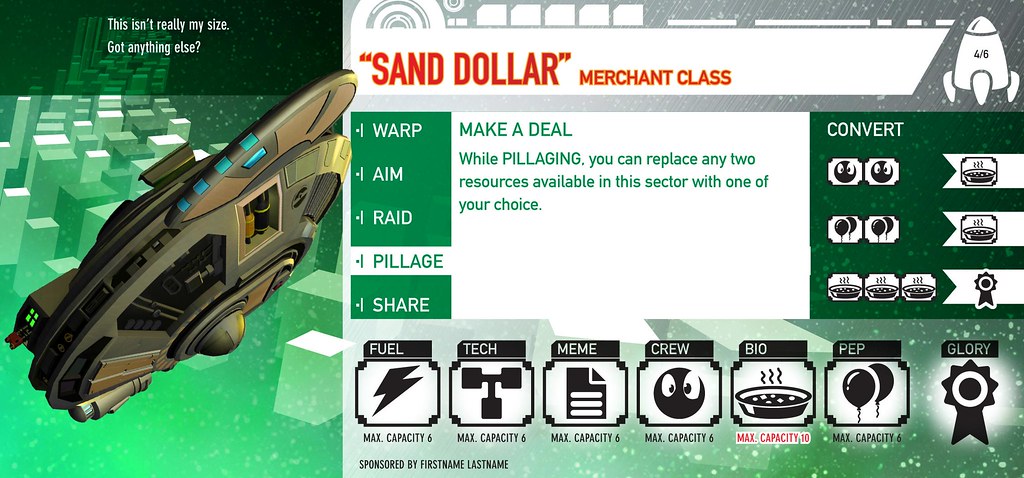
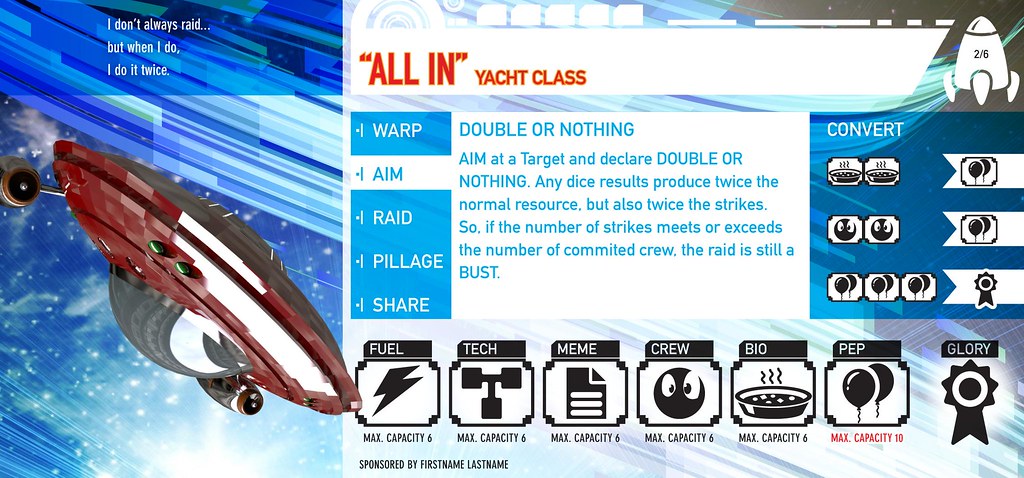
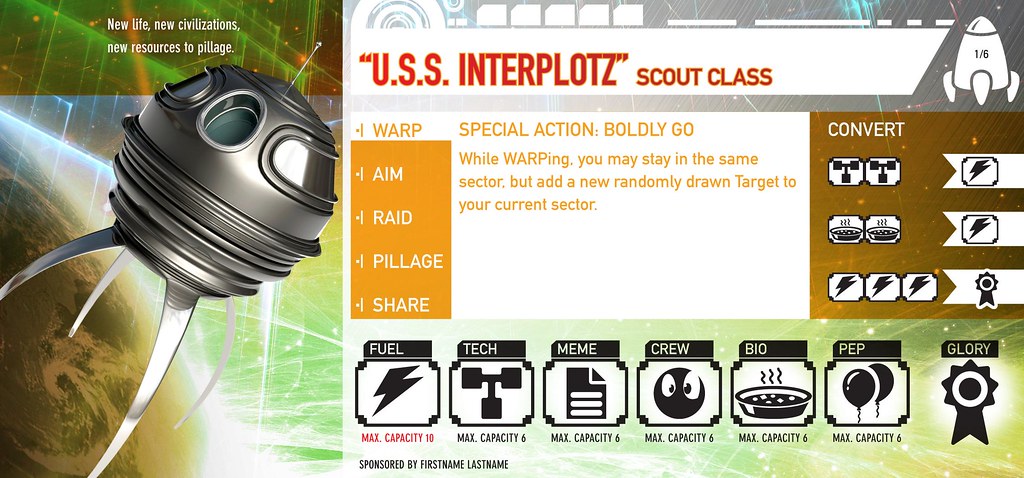
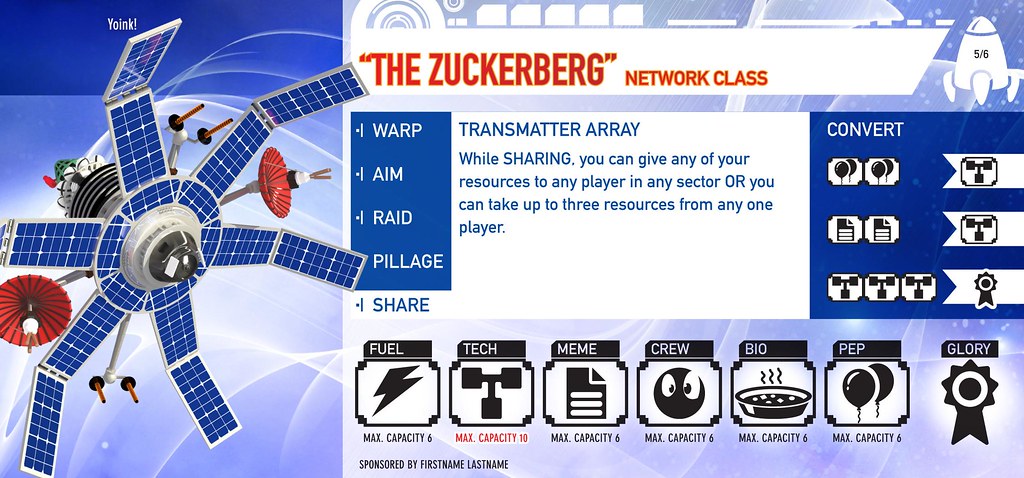
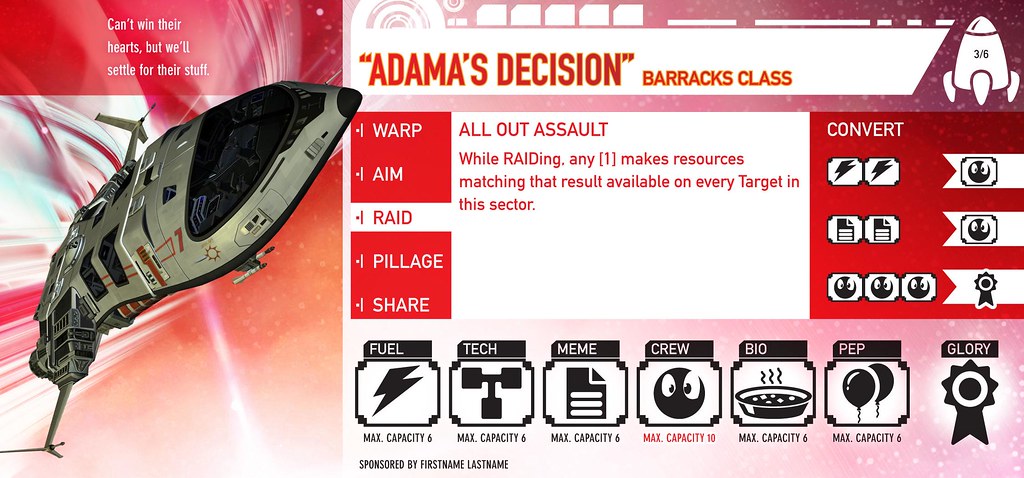
      » Description: You're a Star Captain serving in the ragtag rebel fleet. Your ship is a civilian vessel just barely fit for active duty. Hey, the Fleet takes what it can get. Trash haulers, pleasure yachts, and scrappy shuttlecraft – all against the dastardly Imperial Armada. Cooperate with the other captains to WARP across the galaxy, RAID the Empire, and PILLAGE futuristic resources. Keep your crew alive and bring home glory... FOR THE FLEET!

      » Development Status: Alpha - See the current draft linked in the image. This is the kind of rough draft I usually write for any game with lots of little bits n' pieces. At the end, you'll see a long section outlining various cards and components. Not pretty, but it's easier to design and balance at a glance when it's all in text.

      For now, I have too many commitments for the rest of the year to dwell on this too long. I still encourage comments for future reference, though. I'll revisit this game in earnest in a few months. For now, read the doc, ask questions, leave comments, and enjoy!