Showing posts with label lockout. Show all posts

Thursday, December 6, 2012

A fresh look at the NHL Lockout: why term limits make sense, and other thoughts on Bettman, Fehr, make whole, mediation, and the next CBA

By Finesse (follow me on Twitter)

The NHL Lockout is an emotional time for everyone.  Here are some long-winded thoughts on where things stand today -- term limits, "make whole," mediation, length of the new CBA -- and how they might get resolved. (Almost all details are from stuff on Puck Daddy)

Here's Donald Fehr, upset that his assistant isn't reading his press-clippings loudly enough.
Term limit on contracts

The NHL's offer calls for a maximum contract length of 5 years, or 7 years if a team re-signs its own player.  The players proposed 8 years as a maximum length for contracts.

This is the one provision that probably makes the owners look the worst because it is a mechanism to protect themselves from themselves.  But it might not be that simple.  Even though it's the "owners" giving out these contracts, remember that the "owners" are not a single entity -- they are 30 different people with very different approaches.  When four or five dumb owners give out mega-deals, it drives the price up for everyone and the "smart" owners are left with no choice.  Just look at the Penguins.  Are any of us really confortable with Crosby having a 12-year, $104 million contract, or do we just convince ourselves that it makes sense because we know that's what he would get (at least) on the open market?  Would we really be excited to give Malkin a 12-year deal in 2014 through age 40(!), or would we just say we're OK with it because we know that's what it costs to keep him?

The NBA has 5-year maximum contracts because it became far too common for a guy to sign a mega-deal and not even live up to 50% of the expectations.  The NBA's 5-year maximum doesn't just protect owners from themselves; it also creates an incentive for the players to earn their next contract by not sucking after signing a mega-deal.

7 years, $70 million.  Does anyone know who this is?
That latter concern doesn't seem to have hit epidemic proportions yet in the NHL (save for Ovechkin, most of the precipitous declines we see from mega-deal players are entirely predictable from the outset) but term limits aren't some phony concern used as a negotiating tactic.  Just read the 22nd amendment.  And given how big of a motivating factor money can be -- the term "contract year" is proof of that -- it's not a surprise that the owners view term limits as a critical piece of any new CBA.  So important, in fact, that the NHLPA's proposal accepted the concept (albeit 8 years, not 5).

(Another interesting thing to note: When LeBron James is a free agent in 2014, the maximum length deal he can sign is 5 years.  When Phil Kessel is a UFA in 2014, he'll probably want a 12-year deal.  If Leafs owner Larry Tannenbaum grabbed Kessel by the neck and starting screaming at him, "YOU ARE NOT LEBRON JAMES!!!!! I don't think anyone would have a problem with that.  When you look at it that way, it makes 10+ year deals that much more ridiculous).

Much more after the jump...

All of this clashes, of course, with the principle that if a player wants to play somewhere for 12 years, and an owner wants to sign him, then why should anyone legislate against that relationship?  After all, the freedom to be stupid is a founding principle of this country.

James Buchanan: 15th President of the United States; legendary dumbass
This conflict could be partially resolved by something that's already floating around.  The owners want the 5/7 term limit AND the so-called 5% variance rule -- that is, the actual salary a player earns in any given year of his contract cannot vary more than 5% from year-to-year.  (The players are countering with something in the neighborhood of 25% variance). Though this provision is currently being presented as secondary to the 5-year term limit, in practice it would probably be very effective in limiting the term of contracts.

Consider the case of Zach Parise, who signed a 13-year, $98 million contract with the Wild this summer (still ridiculous).

Under a 5% variance rule with no term limit at all, what could he get?  Under his current deal, the last 4 years are $2M, $1M, $1M, respectively, so we can just lop those off under the theory, "Zach, you better have retired by then."  That means the real "value" of the deal is more like 10 years for $94 million (a cap hit of $9.4M/year).  That would essentially tie him with Oveckin at the highest cap figure in the league.  It's almost unfathomable that anyone would have signed Parise to a deal with a $9.4M cap hit AND $9.4M salary for 10 years.

"Not so fast."
If some team wanted to hand over $9.4 million in cash to a 38 year old Zach Parise, who had 69 points last year at age 28, at least they would suffer the consequences of it in the form of a huge cap hit and actual cash out of pocket.  This kind of stupidity wouldn't necessarily force the smart owners to do the same thing because there would be actual consequences to these terrible contracts.  Under the current system, every year a team tacks on at the end for $1 million dramatically reduces the consequences of the dumb deals by drastically lowering the cap hit.

The more likely scenario is that Parise wouldn't get a 10-year deal, but if he did, it would be for a lot less than $94 million.  And if that happened, it would be a lot less of a risk for the owner because, you know, it wouldn't be $94 MILLION FOR ZACH F'ING PARISE!  You might see him get a 5-year, $50 million contract which is arguably a fair price to pay for having a top-10(ish) player in his prime and is, not coincidentally, the maximum term the owners are offering in negotiations.  And don't sleep on the positive side effect of term limits, which is that he will be in another "contract year" at age 32.  It's good for the game when players are motivated.

Obviously Parise is just one example and what I'm saying may not even be right.  But the takeaway should be this: the 5% variance rule, or even a 0% variance rule (which would be better), is a strong disincentive to give ultra long-term deals.  The 3 years tacked on the end of Parise's contract save the Wild about $2 million/year under the cap.  That can buy you a lot.  It's what the Pens just paid for Tomas Vokoun.

The other element of the owner's proposal is that players could get 7-year deals if they re-sign with their current team.  I couldn't be more in favor of anything than giving players financial incentives to stay with one team.  As fans we will always cheer for the front of the jersey, but it's a lot more fun when you're used to the names on the back, for better or worse.  I want Claude Giroux to be a Flyer.

How to resolve this: The players have to cave on the 5% variance rule.  It is the best way to make contracts have real consequences, and will separate the good GMs from the bad.  The owners should up the max lengths to 6/8 to help the players save face in hopes of actually saving the season.  They could even go to 7/9, because a 7-year deal takes you from UFA at age 27 to age 34, when you aren't washed up yet.

"I beg to differ."
The "Make Whole" Provision

According to reports, the NHL had upped the "Make Whole" provision of its offer from $211 million to $300 million.  Assuming that the players' share of revenue drops from 57% to 50%, this is the money that would be used to make full payments on contracts signed before the lockout.

The players argue that morality is on their side on this issue -- they signed a contract, and they believe it should be paid out.  While it's impossible to argue with that on principle, one problem for the players, as we pointed out months ago, is that these contracts are under the umbrella of a larger contract -- the Collective Bargaining Agreement -- that is no longer in effect.  No need to rehash that analysis here, but suffice it to say that if the players are not "made whole," they won't be suing the owners for breach of contract.

My take: It's not my money, so it's hard to feel invested in this. I'm sure it pisses the players off, but it probably also pisses Ted Leonsis off that Alex Ovechkin is signed for $9.5 million a year through the year 2021 and is a 65 point scorer.

Mediation


Donald Fehr should stop the charade of asking for mediation.  Nothing that happens in mediation is binding.  Billionaire owners are not going to listen to a "non binding" mediator try to tell them what to do for the simple reason that they don't have to.  The only reason to do mediation is if it's so contentious between the parties that they can't even be around each other.  Which it wasn't, until Donald Fehr came back into the negotiating room.

Here's Donald Fehr, probably ruining something
Length of the new CBA

The owners want a 10 year CBA with an opt out after 8 years.  The players want an 8 year CBA with an opt out after 6 (that was recent movement -- before Thursday there were reports that they wanted a 5 year deal).

Having lost a season only 7 years ago, this one is obvious.  The longer the better.  The NHLPA is worried about locking in these "concessions" for 10 years.  It's surprising that this would become a sticking point because the truth is that the vast majority of the players in the league today will not still be in the league in 8 years.  (I have no idea what this website is, or if it's remotely accurate, but it says that over half of all players play less than 100 career games).  So you have to think, who on the union side has a dog in this fight?

I guess young players who plan on being in the league for a long time have a stake in this, but they are 20 years old.  To think that they are positioning themselves for 10 years down the road is to ignore evidence like this 20 year old Red Wings' prospect dressed like a furry and getting arrested for DUI under Michigan's "super drunk" law.

Heavily invested in CBA negotiations.
So other than Donald Fehr's omnipresent ego, that leaves only one group: agents.  Particularly the big agencies.  They have the resources to weather a lost season if it means gains in the long term, even as far as 10, 15, or 20 years down the road.  Does a 35 year old Craig Adams care whether the new CBA is 8 or 10 years?  Or a 32-year old Brooks Orpik?

Speaking of a guy like Craig Adams...

I have no idea where he stands in these negotiations, but here's what I do know.  He is 35 and scheduled to make $675K this year.  After that, he's probably out of the league.  He will never get a 5 year contract and he will not be in the league for the next CBA.  He needs to make his money now because there are going to be hundreds of new players drafted in June gunning for his job.

I don't weep for the Craig Adams types around the league, but they are the ones who have nothing to gain and everything to lose from this dragging on endlessly.  Kudos to Donald Fehr (I guess) for keeping union cohesion up to this point, but when will what's been lost through missed paychecks eclipse what can ever be made up by continuing to negotiate?  We have to be getting closer to the place where unity fractures.  And, frankly, it should. The players are not going to get as much money as they want -- this CBA will be worse for them than the last one.  Do the Craig Adamses of the world want to lose their last year in the league so someone who is in high school today can get a 6th year on his contract in 2022?  That's not for me to say, but I certainly wouldn't fault any player for saying "drop the puck."

It will undoubtedly suck for players to give back money on their current deals or not have the good fortune of signing a 13-year contract because they missed the 2012 free agency spending spree by a year.  But they should look at the bright side of things.  They get paid to play hockey for a living.  And that's pretty awesome.


Thursday, November 15, 2012

GTOG Podcast Live from Mercy Hospital: Ben Roethlisberger's Life Threatening Injury

We report live from Mercy hospital on the status of Ben Roethlisberger's life-threatening injury. This is an exclusive scoop that no one else has.*

Click here to subscribe on iTunes

iPhone/iPad:


Podcast Powered By Podbean

Flash:


*We also discuss whether Game 4 in 1992 against the Blackhawks was Mario's most dominant performance, aesthetically.  The pass we discuss is around the 5:35 mark.

Monday, November 5, 2012

GTOG Podcast: We talk the Steelers' big win, plus election analysis and NHL Lockout watch

It's a power-packed podcast on Election Eve.  Find out our state-by-state prediction, plus Steelers and NHL talk.  It's the GTOG Podcast.

Click here to subscribe on iTunes

iPhone/iPad:


Podcast Powered By Podbean

Flash:

Wednesday, October 31, 2012

GTOG Podcast: The Election, Halloween, Big Ben, the NHL Lockout, and more

With Hurricane Sandy behind us, we assess the election; government postponement of Halloween; Steelers-Giants; Ben's command of Eli, Phil and Matt; the NHL Lockout; and much more. It's the GTOG Podcast.

Click here to subscribe on iTunes


iPhone/iPad

Podcast Powered By Podbean

Flash

Wednesday, October 24, 2012

GTOG Podcast: Steelers, Redskins, and Hockey Fans in Skinny Jeans

It's another podcast bursting at the seams with hardcore analysis and raw emotion. We touch on the Steelers, the NFL, RG3, the NHL, the Winter Classic, what we'd like 24/7 to be about, the Islanders' move to Brooklyn, hockey fans in skinny jeans, doping in high school girls cross-country races, and Lance Armstrong. It's power-packed. It's the GTOG Podcast.

Click here to subscribe on iTunes

iPhone/iPad:


Podcast Powered By Podbean

Flash:

Tuesday, October 23, 2012

NHL shrewdly allowing owners to talk directly with players; what it means for the lockout

By Finesse

Good scoop by Yahoo! Sports obtaining a memo from the NHL to its owners allowing them to discuss some aspects of the NHL's current proposal to end the lockout with players over a 48-hour period last week (with the required legal disclaimers, of course).

The NHLPA is upset by this tactic, which is understandable given that they have the difficult job of wrangling hundreds of players with vastly different opportunities and incentives.  For them, the entire function of the Fehr family is to be the filter through which the players evaluate (and reject) the owners' proposals.  When you lose the filter, you lose the ability to control the message your players receive.

It's too early to tell whether this will work for the owners or at least have the effect of chipping away at union unity, but it is in my mind a very shrewd tactic.

As a union, the NHL players clearly don't like "the owners."  But as individual players, they likely feel a lot better about "their owner," also known as the old white guy who has been writing them big checks and probably acts a little star struck when he's around them.  They're probably friends, or at least friendly.  And in some cases, they are even landlord and tenant.

This is what Artistry looks like when he's posing for pictures with his 3 year-old son.
The message from the owners is not changing, or at least it's not supposed to.  But the messenger is, and that matters.  If your girlfriend tells you that you have something in your teeth,  you get it out.  If the guy behind you at airport security tells you that you have something in your teeth, you end up on the No Fly List.

As we've said repeatedly, we don't care who wins the lockout.  It's not our money.   But the players have to know that they are going to "lose" this negotiation at some point, in the sense that they aren't going to get as good of a deal as last time.  The danger is that even though the players know this, the lockout will drag on because the players don't want to lose to Gary Bettman.  Might they be more willing to lose to Mario?  If he's allowed to text them, they may not have a choice.

Tuesday, October 16, 2012

GTOG Weekend Review: Vick's Dog, Nats' Collapse, and New NHL Proposal

What a weekend.  An Austrian guy jumped out of a hot air balloon in space and landed in New Mexico.  Alex Rodriguez struck out 9 times in 5 at-bats.  And the Steelers have continued efforts to go down as one of the most unlikable collections of individuals in team history (more on that later this week).

But there is no bigger story than the news that Mike Vick is a dog owner again, as he inadvertently revealed on Twitter in a photo showing a box of milk bones.  It's unclear where he got this new pet, but our sources tell us that it's from a shelter caddy-corner to the TGIFriday's that just hired Josh Hamilton as a bartender.

(photo via USAToday)
Having gotten that out of the way, let's get to the rest of what was an enormously busy weekend....


- The Washington Nationals' epic collapse from a 6-0 lead to a 9-7 loss over the course of 6 innings was nothing short of spectacular.  I don't say that because of the glee felt seeing another Washington-area team get crushed after prematurely celebrating a championship they hadn't yet won, but because it was an incredibly fascinating sporting event.  I almost forgot it was baseball.

- As funny as the ending of that game was, the amazing season the Nats had and the incredible atmosphere at Nats Park after the Jayson Werth home-run in Game 4 makes it that much sadder that the Pirates are no closer to giving the city of Pittsburgh a similar experience than they were 20 years ago.

Pirate fever! Catch it!
- After an NFL Sunday which proved that we might be in the midst of the first season ever with no good teams, here's where the especially not-good Steelers sit: a half game out of the top wild card spot behind the following teams:

New York Jets (pending collapse)
Buffalo Bills (???)
Miami Dolphins (Les Brown's girlfriend > Ryan Tennehill's wife)
Cincinnati Bengals (Ike Taylor asked for a temporary restraining order this morning to enjoin the butchering he will receive from A.J. Green this week)
San Diego Chargers (Rivers will never beat Roethlisberger in a big game)

Here's the point.  We're as down on the Steelers as anyone and remain convinced that this team is not good.  But fortunately (or unfortunately), they also may not be quite bad enough to avoid the following scenario: finish 9-7, upset Denver in the wildcard game, and then lose by 21 to Baltimore in the second round of the playoffs.

- Last week Andrew Luck was a futuristic Aaron Rodgers with a dusting of Ben Roethlisberger on top and RGIII was concussed.  This week Luck had a QB rating of 40 while RGIII looked like the second coming of the first coming of Michael Vick.  We're six weeks in to these guys' careers.  Let's solve this already.

Make up your mind.
- Our thoughts and prayers are with the Yankees and the remaining $180 million worth of players on their roster.

- For filing in the "THERE IS SIMPLY NO POSSIBLE WAY THAT A 38 YEAR OLD MAN WITH SUPER-HUMAN STRENGTH TEARING HIS TRICEPS IS RELATED TO STEROIDS" cabinet, Ray Lewis out for the season.  I say this genuinely -- I like Ray Lewis.  He makes everything more interesting.

- Word has just broken that the NHL, in a copycat move of the proposal suggested on our podcast, has offered the players' union a 50/50 split of hockey related revenue. I'm sure there are details to work out, but 50/50 is good enough for Tom Brady and LeBron James.  Let's hope it's good enough for Craig Adams.

- Finally, Deadspin broke the story that the NHL owners have been using notoriously effective yet despised pollster Frank Luntz to help craft the league's image during the lockout.  This tactic was portrayed as "bullshit" and some comments on the story were, uh, pointed.  (Example: "Dear Frank Luntz: Get your dirty, slimy, scheming, blood-soaked hands off my damn hockey season. That is all.")

Maybe not blood-soaked, but definitely a douche.
We can call it bullshit all we want, but Frank Luntz isn't hired to do this because it doesn't work.  He's hired because it will work, at least to some degree.  Much of the backlash will be exaggerated because a lot of people have extreme feelings about Luntz's politics, but this is neither an unexpected move by the NHL nor is it something that the NHLPA wouldn't do.  In fact, as Dave Molinari reported this morning, "officials of the NHLPA have been encouraging members to burnish the group's image with displays of community involvement, specifically by practicing, or at least skating, with members of youth hockey teams."  This is definitely a less sinister-seeming tactic than backroom message testing, but it's a means to the same end: making you think they're the good guys, even if they're not.

Check that.  Playing with kids is definitely a more savvy strategy.  It's a shame the owners didn't think of that first.


Tuesday, October 9, 2012

GTOG Podcast: Steelers, Roethlisberger, Sandusky, and more

It's a marathon podcast hitting on all the key topics: the Steelers, fatherhood, Bruce Arians, baseball, Dottie Sandusky, the NHL Lockout, drugs, sex, alcohol, Mario Lemieux, Washington sports fans, Artistry's father, and so much more.  It's the GTOG Podcast.

Click here to subscribe to the podcast on iTunes

iPhone/iPad:


Podcast Powered By Podbean

Flash:


A new love for B.A.?

Friday, September 21, 2012

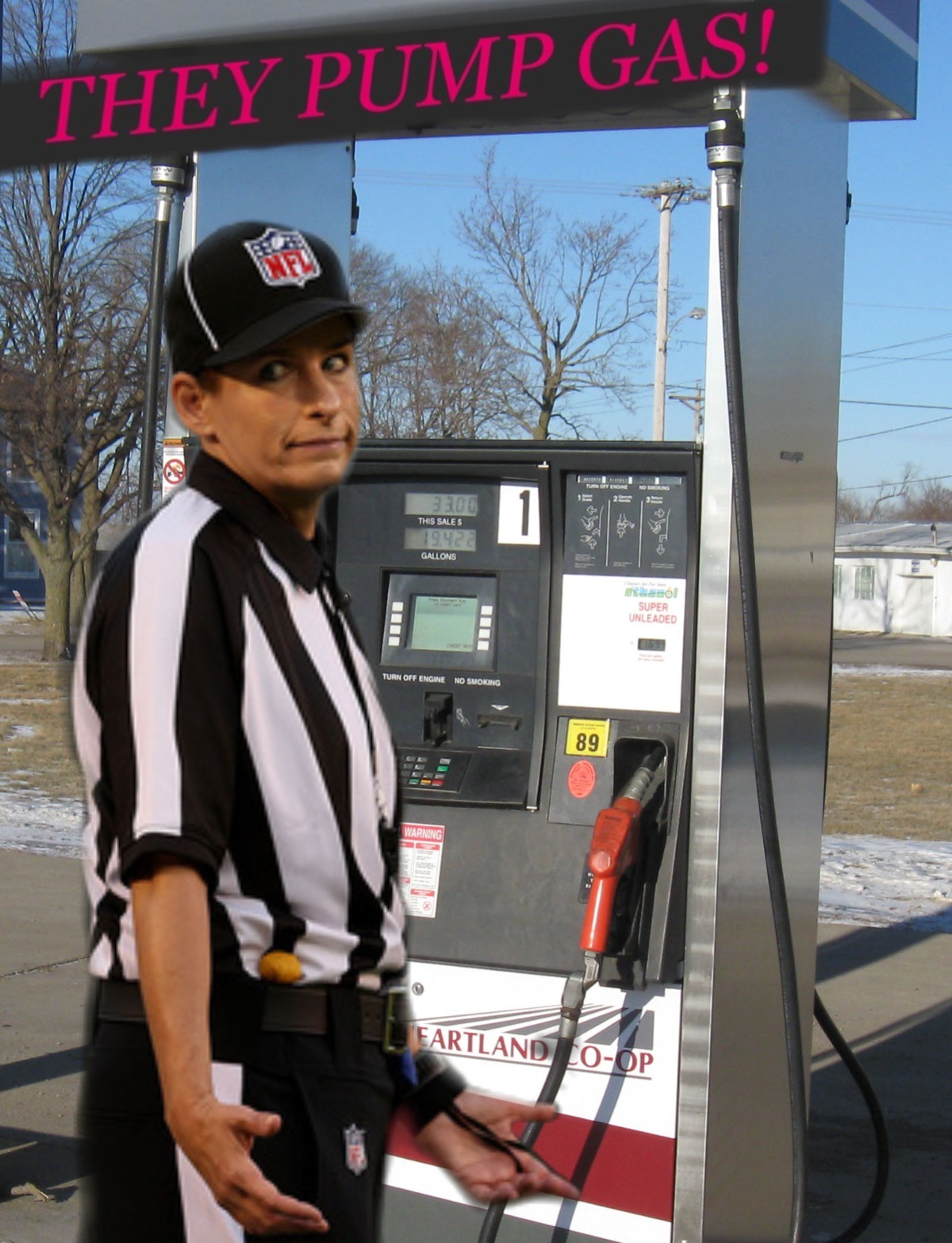
Why I Love the NFL Replacement Referees

By Finesse

As has become recent American tradition, the national media has embraced another opportunity to unite in outrage and indignation.  This month's target is the NFL replacement referees, and the punditry is up in arms. The integrity of the league is at stake.  The integrity of gambling is at stake.  The integrity of Facebook is at stake.  The integrity of fantasy football is at stake.  And, according to Sally Jenkins of the Washington Post, players' lives are at stake.

I love the replacement refs.  That's partly because anything that unanimously upsets the sports media and leads to endless one-upping over who is more outraged and who can be more dramatic is something I support.  But more importantly, I love the replacement referees because they're real people.

The simplest way to put it is that these are a bunch of little old men playing pretend.  It's cute!  They're like Civil War reenactors who suddenly found themselves in the Battle of Antietam.

"Automatic ... first down!!!"
And, unlike those stuffy regular referees who have highfalutin regular jobs, the replacement refs are just like us!  They have fantasy teams, they pledge their fan-loyalties on Facebook, and so much other stuff!


The truth is that the replacement-ref-bashing is not merely an overblown story to fire up talk radio listeners; it's pummeling an easy scapegoat to hide bigger problems.

Find out the truth after the jump...

The hand-wringing from Jenkins and others over the replacement refs is a convenient distraction from the ineptitude of people with a lot more experience who are getting paid a lot more money.  Take John Fox.  Last Monday night, he went ballistic about a too-many-men-on-the-field call, committed verbal manslaughter on the officials, and then threw a challenge flag. Guess what?  There were 12 men on the field.  If not for the announcers harping on some earlier missed call by the replacements, they might have had to, you know, actually talk about it.

Obviously, there have been some historically bad calls made by the replacements, but it's not like the regular referees are so much better.  (Another example, per ESPN: "Instant replay reviews are way up, an increase of 16. But the percentage of reversals is way down: 23 this year out of 62 as opposed to 21 of 46 in 2011.")

...and another example
The game has evolved to being virtually impossible to officiate well.  The players are unnaturally enormous and have the same regard for their bodies as Lindsay Lohan has for pedestrians.  The rule book is hundreds of pages long and there are eight Harvard grads in every broadcast booth Ctrl+F'ing their way through it to find some minute detail from a rule no one's ever heard of.  Every game is filmed with fifty super high-def, super slow-mo cameras to a national audience of armchair referees with Twitter accounts.  Coaches masquerading as grown men are engaged in embarrassing histrionics to distract your attention away from the field.   If it wasn't lucrative, it wouldn't be worth the aggravation.

Not how grown-ups behave.
And therein lies the bigger problem with the lockout and refereeing generally: the NFL has it backwards.  Instead of nickle-and-diming the refs, the league should both give the refs more and demand more from them.  The premise in Jenkins' article that refs should lower their demands because they only have to work 16 Sundays may make sense economically, but isn't it possible that only working 16 Sundays is the very reason why the refereeing isn't great?

Jenkins' and others' worst misfire, however, comes when they assign responsibility for player safety on everyone but the players.  The league's responsibility is to give the player's world-class medical care, complete information about the risks of the sport, and a rule-book that helps protect the players while at the same time keeping the sport popular so everyone can make lots of money.  The referees' responsibility is to enforce those rules.

But it's the players' responsibility to abide by them.  So if (when) Troy Polamalu launches himself headfirst into Darren McFadden this weekend and they're both decapitated, it will be no one's fault but his own. It certainly not going to be the fault of the replacement referees; after all, aren't the pending billion-dollar lawsuits against the league based on hits that happened while the regular referees were still reffing?

Textbook form.
Maybe Jenkins' point was more narrow, that the risk is that refs can't control sideline pushing-and-shoving and this will eventually lead to a fight where players get hurt.  Maybe it will, although that seems unlikely given that almost all of these scuffles are merely posturing for the cameras.  But even if some fight does break out this weekend, why preemptively absolve the players of blame for it?  Aren't they the ones who would be flagrantly violating the rules and jeopardizing "player safety?"

The replacement refs have been bad.  The regular referees are better, though not by much.  And the NFL has its priorities backwards.  But however this resolves, let's hope it's not compelled by the pen of fake-outrage and misdirected blame.  Instead, a resolution should be crafted to solve the one indisputable problem finally and conclusively revealed by this replacement referee experiment: it's really hard to be a referee.